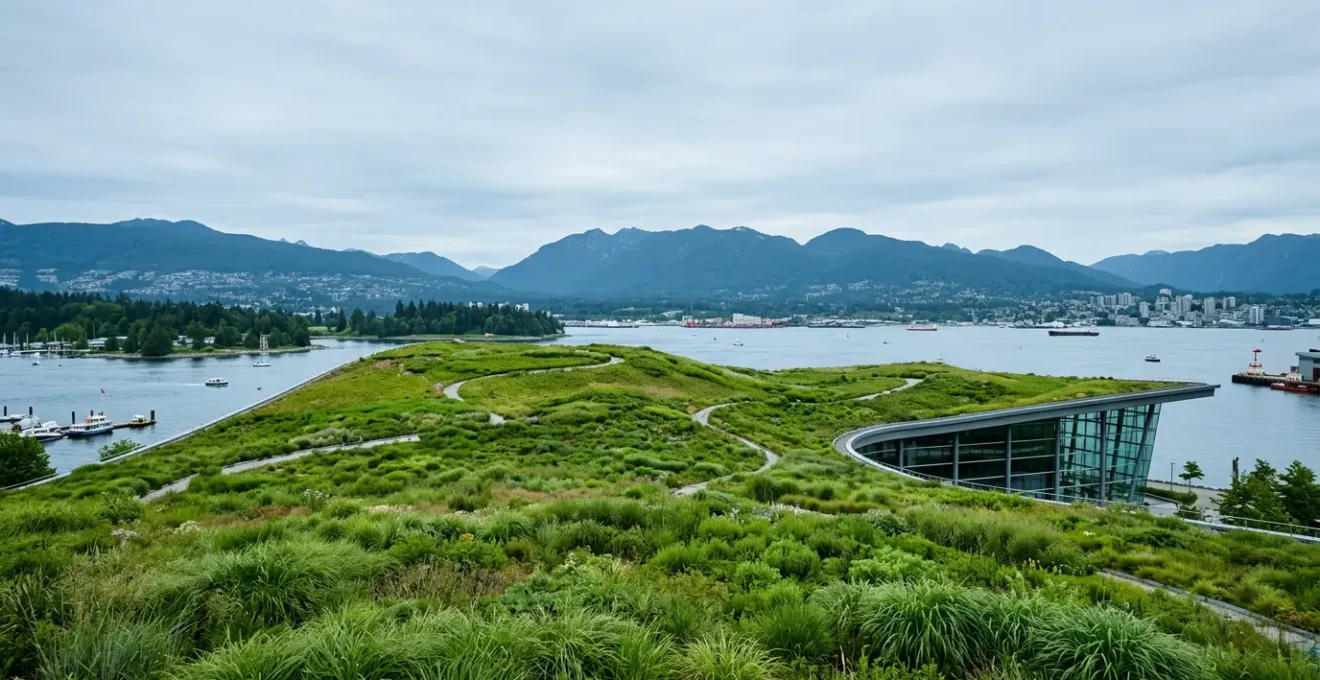
The Vancouver Convention Centre’s six-acre living roof isn’t just an aesthetic choice; it’s a high-performance, self-regulating urban ecosystem.
- It reduces summer heat gain by 96% and integrates a carbon-neutral seawater cooling system, contributing to its double LEED Platinum status.
- It’s the apex of a city-wide philosophy seen in neighbourhood-scale energy utilities and zero-emission transit networks.
Recommendation: For design students and eco-travelers, view the roof not as a feature, but as a systemic blueprint for regenerative urbanism.
From the air, it is one of Vancouver’s most defining features: a sprawling, six-acre expanse of native grasses that undulates against the backdrop of Coal Harbour and the North Shore mountains. The immediate question for many is a simple one of curiosity. But for architecture students and eco-conscious travelers, the inquiry goes deeper. The common answers—that it features 400,000 native plants or is good for insulation—while true, are merely the surface layer.
This widespread assumption that it is simply “green decoration” misses the profound architectural and ecological statement being made. The design, crafted by LMN Architects, isn’t just about mitigating a building’s negative impact. It’s a radical rethinking of a building’s role within its environment. What if the true purpose of the Vancouver Convention Centre’s living roof isn’t just to be a roof, but to function as a systemic blueprint for a new kind of urban ecology? This structure is not a passive object; it is an active, living machine designed for regenerative impact.
This article deconstructs that living machine. We will move beyond the superficial to analyze its performance metrics, place it within the wider context of Vancouver’s ambitious green initiatives, and reveal how this single architectural element is a masterclass in biomimicry and sustainable urban metabolism. We will explore the standards that certify its excellence, the city-wide systems it reflects, the micro-habits it inspires, and how you, as a visitor, can engage with this city-as-an-ecosystem.
This guide will explore the interconnected systems—from building certifications to public transit and waste management—that collectively answer the question of the grass roof. Each section reveals another layer of the city’s integrated approach to sustainability, demonstrating how the Convention Centre is the ultimate symbol of a much larger vision.
Summary: A Deep Dive into Vancouver’s Urban Ecosystem
- Platinum vs Gold: What Do LEED Ratings Mean for Vancouver Hotels?
- How to Tour the Olympic Village’s Green Energy Systems on Foot?
- The Recycling Bin Confusion: Where to Throw Your Coffee Cup in Vancouver?
- The Myth of the “Green” Electric Bus: Are They Really Zero Emission?
- When to Visit the VanDusen Botanical Garden Maze for Bloom Season?
- Canada Place Views: Which Pan Pacific Rooms Look Directly at the Sails?
- From Train Repair to Community Hub: What Remains of the Original Engine 374?
- Zero Waste Travel: How to Visit Vancouver Without Generating Plastic Trash?
Platinum vs Gold: What Do LEED Ratings Mean for Vancouver Hotels?
To understand the significance of the Convention Centre’s design, we must first understand the language of its success: LEED (Leadership in Energy and Environmental Design). This globally recognized rating system is not a simple pass/fail; it is a rigorous, point-based framework that quantifies a building’s performance. Structures are evaluated across categories like energy efficiency, water usage, and indoor environmental quality, earning one of four certification levels: Certified (40-49 points), Silver (50-59 points), Gold (60-79 points), or Platinum (80+ points).
For a hotel or large public venue in Vancouver, achieving Gold or Platinum status is a declaration of high performance and a key differentiator for eco-conscious travelers and event planners. It signifies a tangible commitment to reducing the building’s operational footprint. This is where the Vancouver Convention Centre sets an unparalleled standard. It was the world’s first convention centre to achieve double LEED Platinum certification—once for its initial design and construction, and again for its ongoing building operations and maintenance.
This is not merely an award; it’s a measure of the building’s active metabolism. The six-acre living roof is a critical component of this achievement. The Canada Green Building Council’s case study confirms the roof is a high-performance machine, responsible for a staggering 96% reduction in summer heat gain and a 26% reduction in winter heat loss. This natural insulation drastically lowers the energy required for heating and cooling. Paired with its innovative seawater-based geothermal system that provides heating and cooling with near-zero carbon emissions, the building operates less like a static structure and more like a living organism, intelligently managing its energy needs.
This level of performance elevates the Convention Centre from a mere building to a piece of functioning ecological infrastructure, setting a benchmark that other venues in the city strive to emulate.
How to Tour the Olympic Village’s Green Energy Systems on Foot?
The systemic thinking behind the Convention Centre’s roof is not an isolated marvel. It’s a philosophy that has been applied at a neighbourhood scale, most notably in the False Creek Olympic Village. Here, the concept of an “urban ecosystem” expands from a single building to an entire community, and its most innovative features are accessible on a self-guided walking tour.
The centerpiece of this system is the False Creek Neighbourhood Energy Utility (NEU), located discreetly beneath the Cambie Street Bridge. This is not a traditional power plant. Instead, it employs a revolutionary sewage heat recovery system. In simple terms, it captures thermal energy from the wastewater flowing through the city’s mains and uses it to heat the water for the entire Olympic Village. The system is remarkably efficient, demonstrating a nearly 4:1 heat energy output ratio, meaning for every unit of electrical energy put in, it produces four units of heat energy. The pipes that carry this captured energy are the hidden arteries of a regenerative urban design.
As you walk along the False Creek seawall, you are walking through a living laboratory of sustainable design. The 21 buildings of the village receive 70% of their heating from this system. The Creekside Community Centre consumes 50% less energy than a standard building thanks to features like rainwater harvesting and a green roof. Nearby, Habitat Island, a man-made sanctuary, showcases how urban development can actively create, rather than destroy, natural habitats for local flora and fauna. The tour culminates with a view of Canada’s first residential Net Zero Building, which generates as much energy as it consumes annually. To explore this area, follow these key points:
- Start at the NEU building under the Cambie Street Bridge, marked by a distinctive sculpture whose lights indicate city energy use.
- Walk southeast on the seawall to view the village buildings powered by heat recovery.
- Visit Habitat Island to see an urban sanctuary with over 200 native plant species.
- Explore Creekside Community Centre to see green roof technology and solar cooling in action.
- View the Net Zero Building (Parcel 9), a model for self-sufficient residential design.
This walking tour transforms abstract concepts like “district energy” and “regenerative design” into a physical experience, proving that the philosophy of the Convention Centre’s roof can scale to create truly sustainable communities.
The Recycling Bin Confusion: Where to Throw Your Coffee Cup in Vancouver?
From the macro-scale of urban planning, we zoom into the micro-scale of daily life. The same systemic, detail-oriented approach that governs Vancouver’s architecture also applies to its waste streams—a reality every visitor encounters when holding an empty coffee cup. In a city that is a hub for coffee culture, this single item represents a massive logistical challenge. It is estimated that residents and visitors in Vancouver throw away a staggering 2.6 million disposable cups every week.
The “recycling bin confusion” is real. A typical coffee cup is a composite product: a plastic-coated paper body, a plastic lid, and a cardboard sleeve. Each component must be handled differently, and Vancouver’s system is highly specific. Tossing the entire cup into a single bin is the most common mistake, leading to contamination that can doom an entire batch of recyclables to the landfill. The city’s methodology is a prime example of urban metabolism in action: breaking down complex outputs into pure, reusable inputs.
For the eco-conscious traveler or student of urban systems, correctly disposing of a coffee cup is a small but meaningful act of participation in the city’s complex ecosystem. It requires a moment of deconstruction, separating the object into its constituent parts and directing them to the correct streams. This process highlights the challenges and innovative solutions in a circular economy, such as the fact that Vancouver’s “compostable” cups are not actually composted locally but are shipped to specialized facilities in South Korea that can separate the fused layers of paper and plastic.
Action Plan: Deconstructing Your Vancouver Coffee Cup
- Cup Body: Rinse the cup and place it in the blue bin for containers, not the paper recycling. It is handled as a polycoated container.
- Plastic Lid: Separate the lid from the cup and place it in the same blue bin for containers. Separation is crucial for sorting.
- Cardboard Sleeve: Remove the sleeve and place it in the mixed paper/cardboard recycling stream (often a yellow bag or separate bin).
- Compostability Myth: Do not put any part of the cup in the green bin for organics. Despite “compostable” labels, they are not accepted by local processors.
- The Final Journey: Understand that your rinsed cup is part of a global supply chain, destined for a facility that can achieve what local ones cannot.
This single, everyday object reveals the intricate, and sometimes counter-intuitive, systems required to move a city towards a zero-waste future. It’s a tangible link between individual action and city-wide ecological goals.
The Myth of the “Green” Electric Bus: Are They Really Zero Emission?
If the Convention Centre is the city’s green heart and the Olympic Village its lungs, then the transit system is its circulatory network. A key component of Vancouver’s sustainability claim is its fleet of electric buses. But for the discerning student of architecture and urbanism, the term “zero emission” warrants deeper scrutiny. A vehicle is only as clean as the energy that powers it. So, are Vancouver’s electric buses truly green?
The answer lies not in the bus itself, but in the provincial power grid. The vast majority of TransLink’s electric fleet is powered by BC Hydro, which generates 98% of its electricity from clean or renewable sources, primarily massive hydroelectric dams. This crucial upstream factor means that when an electric bus in Vancouver plugs in, it is drawing from one of the cleanest energy grids in North America. This makes its “well-to-wheel” emissions profile nearly, if not truly, zero-emission in operation.
Vancouver’s commitment to electric transit is not a recent trend. The city has operated a zero-emission electric trolleybus system since August 16, 1948, making it one of the oldest and most extensive in North America. These 262 trolleybuses draw power directly from overhead wires, a time-tested technology. They are now being complemented by a new generation of battery-electric buses. These newer models offer greater route flexibility, with the ability to operate off-wire, while still achieving a massive reduction of 100 tonnes of greenhouse gas emissions annually compared to a diesel bus.
The table below, based on data from TransLink, breaks down the true emissions profile and operational characteristics of the different bus technologies that make up Vancouver’s public transit network, offering a clear comparison for understanding the city’s strategy.
| Bus Technology | Power Source | Infrastructure | Operational Flexibility | True Emissions Profile |
|---|---|---|---|---|
| Electric Trolleybus (1948-present) | Direct overhead wire connection to BC Hydro grid | Fixed overhead wire network | Limited to wire routes | Near-zero (98% clean hydro upstream) |
| Battery-Electric Bus (2023+) | On-board battery charged from BC Hydro grid | 5-minute fast-charge stations at terminals | Can operate 20km off-wire | Near-zero (98% clean hydro upstream, battery production emissions) |
| Diesel Bus (baseline) | Petroleum diesel | Standard fueling station | Full route flexibility | 100 tonnes CO2 per bus annually |
| Renewable Diesel (transition) | Organic waste & vegetable oil | Standard fueling station | Full route flexibility | Reduced but not zero tailpipe emissions |
Ultimately, Vancouver’s electric buses are not a myth. They are a powerful demonstration of a systemic approach where clean energy generation and public transportation are strategically integrated to achieve genuine, large-scale emissions reduction.
When to Visit the VanDusen Botanical Garden Maze for Bloom Season?
While the Convention Centre roof represents a constructed, high-tech version of an urban ecosystem, the VanDusen Botanical Garden represents a curated, biological one. For the student of urban ecology, it is a living library of plant species and a masterclass in landscape architecture. At its heart lies the Elizabethan Hedge Maze, a puzzle not just of pathways, but of horticulture and seasonal cycles.
Unlike a flower garden, the maze’s “bloom season” is a more subtle affair. Composed of over 3,000 pyramidal cedars (Thuja occidentalis), its beauty is not in ephemeral flowers but in the year-round vibrancy of its evergreen structure. However, the experience of the maze changes dramatically with the seasons, making the “best” time to visit a matter of architectural and sensory preference. From a design perspective, the maze offers different lessons depending on the time of year.
A visit in the late spring (May-June) is ideal for observing the maze in its most vigorous state. The new growth on the cedars is a brilliant, soft green, creating a sharp contrast with the darker, older foliage. The air is filled with the fresh scent of cedar, and the dense hedging creates a powerful sense of enclosure and discovery. This is the time to appreciate the maze as a living, growing sculpture. Conversely, a visit in the autumn (October-November), particularly on a misty Vancouver day, transforms the maze into an atmospheric and contemplative space. The fog softens the sharp architectural lines, the crowds thin, and the focus shifts from the structure itself to the experience of being lost and found within it.
Therefore, the question is not “when does it bloom,” but rather “what architectural experience do you seek?” Whether you desire the vibrant, life-affirming energy of spring or the quiet, introspective mystery of autumn, the VanDusen maze offers a year-round lesson in how curated nature shapes human experience within the city.
Canada Place Views: Which Pan Pacific Rooms Look Directly at the Sails?
The architectural dialogue in Coal Harbour is dominated by two iconic structures: the white, sail-like forms of Canada Place, and the green, living carpet of the Convention Centre’s West building. Understanding their relationship in the skyline is key to appreciating Vancouver’s waterfront design. For a visitor, particularly one staying at the Pan Pacific Hotel which is integrated into the Canada Place terminal, securing a room with a direct view is to have a front-row seat to this conversation.
The hotel’s rooms are categorized by their views: City, Harbour, or Panoramic. To look directly at the five white sails of Canada Place, one must paradoxically look away from them. The rooms that offer this iconic view are typically the “Harbour View” rooms on the western side of the hotel. From this vantage point, guests are not looking *out from* the sails, but *across* at them, often with the dramatic, green expanse of the Convention Centre roof in the mid-ground and the North Shore mountains providing a stunning backdrop. This perspective allows one to see the two buildings not as separate entities, but as a cohesive architectural statement.
This specific viewpoint reveals the genius of the waterfront’s master plan. The white, tensile fabric of the Canada Place sails, evoking maritime history and travel, is in direct conversation with the organic, living texture of the Convention Centre roof, which speaks to a sustainable future. It is a dialogue between technology and nature, between human movement and ecological rootedness. From an elevated room, one can observe the interplay of light on both surfaces throughout the day, the changing tides in the harbour, and the constant flow of seaplanes, ships, and people that animate the space.
Securing this view transforms a hotel room from simple accommodation into an observation deck for urban architectural theory, offering a continuous and evolving perspective on how Vancouver has shaped its world-famous waterfront.
From Train Repair to Community Hub: What Remains of the Original Engine 374?
The story of Vancouver’s sustainable urbanism is not just about new, gleaming structures; it’s equally about the intelligent and respectful transformation of its past. The Roundhouse Community Arts & Recreation Centre in Yaletown is a prime example of this principle of adaptive reuse. At its core is Engine 374, the first passenger train to pull into Vancouver in 1887, effectively connecting the nascent city to the rest of Canada. But what remains of its original context?
The Roundhouse itself is the most significant artifact. It was originally a CPR maintenance facility for the steam locomotives that were the lifeblood of the city’s early industrial economy. The soaring timber beams, vast open spaces, and the remaining tracks embedded in the floor are not just decorative elements; they are the authentic structural bones of a bygone industrial era. The decision, made in the 1990s, to preserve this building and integrate it into a new community centre was a visionary act of urban planning. It recognized that the building’s historical and architectural value was an irreplaceable asset.
Today, the original Engine 374 sits preserved in a glass pavilion at the centre of the Roundhouse. While it is static, the building around it is a hive of activity, hosting everything from pottery classes to theatre performances. This juxtaposition is the key to its success. The building’s transformation from a place of heavy industry (train repair) to one of cultural production (arts and recreation) is a physical manifestation of Vancouver’s own economic and social evolution. It’s a process of urban regeneration, where the embodied energy and cultural capital of an old structure are repurposed for a new public good, rather than being demolished and sent to a landfill.
This approach is the historical counterpart to the ecological principles seen at the Convention Centre. Both projects, in their own way, are about creating a more sustainable and resilient urban fabric—one by integrating living systems into new architecture, the other by breathing new life into the heritage of the old.
Key takeaways
- The Convention Centre’s roof is a high-performance system, not just decoration, proven by its double LEED Platinum status.
- Vancouver’s sustainable philosophy is systemic, visible at the neighborhood scale (Olympic Village) and in its city-wide infrastructure (electric transit).
- Individual actions, like recycling a coffee cup correctly, are an integral part of the city’s complex urban metabolism.
Zero Waste Travel: How to Visit Vancouver Without Generating Plastic Trash?
The principles embodied by the Convention Centre’s living roof—resourcefulness, circularity, and a zero-waste philosophy—can be translated into a personal travel ethic. Visiting Vancouver without generating plastic trash may seem like a daunting goal, but the city’s infrastructure and culture make it more achievable than in many other places. It requires shifting one’s mindset from that of a temporary consumer to a temporary, but responsible, participant in the city’s urban ecosystem.
The first step is preparation. A zero-waste travel kit is essential: a reusable water bottle, a reusable coffee cup (a crucial tool in this city), cloth shopping bags, and reusable containers for takeout or bulk food purchases. Vancouver’s tap water is famously of high quality and readily available, making single-use plastic water bottles entirely unnecessary. Many cafes also offer discounts for customers who bring their own cups. The second principle is to seek out businesses that share this ethos. The city is rich with farmers’ markets, bulk-bin food stores, and restaurants that prioritize local sourcing and minimize packaging.
This approach mirrors the large-scale efforts of the city’s institutions. The Vancouver Convention Centre itself, for instance, manages the waste from the 1.8 million visitors it hosts annually with a robust, audited zero-waste system. As the Canada Green Building Council notes in their case study:
The Vancouver Convention Centre developed a robust waste management system that supports the essential environmental principles of reduce, reuse, and recycle, working closely with Happy Stan’s Recycling to perform monthly waste audits.
– Canada Green Building Council, Vancouver Convention Centre LEED Platinum Case Study
By adopting these practices, a traveler is not just reducing their own footprint; they are actively engaging with and supporting the very systems that make Vancouver a leader in sustainability. It is the ultimate expression of respect for the host city’s values.
Ultimately, traveling zero-waste in Vancouver is the final piece of the puzzle. It completes the circuit, connecting the large-scale, systemic designs of the city’s planners and architects with the conscious, daily choices of its inhabitants and visitors, creating a truly integrated and regenerative urban experience.