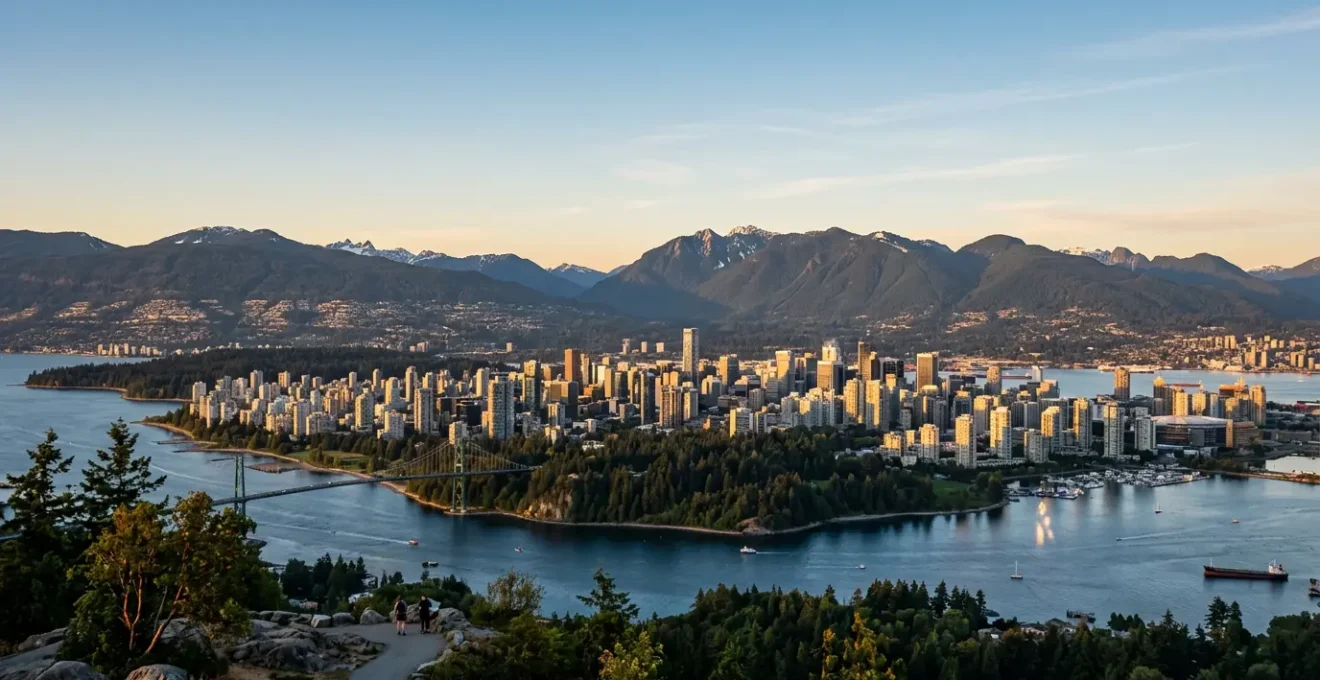
Mastering Vancouver photography is less about simply finding a location and more about mastering light, timing, and specific angles.
- The most compelling views often require understanding atmospheric conditions like the marine layer or exploiting telephoto compression to alter perspective.
- Timing is the critical variable, from knowing the true sunset time in June to waiting for the “blue hour” saturation after the main crowds have already left.
Recommendation: Before any shoot, consult local webcams and astronomical data; this logistical intelligence is the key to transforming your plan into a successful photograph.
For any photographer, Vancouver presents a tantalizing challenge. The city is a world-class intersection of glass towers, dense rainforest, and dramatic mountain backdrops, offering a seemingly endless supply of stunning vistas. It’s easy to fall into the trap of visiting the well-trodden lookouts, pointing a camera, and getting the same postcard shot as thousands of others. The common advice revolves around having the right gear—a wide-angle lens for Stanley Park, a tripod for night shots—but this misses the fundamental truth of landscape photography.
The real craft isn’t in the gear, but in the deliberate manipulation of light and time. It’s about understanding why the sun sets so late over English Bay in June and how that lingering twilight creates a unique photographic window. It’s about knowing that the “best” view of the Lions Gate Bridge isn’t a single spot, but a choice between two distinct compositional stories told at different times of the day. The difference between a snapshot and a portfolio-worthy image lies in this deeper knowledge: the logistical intelligence of checking mountain webcams for cloud inversions or knowing which specific hotel rooms offer an unobstructed view of the Canada Place sails.
This guide abandons the generic “Top 10” list. Instead, it dives into the *why* and *when* behind Vancouver’s most iconic photographic opportunities. We will explore how to leverage atmospheric conditions, strategic timing, and compositional intent to move beyond the obvious and capture images that truly convey the city’s unique character. We’ll analyze specific locations not for their accessibility, but for the quality of light they offer and the photographic problems they help solve.
This article provides a photographer’s perspective on capturing Vancouver’s best angles. Explore the detailed breakdown of key locations and techniques to elevate your photography from a simple record to a work of art.
Summary: A Photographer’s Guide to Vancouver’s Best Views
- Why Sunset at English Bay Happens Later Than You Think in June?
- Queen Elizabeth Park: Where is the Best Free View of the Skyline?
- The “Marine Layer” Frustration: How to check Visibility Before Heading Up Grouse?
- Prospect Point or Ambleside: Which Angle Shows the Bridge and Ocean Best?
- The Secret Bench at Third Beach: How to Escape the Seawall Crowds?
- The Wind Turbine Viewpod: Is the Glass Floor Scary?
- Canada Place Views: Which Pan Pacific Rooms Look Directly at the Sails?
- Night Photography: How to Capture Neon Signs in Chinatown Safely?
Why Sunset at English Bay Happens Later Than You Think in June?
Every photographer in Vancouver knows English Bay is the classic sunset spot, but most visitors misjudge the timing, especially around the summer solstice. The key to a successful shoot here isn’t just arriving before sunset; it’s understanding the extended timeline of light that June offers. On the longest days of the year, the sun’s trajectory is far more forgiving, providing a much wider window for capturing golden light and deep twilight colours. This isn’t just a feeling; it’s a measurable phenomenon.
Around the summer solstice, the actual sunset happens remarkably late. For instance, precise astronomical calculations show the sunset at 9:23 PM on June 21st. More importantly for photographers, the subsequent twilight can last for an additional 70 to 100 minutes. This extended “blue hour” is when the sky becomes saturated with rich, cool tones, long after the casual beachgoer has packed up and left. Planning your shoot around this post-sunset window is crucial for capturing the most dramatic colours with fewer crowds.
To truly capitalize on this, a photographer’s schedule should be built around these phases of light:
- Arrival (7:30 PM): Claim your spot, ideally near the Inukshuk, for an iconic foreground element against the sea and sky.
- Golden Hour (from 6:52 PM): This period provides the warm, directional light perfect for setting up and capturing initial shots with beautiful shadows and highlights.
- Sunset (9:23 PM on June 21): This is the peak moment for capturing the sun dipping below the horizon.
- Blue Hour (9:40 PM – 10:10 PM): The most valuable photographic window. The light is soft, the colours are deeply saturated, and the crowds have thinned significantly.
- Civil Dusk (until 10:00 PM): Usable twilight persists, allowing for long exposures that smooth the water and intensify the sky’s gradient.
Thinking in terms of this timeline, rather than just a single sunset moment, allows you to work with the light as it evolves, resulting in a much more dynamic and complete series of images. This is the difference between capturing a moment and telling the story of an entire evening.
Queen Elizabeth Park: Where is the Best Free View of the Skyline?
While many free viewpoints offer a glimpse of the Vancouver skyline, Queen Elizabeth Park provides a unique photographic advantage that others lack: elevation and distance. As the highest point in the city, its lookout gives photographers the power to use telephoto compression. This technique, which involves using a long lens (e.g., 70-200mm), makes background elements like the North Shore Mountains appear dramatically larger and closer to the downtown core than they do to the naked eye. This creates a powerful compositional story where the mountains seem to embrace or tower over the city.
The park’s official status as the highest point, sitting at 125 meters above sea level according to the City of Vancouver, is what facilitates this unique perspective. From this vantage, you are not just looking at the skyline; you are composing it against a majestic natural backdrop. The best spot is not the main plaza but slightly to the west, near the top of the Quarry Garden, where you can frame the shot with seasonal foliage. In autumn, the vibrant reds and oranges of the trees create a stunning foreground layer that adds depth and context to the image.
This elevated viewpoint transforms the relationship between the city and its surrounding nature, creating an image with layers and scale that ground-level shots can’t replicate.
As you can see in this type of composition, the telephoto lens fundamentally alters reality to create a more impactful visual narrative. The key is to think beyond a wide-angle “capture it all” approach and instead use a longer focal length to isolate and enhance the relationship between the city’s architecture and the imposing mountain range behind it. This is the true, free power of the Queen Elizabeth Park viewpoint.
The “Marine Layer” Frustration: How to check Visibility Before Heading Up Grouse?
For any photographer, driving up a mountain like Grouse only to find the view completely obscured by clouds—the infamous “marine layer”—is a massive frustration. The weather at sea level in Vancouver is often a poor indicator of conditions at the summit. The key to avoiding a wasted trip is not to guess, but to use a simple and effective logistical tool: the mountain’s own webcam system. This provides the real-time data needed to make an informed decision.
The most exciting scenario for a photographer is not a perfectly clear day, but a cloud inversion. This is when you can get above the clouds and photograph a “sea of fog” with the peaks of other mountains emerging like islands. This rare opportunity can only be identified by comparing webcam views.
Cloud Inversion Photography Opportunity Recognition
The high-elevation webcams at Grouse Mountain (positioned at 1,750m) provide photographers with a critical decision-making tool. When the base city webcam shows complete fog coverage (‘socked in’) but the mountaintop camera displays bright, clear skies, this indicates a cloud inversion layer sitting between 800-1,000m elevation. This creates a rare photographic opportunity where you’ll shoot from above the clouds, capturing a ‘sea of fog’ with mountain peaks emerging as islands. The webcam system updates every 10 minutes, giving photographers a real-time window to make the drive up before conditions change.
This “visibility protocol” is an essential part of a mountain photographer’s workflow. It turns a potential frustration into a strategic advantage. Instead of hoping for good weather, you are actively monitoring conditions for a specific, extraordinary photographic event. The process is simple but must be followed diligently.
Here is the decision-making protocol for assessing visibility before heading up:
- Primary Source: Check Grouse Mountain’s official webcams, which provide near real-time conditions with updates every 10 minutes.
- Inversion Check: If the city-facing webcam shows fog BUT the mountaintop cam is bright and clear, this signals a potential cloud inversion. This is a high-priority opportunity; go immediately.
- Multi-Angle Assessment: Review multiple webcam views (Chalet, Outpost, and city-facing) to understand visibility in all directions, not just towards the skyline.
- Condition Monitoring: Use the webcams to assess other factors like overnight snowfall in the morning or crowd levels in the afternoon. High-elevation cameras are far more reliable for this than base area cameras.
Prospect Point or Ambleside: Which Angle Shows the Bridge and Ocean Best?
Photographing the Lions Gate Bridge is a quintessential Vancouver experience, but the two primary viewpoints—Prospect Point in Stanley Park and Ambleside Park in West Vancouver—offer vastly different compositional stories. The choice isn’t about which is “better,” but which narrative you want to capture. Prospect Point provides the classic, elevated, “gateway to the city” shot, while Ambleside offers a more grounded, contextual view that connects the bridge to the sea and skyline.
An expert opinion can often clarify the choice. As photographer Michael Russell notes, the less obvious location can sometimes be superior for its lighting and clarity. He points out that the view from West Vancouver offers a cleaner composition, especially during the soft light of dusk.
Ambleside Park actually offers a better view of the bridge than from most of Stanley Park. Clear and unobstructed, and during dusk at least – with a nicer background that is more evenly lit.
– Michael Russell, Michael Russell Photography
This highlights the importance of light quality. Your decision should be driven by the time of day and the specific mood you want to create. Afternoon and evening light favors Prospect Point, illuminating the west side of the bridge for a dramatic golden hour shot. Conversely, morning light at Ambleside backlights the bridge, creating a silhouette while illuminating the downtown skyline behind it, telling a story about the city waking up.
To make a deliberate choice, a direct comparison is the most effective tool. This table breaks down the key photographic differences, based on information from an analysis of scenic views of the bridge.
| Criteria | Prospect Point (Stanley Park) | Ambleside Park (West Vancouver) |
|---|---|---|
| Best Time of Day | Afternoon to evening (sun illuminates west side of bridge) | Morning light (backlit bridge, illuminated downtown skyline) |
| Compositional Story | Classic ‘gateway to the city’ majestic feel, elevated top-down view | Relationship between city, sea, and daily life (beach activity, dogs playing) |
| View Direction | Looking north across Burrard Inlet toward North Shore Mountains | Looking south/southeast toward downtown with bridge in mid-ground |
| Foreground Elements | Framed by trees and ocean, ships entering harbour visible | Seaweed-covered rocks at low tide create world-class foreground interest |
| Accessibility | Paid parking, 30-minute walk from transit, elevated lookout platform | Clear and unobstructed beach access, ample parking, public park |
| Lighting Quality | Golden hour on bridge structure, dramatic sunset backdrop | Evenly lit background during dusk, cleaner horizon line |
The Secret Bench at Third Beach: How to Escape the Seawall Crowds?
Third Beach is a magnificent location for sunset photography, offering a wide, west-facing view over the water. However, its popularity means the Seawall and beach are often packed, making it difficult to find a clean, unobstructed shot. The “secret” isn’t a hidden location, but a strategic understanding of timing and crowd behaviour. The key to escaping the crowds is not to arrive early, but to stay late. The best light and the quietest moments happen in the 30-minute window *after* the sun has dipped below the horizon.
There is an elevated bench just south of the main beach area, offering a slightly higher vantage point above the logs and people. Securing this spot is the first step, but the real magic is observing the “crowd exodus.” The majority of tourists leave within 10 minutes of the sun disappearing. This is precisely when the sky begins to ignite with the deepest colours of the blue hour. By simply outlasting the crowd, you are rewarded with a front-row seat to the best part of the show, in near-total solitude.
This temporal strategy transforms a crowded tourist spot into a serene, private studio. The civil twilight during this period produces a beautiful colour gradient in the sky and soft, even light on the landscape. This is the optimal condition for long exposures that render the ocean as a soft, misty surface and the sky as a vibrant canvas.
A successful shoot at Third Beach is a matter of patience and following a clear timeline:
- Arrive during golden hour (about 60 minutes before sunset) to claim the elevated bench position and set up.
- Note the crowd exodus, which typically occurs within 10 minutes after the sun officially sets. This is your cue that the best conditions are beginning.
- Stay for the blue hour, an additional 30 minutes post-sunset, when the sky’s colour saturation peaks.
- Utilize the full twilight phase, which can last up to 100 minutes in total, to experiment with long exposures in a quiet environment.
By employing this timing strategy, you are not just taking a picture; you are orchestrating an experience that allows you to work with the best light under the best conditions.
The Wind Turbine Viewpod: Is the Glass Floor Scary?
Grouse Mountain’s “Eye of the Wind” turbine offers a 360-degree view from a pod near the top of the massive structure. Its most talked-about feature is a small glass floor section, marketed as a thrilling way to see the ground far below. For a photographer, however, the question isn’t whether it’s scary, but whether it’s *usable*. The reality is that the glass floor is more of a novelty than a practical photographic tool.
The experience of photographers who have used the Viewpod reveals the floor’s limitations. The glass is not a single, clear pane but features a grid of opaque safety dots. These dots severely compromise image clarity, making it nearly impossible to get a clean, sharp downward shot. It’s an interesting experience, but not one that yields professional-quality images.
The glass floor of the Eye of the Wind Viewpod presents a unique challenge for photographers. While marketed as a transparent viewing platform, the glass features a grid of opaque safety dots that significantly limit photographic clarity for downward shots. Most photographers find it functions more as a novelty experience than a serious photographic tool. The viewing windows around the perimeter offer superior image quality, with the northeast-facing window in morning light providing the clearest shot of the Grouse Mountain chalet and the distinctive twin peaks of The Lions without glass interference.
– Photographer Experience with Grouse Mountain Eye of the Wind Viewpod
The real value of the Viewpod lies in its perimeter windows. However, shooting through any glass introduces the problem of reflections. This is where a circular polarizing filter (CPL) becomes an indispensable tool. By rotating the filter, you can selectively cut out glare and reflections from the window, dramatically improving the clarity and colour saturation of your final image.
Managing reflections is a technical skill that separates amateur and professional results when shooting from observation decks, hotel rooms, or any glassed-in viewpoint.
Instead of focusing on the floor, a savvy photographer will use the Viewpod’s height and unique perspective, armed with a CPL filter to overcome the challenge of the glass. The best shot is often found at the northeast-facing window during the morning, which offers an unparalleled view of the chalet below and the iconic twin peaks of The Lions in the distance.
Canada Place Views: Which Pan Pacific Rooms Look Directly at the Sails?
Photographing the iconic white sails of Canada Place is a top priority for many visiting photographers, but getting a clean, elevated, head-on shot can be difficult from public spaces. The ultimate vantage point is from a hotel room with a direct view, but not all “harbour view” rooms are created equal. To secure the perfect shot, especially for events like Canada Day fireworks, you need highly specific booking intelligence.
The key is to request not just a room type, but a specific room number or location within the hotel. For the classic, symmetrical shot of the sails, the Pan Pacific Hotel is the primary choice. However, for a unique side-angle composition that includes both the sails and Stanley Park, the Fairmont Pacific Rim offers a compelling alternative. For those on a budget, a little-known public deck provides a great free option during business hours.
Here is a guide to securing the best possible view of the Canada Place sails:
- The Head-On Shot: At the Pan Pacific Vancouver, request a “Panoramic Harbour View Room,” specifically noting your preference for rooms ending in ’01’ to ’05’. These offer the most direct, iconic view of the sails.
- The Side-Angle Story: For a composition that includes Stanley Park, request a north-facing suite at the Fairmont Pacific Rim.
- The Free Alternative: During business hours, the public observation deck on the 5th floor of the Waterfront Centre parkade offers an excellent elevated viewpoint.
- Event Planning: For Canada Day (July 1st) or New Year’s Eve, you must book these specific rooms 6-8 months in advance to have any chance.
Even with the perfect room, a new technical challenge arises at night: window reflections. Capturing the illuminated sails against the dark sky requires meticulous reflection management.
Window Reflection Management for Night Photography from Hotel Rooms
Shooting the illuminated Canada Place sails at night from a hotel room presents a specific technical challenge: eliminating reflections from interior room lighting on the window glass. Professional photographers recommend two solutions: using a specialized ‘LENSKIRT’ device that creates a light-tight seal between the lens and window, or the budget alternative of pressing the lens hood flush against the glass and draping a dark jacket or cloth over the camera body to block all interior light sources. This technique is essential during evening events when the dramatic exterior lighting contrasts with the dark sky, making any interior reflection highly visible in long exposures.
Key takeaways
- Photographic success in Vancouver depends more on understanding light, timing, and atmospheric conditions than on simply visiting famous spots.
- Leverage tools like webcams for mountain visibility and astronomical apps for precise sunset/blue hour times to gain a strategic advantage.
- Mastering technical skills like using telephoto compression and managing window reflections is what elevates a snapshot to a professional photograph.
Night Photography: How to Capture Neon Signs in Chinatown Safely?
Vancouver’s Chinatown is home to one of North America’s most treasured collections of vintage neon signs, offering a unique opportunity for vibrant night photography. However, capturing this “Blade Runner” aesthetic requires both technical skill and situational awareness. Success depends on a combination of the right camera settings to make the colours pop, and a smart approach to timing and location for personal safety.
The technical challenge is to balance the bright neon tubes with the dark surroundings and competing orange glow of streetlights. The key is to take manual control of your camera’s white balance. Setting it to “Tungsten” or a custom Kelvin temperature around 3400K will neutralize the orange cast of street lamps, allowing the true, saturated colours of the neon signs to shine through. Combining this with a narrow aperture (f/8 to f/11) will create a beautiful “starburst” effect on point light sources, adding a dynamic, graphic quality to your images.
Neon Photo Walk Route: Millennium Gate to Historic Signs
Vancouver’s Chinatown offers one of North America’s most photogenic concentrations of vintage neon signage, but timing and route selection are critical for both safety and optimal light. The recommended photo walk begins at the illuminated Millennium Gate (visible from multiple angles on Pender Street), then progresses east along Pender to capture iconic signs including Ho-Ho Chop Suey’s red script, Modernize Tailors’ vertical lettering, and Sai Woo’s distinctive storefront glow. The optimal window is Friday and Saturday evenings between 7-10 PM when restaurant activity keeps streets populated. Photographers should remain on the well-lit Pender and Keefer corridor, avoiding the industrial blocks east of Gore Street where foot traffic drops significantly after dark.
Safety is paramount. The best strategy is to use the natural activity of the neighbourhood to your advantage. A well-planned photo walk should be an audit of both creative opportunities and potential risks.
Action Plan: Your Night Photography Safety & Gear Audit
- Route & Timing Check: Confirm your photo walk route (e.g., Pender/Keefer) and check that your timing (e.g., Fri/Sat 7-10 PM) aligns with peak business hours for natural safety.
- Gear Inventory: Assemble essential night gear: a sturdy tripod, a fast prime lens (for light gathering), and a CPL filter (for reflection control on wet streets).
- Settings Pre-flight: Pre-set your camera’s White Balance to ‘Tungsten’ (~3400K) and starting Aperture to f/8 to be ready for starburst effects before you even leave.
- Environmental Scan: Check the weather forecast. Is there a chance of light rain for stunning wet pavement reflections? Confirm your chosen route is well-lit.
- Personal Safety Plan: Inform someone of your route and your expected return time. Keep your gear discreet when moving between locations and always be aware of your surroundings.
Now that you are armed with the strategies to see beyond the obvious, the next step is to take this mindset and apply it. Pick one of these locations, study the light and timing, and execute a deliberate, well-planned shoot to transform your own Vancouver photography.