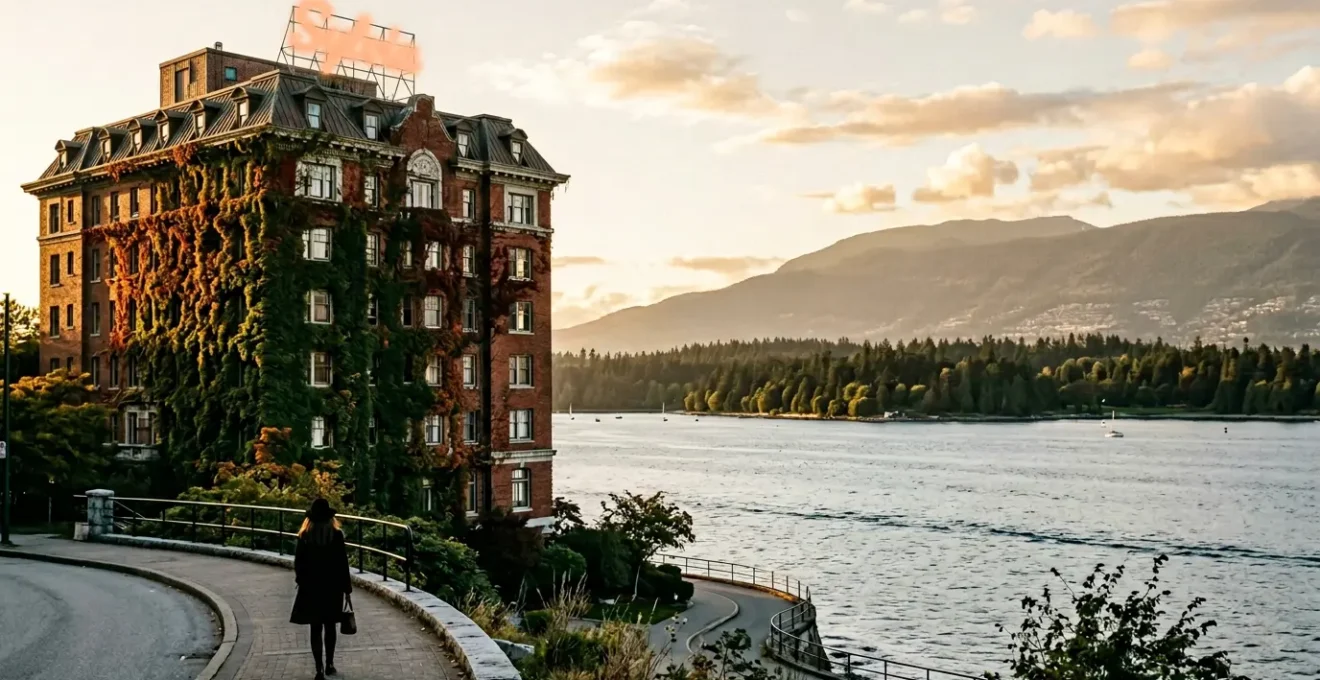
Staying at the Sylvia Hotel is not about modern luxury; it’s an immersive dialogue with Vancouver’s architectural soul, where every creak and quirk tells a story.
- The building’s charming “flaws,” like lower water pressure or a small elevator, are not defects but authentic hallmarks of preserved 1912 construction.
- The Sylvia Lounge isn’t just a bar; it’s a cultural landmark that single-handedly launched Vancouver’s cocktail scene in 1954.
Recommendation: Embrace the experience not as a tourist, but as a temporary custodian of history, appreciating the patina and structural honesty that modern hotels cannot replicate.
For the nostalgic traveler, the allure of a city is often found not in its gleaming new towers, but in the quiet dignity of its historic structures. In Vancouver, a city defined by glass and steel, the ivy-clad façade of the Sylvia Hotel stands as a defiant, romantic testament to a bygone era. Built in 1912, it gazes over English Bay like a grande dame, holding secrets of the city’s past within its brick walls. Many guides will tell you of its charm, its prime location, or its status as a local landmark. They might even mention it housed Vancouver’s very first cocktail lounge, a pivotal moment in the city’s social history.
But these facts only skim the surface. They treat the hotel as a static museum piece rather than a living, breathing structure. The true secret, cherished by those who appreciate architectural honesty, lies in understanding *why* it feels the way it does. What if the perceived inconveniences of a heritage building—the temperamental plumbing, the cozy elevators—are not flaws, but the very language through which the building speaks? What if the key to an authentic stay is not to demand modern perfection, but to learn how to listen to the building’s material soul?
This is not a conventional hotel review. This is a conservator’s guide to reading the Sylvia and its historic Vancouver counterparts. We will decode the structural quirks, appreciate the patina of a century of stories, and understand the delicate balance between preservation and modern life. By exploring the very fabric of these buildings, from their foundations to their rooftops, you will discover why a stay in a landmark like the Sylvia offers a connection to place that no new-build hotel can ever hope to match.
To truly appreciate the depth and character of Vancouver’s heritage architecture, we will delve into the specific details that define this unique experience. The following sections explore everything from the tangible sensations within these buildings to their place in the city’s wider historical narrative.
Summary: A Conservator’s Perspective on Vancouver’s Heritage Stays
- The Water Pressure: What to Expect in a Heritage Hotel Bathroom?
- Hotel Europe: Is the Gastown Flatiron Building Really Haunted?
- The Vintage Lift: Will a Double Stroller Fit in the Hotel Elevator?
- The First Cocktail Bar: Why Is the Sylvia Lounge Historic?
- Hotel Georgia: How Did the Renovation Preserve the Roaring 20s Vibe?
- Brick and Beam: Why Are Gastown Lofts So Expensive despite the Noise?
- Pender Street: How to Appreciate the Heritage Buildings While Staying Safe?
- The Douglas vs The Loden: Which Boutique Hotel Fits a Creative Traveler?
The Water Pressure: What to Expect in a Heritage Hotel Bathroom?
One of the first sensory encounters in a heritage hotel bathroom is often with the water. You turn the handsome, weighty porcelain tap and the flow is… gentle. It’s a common experience, but it’s not a sign of neglect. It is the building’s history, embodied in its plumbing. In a city like Vancouver, the infrastructure of a 1912 building is a complex tapestry of original materials and necessary updates. The lower pressure is a direct consequence of this history, as older houses are notorious for having low water pressure due to aged, narrower pipes and decades of mineral buildup. These systems were designed for a different era, with different demands.
Modernizing such a system is not as simple as replacing a few fixtures. It involves a deep, often structural intervention that can compromise the very fabric of the building we seek to preserve. As experts in local heritage renovations note, the challenge is immense. In a statement on the complexities of such projects, CAS Vancouver Heritage Renovation Specialists highlight this very issue:
Older wiring and plumbing often require upgrades to meet code
– CAS Vancouver Heritage Renovation Specialists, Heritage Homes Renovation Vancouver: Rules, Costs & Challenges
This necessity for upgrades is balanced against the desire to maintain architectural integrity. The result is a careful compromise. So, when you stand under a shower at the Sylvia, the softer flow isn’t a flaw; it is a sensory blueprint of its time. It’s a quiet reminder that you are inhabiting a structure that has stood for over a century, a physical connection to the water systems that served Vancouverites in the early 20th century. It is an authentic part of the heritage experience, a trade-off for the soul and character that cannot be manufactured.
Hotel Europe: Is the Gastown Flatiron Building Really Haunted?
While the Sylvia Hotel embodies romantic charm, another of Vancouver’s historic lodgings, the Hotel Europe in Gastown, exudes an aura of mystery. Its dramatic flatiron shape, a design necessitated by a triangular lot, makes it one of the city’s most photographed buildings. But beyond its architectural significance as Canada’s first reinforced concrete structure, the Hotel Europe is cloaked in ghost stories. These tales, whether rooted in fact or folklore, have become part of the building’s identity, a patina of narrative layered over its brick and terra cotta.
Case Study: The Hauntings of Hotel Europe
Commissioned by Angelo Calori in 1908, the Hotel Europe was a marvel of its time. Situated near the steamship docks, it was a hub of activity. According to local lore and historical accounts, its history is not entirely peaceful. Haunting reports, sourced from a detailed chronicle of its history, include a contractor in the 1980s hearing scratching sounds and feeling a ‘bad presence’ in the cellar. More recently, in the early 2000s, staff at a poster shop in the building’s basement reported sightings of a tall, phantom figure in a black coat and flat cap.
From a conservator’s perspective, these stories are as much a part of the building’s heritage as its physical structure. They represent the human element, the unrecorded histories and emotions that become absorbed by a place over time. The “bad presence” in the cellar or the apparition in the basement are manifestations of the building’s embodied history. They transform the Hotel Europe from a mere architectural object into a character in Vancouver’s ongoing story. Whether you believe in ghosts or not is irrelevant; acknowledging these tales is to appreciate the building’s full, complex identity.
The Vintage Lift: Will a Double Stroller Fit in the Hotel Elevator?
Returning to the practical realities of staying in a heritage building like the Sylvia, we encounter the elevator. It’s often a beautiful piece of machinery, with ornate brass fittings and a cage-like door that feels like a portal to another time. It is also, invariably, small. For a family traveling with a double stroller, this can seem like a major design flaw. But it is not a flaw; it is a feature of preservation, a necessary adaptive compromise between historical authenticity and modern accessibility.
The core of a historic building—its stairwells, shafts, and structural columns—is its most defining and often most fragile feature. Enlarging an original 1912 elevator shaft would require demolishing load-bearing walls and irrevocably altering the building’s structural integrity. This is not a decision taken lightly. In fact, the challenges of retrofitting heritage buildings are so significant that they are recognized in building codes. For instance, in a specific ruling, it was acknowledged that perfect modern accessibility is sometimes impossible without destroying the character that makes a building historic in the first place, as confirmed by a BC Building Code Appeal Board decision which found it impractical to mandate full access in certain heritage contexts.
So, the small elevator is a conscious choice. It prioritizes the preservation of the building’s soul over the convenience of modern dimensions. It asks the guest to adapt to its scale, rather than forcing the building to mutilate itself for our convenience. That compact space is the price of admission for an authentic journey into the past. It forces a moment of pause, a closer interaction with the material soul of the hotel, from the feel of the brass button to the gentle hum of its century-old mechanics.
The First Cocktail Bar: Why Is the Sylvia Lounge Historic?
Beyond its physical structure, a heritage building’s significance is often cemented by the cultural history it has hosted. The Sylvia Hotel holds one of Vancouver’s most important social milestones within its walls. Before 1954, the city’s drinking culture was starkly puritanical, confined to segregated, all-male beer parlours. The concept of a sophisticated lounge where men and women could mingle over a well-crafted cocktail was not just foreign; it was illegal. The Sylvia Hotel changed everything.
Case Study: The Birth of Vancouver’s Cocktail Culture
On July 2nd, 1954, the Sylvia Hotel was granted the city’s first-ever cocktail lounge license. The medieval-themed “Tilting Room” opened its doors, and Vancouver’s social landscape was transformed overnight. This wasn’t just a new bar; it was a cultural revolution. As the hotel’s own history proudly recounts, this pivotal moment ushered in an era of social sophistication, attracting figures from Malcolm Lowry to Errol Flynn. It was here that the iconic “Vancouver Cocktail” was born, a signature drink that, according to cocktail historian Steve Da Cruz, cemented the city’s place on the mixology map, a fact he confirms in an interview on the vintage classic.
Today, when you sit in the Sylvia’s lounge, you are occupying a space of profound historical importance. This room is not merely decorated to *look* old; it *is* the origin point. The very act of ordering a cocktail here is a reenactment of a historic moment of liberation from stuffy, archaic laws. The lounge’s continued existence is a testament to the hotel’s role as a cultural incubator. It demonstrates how a building can be more than just a passive container for people, but an active participant in shaping a city’s identity.
The history is not on a plaque on the wall; it is in the room’s very purpose. It is the reason the lounge feels different from a modern hotel bar. It has an earned, authentic ambiance, a quiet confidence that comes from being the first. It’s a space where the architectural and social histories of Vancouver converge, offering a drink that tastes of more than just its ingredients—it tastes of history itself.
Hotel Georgia: How Did the Renovation Preserve the Roaring 20s Vibe?
If the Sylvia represents romantic, ivy-clad heritage, the Rosewood Hotel Georgia, originally opened in 1927, embodies opulent, Jazz Age grandeur. Its major renovation and reopening in 2011 is a masterclass in how to infuse a historic building with five-star luxury without sacrificing its soul. The challenge for the conservators and designers was immense: how to weave in modern systems and amenities while keeping the spirit of the Roaring Twenties alive? The answer lay in a philosophy of restoration over replacement.
The first principle was to treat the building’s original finishes as priceless artifacts. Instead of gutting the interiors, the team painstakingly restored the lobby’s mahogany-paneled walls, ornate plaster moldings, and grand staircase. The original terrazzo and marble floors were polished back to their 1927 luster. This process is far more labor-intensive and expensive than installing new materials, but it preserves the authentic patina of time—the subtle variations in colour and texture that can only be achieved through decades of existence. The Roaring 20s vibe isn’t just a decorative theme; it’s felt in the solidity of the original woodwork and the cool touch of the historic marble.
The second principle was concealment. Modern necessities like air conditioning, Wi-Fi, and sophisticated lighting systems were cleverly integrated to be almost invisible. Vents were hidden within custom millwork, and wiring was threaded through existing cavities to avoid disturbing the historic plaster. The goal was for guests to experience 21st-century comfort while being visually immersed in the 1920s. The result is a seamless blend where the structural integrity and historical aesthetic remain paramount. The renovation succeeded because it respected the building’s original language, choosing to whisper modern conveniences rather than shout them, ensuring the hotel’s story continues, unabridged.
Brick and Beam: Why Are Gastown Lofts So Expensive despite the Noise?
Moving from hotels to residences, Gastown’s converted heritage warehouses present a fascinating paradox. These “brick and beam” lofts command premium prices, often exceeding those of brand-new luxury condos, despite being located in a bustling, sometimes noisy, historic district. Why do discerning buyers pay so much for century-old structures? The answer lies in an appreciation for architectural honesty and material soul. A brick and beam loft is not just a home; it’s a piece of Vancouver’s industrial history.
What makes these spaces so desirable is their exposed structure. The massive, old-growth Douglas fir beams and the weathered, terracotta-hued brick walls are the building’s original skeleton. In a new-build, these structural elements are hidden behind drywall. In a loft conversion, they are the main event. This rawness provides a sense of authenticity and permanence that is the ultimate luxury. The visible signs of age—the nicks in the wood, the variations in the brick—are not imperfections; they are a testament to the building’s resilience and a direct connection to the hands that built it over a century ago.
Furthermore, the inherent qualities of these buildings—soaring ceilings, huge windows designed for factory work, and vast open floor plans—create a sense of volume and light that is difficult to replicate in modern construction. The price, therefore, is not for square footage alone. It is for character, volume, and the irreplaceable patina of history. It’s a premium paid for living within a piece of art, where the structural integrity itself becomes the primary aesthetic feature. The ambient noise of Gastown is seen not as a deterrent, but as part of the vibrant, urban context that makes these authentic spaces so compelling.
Pender Street: How to Appreciate the Heritage Buildings While Staying Safe?
Appreciating Vancouver’s heritage architecture extends beyond single buildings into the streetscapes that connect them. Pender Street, which cuts through Chinatown and the Downtown Eastside, offers one of the city’s most concentrated and diverse collections of historic structures. However, this area also presents complex social challenges, requiring a mindful approach from any architectural enthusiast. Appreciating the beauty here involves looking up, both literally and figuratively, while remaining grounded and aware.
The first step is to lift your gaze. Many of Pender Street’s architectural treasures are hidden above modern ground-floor retail. The upper storeys reveal a rich tapestry of Edwardian and Art Deco façades, with original brickwork, terra cotta details, and elegant fenestration. The Sun Tower at Beatty and Pender, with its iconic Beaux-Arts dome, and the intricate details of the Chinese Freemasons Building are prime examples. Look for “ghost signs”—faded, hand-painted advertisements on the sides of brick buildings—that offer a direct portal into the area’s commercial past.
While admiring the architecture, it is crucial to practice situational awareness. This means being mindful of your surroundings and personal belongings. The area is home to a vulnerable population, and it’s important to be respectful and non-intrusive. The experience is about quiet observation, not spectacle. To combine appreciation with safety, a planned daytime walk is best. The following checklist can help structure your exploration.
Your Action Plan for a Safe Heritage Walk on Pender Street
- Plan Your Route: Identify key buildings (like the Sam Kee Building, the world’s narrowest commercial building) in advance and map a clear daytime route.
- Look Up: Consciously train your eyes to scan above the ground-floor storefronts to see the original, often-preserved upper levels of the buildings.
- Observe Details: Bring binoculars or use a camera zoom to appreciate intricate details like cornices, window casings, and decorative masonry from a safe distance.
- Practice Awareness: Walk with purpose, keep valuables out of sight, and be respectfully aware of the people who call the neighborhood home.
- Join a Tour: Consider a guided walking tour from a group like the Vancouver Heritage Foundation for expert context and the security of a group setting.
Key Takeaways
- Authentic heritage stays are defined by their structural honesty, where quirks like low water pressure are part of the experience, not flaws.
- The value of heritage buildings lies in their “material soul”—the irreplaceable patina of age on materials like brick, wood, and brass.
- Preservation is an “adaptive compromise,” balancing historical integrity with modern needs, which explains features like smaller vintage elevators.
The Douglas vs The Loden: Which Boutique Hotel Fits a Creative Traveler?
For the creative traveler, a hotel is more than a place to sleep; it’s part of the aesthetic journey. In Vancouver, the choice often comes down to different philosophies of luxury. On one hand, you have design-forward boutique hotels like The Douglas and The Loden. On the other, the authentic heritage experience. While The Douglas and The Loden are excellent, they offer a curated interpretation of character, distinct from the earned character of a place like the Sylvia.
The Douglas, an Autograph Collection hotel, builds its identity around a stunning 25-foot replica Douglas fir tree in the lobby. Its aesthetic is a modern homage to nature and industry, using vast amounts of wood and sophisticated design to evoke a connection to British Columbia’s landscape. The Loden represents a different kind of modern luxury: understated, meticulously detailed, and focused on serene, personal service. Its vibe is one of quiet, urban sophistication.
A creative traveler seeking inspiration might be drawn to these, but one seeking authenticity might find them lacking. Their character is designed and applied, whereas the character of a heritage building is inherent and discovered. The table below outlines this fundamental difference.
| Attribute | Modern Boutique (e.g., The Douglas, The Loden) | Heritage Landmark (e.g., The Sylvia Hotel) |
|---|---|---|
| Character | Designed and curated; an aesthetic theme. | Inherent and earned; a result of history and aging. |
| Materials | New, pristine, often replicating natural textures. | Original, showing a patina of age and use. |
| Experience | Seamless, predictable, and perfected. | Immersive, with unique quirks and sensory surprises. |
| Inspiration | Found in the perfection of the design and service. | Found in the authenticity of the structure and its stories. |
Ultimately, the choice depends on the type of creativity being sought. For inspiration drawn from flawless execution and modern design, The Douglas or The Loden are superb. But for a creative traveler who finds beauty in imperfection, who is energized by the dialogue between past and present, and who wants to feel the very soul of a city, the choice is clear. The slightly uneven floor, the gentle water pressure, the compact elevator—these are not inconveniences. They are the story, and for the right traveler, that is the greatest luxury of all.
For the traveler who finds romance in history and beauty in authenticity, the path is clear. Choosing a heritage landmark is not just booking a room; it is an active decision to immerse oneself in the continuing story of a place, becoming a temporary custodian of its unique architectural soul.