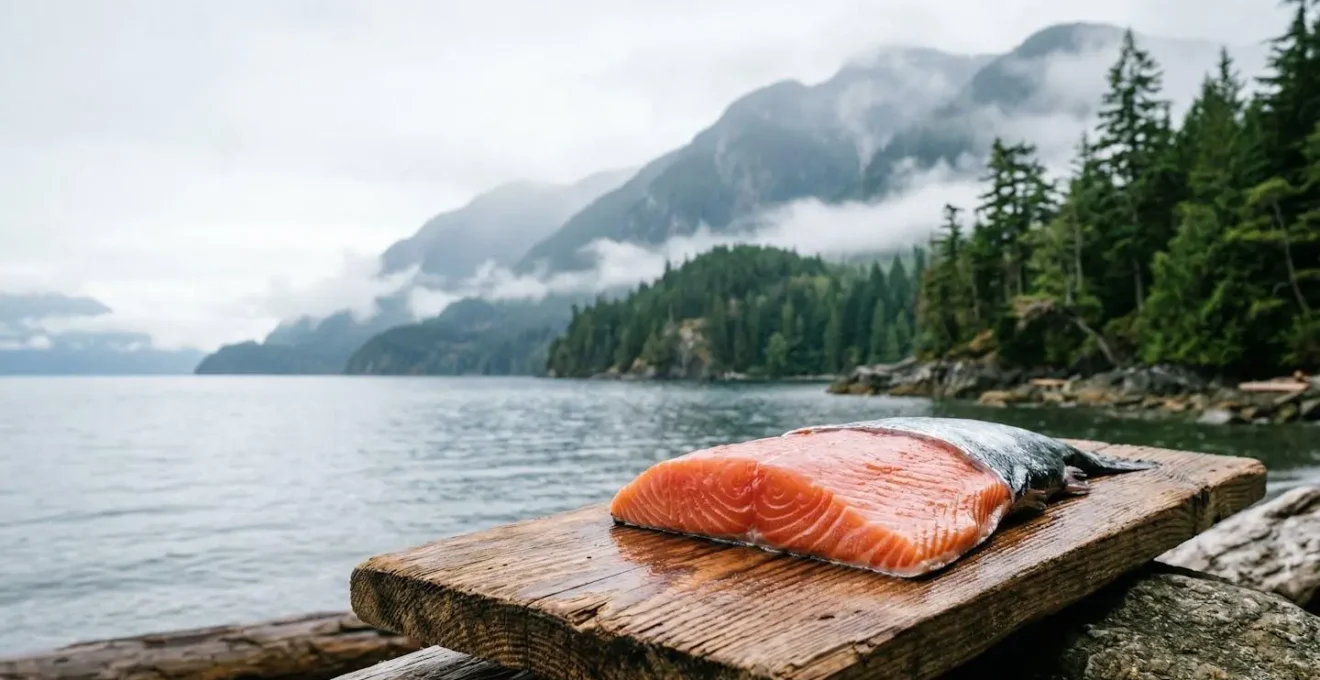
Standing at a Vancouver fish counter, confused by the difference between Sockeye and Chinook? The secret isn’t just the name; it’s the texture and fat. Chinook (King) salmon is rich and buttery, with a high fat content that makes it forgive mistakes on the grill and perfect for cedar planking. Sockeye (Red) is leaner with a firmer texture and a more robust, classic salmon flavour that shines with a quick, high-heat sear. Your choice depends on the culinary experience you’re after.
You’re standing in front of the fish counter at a Granville Island market or a local Vancouver shop. Before you are two beautiful slabs of Pacific salmon, gleaming under the lights. One is labelled “Wild Sockeye,” a deep, almost ruby red. The other, “Wild Chinook,” is a lighter, marbled pink. You have a barbecue waiting at your Airbnb, a classic West Coast evening ahead, but a crucial question stands in your way: which one is the right choice? Many will tell you Sockeye is red and Chinook is fatty, but that’s only scratching the surface.
The real difference isn’t just in the colour or a simple label; it’s in the mouthfeel, the way the fat renders on the heat, and the story the fish tells about its journey. Choosing the right salmon is less about a name and more about understanding its character. In Vancouver, salmon isn’t just food; it’s a culture, from the hyper-seasonal rush for Spot Prawns to the sweet, jerky-like texture of traditional First Nations “Indian Candy.” The common advice to simply “buy wild” is a good start, but it doesn’t help you decide which *kind* of wild salmon will make your barbecue a success.
But what if the key wasn’t about picking a “better” fish, but about matching the fish’s unique texture and fat profile to your desired cooking outcome? This is how a fishmonger thinks. It’s about seeing Chinook not just as “the fat one,” but as the perfect candidate for slow, smoky cedar plank grilling where its oils keep it moist and luscious. It’s about recognizing Sockeye’s firm flesh and bold flavour as ideal for a quick, direct-heat sear that crisps the skin and leaves the inside perfectly flaky.
This guide will walk you through that decision process. We’ll start at the docks to learn how to buy with confidence, explore the nuances of texture and flavour, understand the critical difference between wild and farmed, master the art of the cedar plank, and even plan a food tour to taste it all for yourself. By the end, you won’t just be buying salmon; you’ll be selecting the centerpiece for a perfect Vancouver meal.
This article provides a comprehensive tour of Vancouver’s salmon culture, from purchasing tips to cooking techniques and local culinary secrets. The following table of contents outlines the key topics we’ll explore to help you navigate your seafood journey.
Summary: A Guide to Grilling Vancouver’s Iconic Salmon
- Steveston Sales: How to Buy Salmon Directly from the Boat?
- Indian Candy: Why Is This Smoked Salmon Sweet and Hard?
- Wild vs Farmed: Why Do Vancouver Menus Specify “Wild” Salmon?
- Ocean Wise Symbol: Why You Should Look for It on Every Menu?
- The Soaking Rule: How to Prevent Your Cedar Plank from Catching Fire?
- Dry Ice Packing: How Long Can Frozen Salmon Stay Cold in Luggage?
- The 6-Week Window: When Can You Eat Live Spot Prawns in Vancouver?
- Japadog to Dim Sum: How to Plan a Self-Guided Food Tour in Downtown?
Steveston Sales: How to Buy Salmon Directly from the Boat?
The ultimate way to connect with your food is to buy it directly from the source. In Richmond, a short drive from Vancouver, the Fisherman’s Wharf at Steveston Harbour offers a “public fish sales float” where you can buy salmon and other seafood straight off the fishing boats. This isn’t a polished supermarket experience; it’s a vibrant, authentic market. To navigate it with confidence, you need to think like a local. The first thing to know is that this is a cash-and-carry environment. Bring Canadian cash, as you’re dealing directly with the fishers.
Freshness is everything. Look for vendors who display their catch on plenty of ice. A truly fresh salmon will have clear, bright eyes (not cloudy or sunken), firm flesh that springs back when pressed, and a mild, oceanic scent—it should never smell “fishy.” Don’t be shy to ask questions. A knowledgeable vendor can tell you where the fish was caught. A Fraser River Sockeye, for instance, has a different fat content and flavour profile than one from the Skeena River due to the length and difficulty of its journey upstream. This story is part of the flavour.
Timing is also crucial. While you can find some salmon year-round, the peak season for the prized Wild Sockeye is relatively short. According to the Steveston Harbour Authority seasonal guide, you’ll find the best Sockeye from July to September. Chinook, also known as King salmon, has more varied availability throughout the year. For the freshest options, check the social media of popular vendors before you go or simply visit during these peak months.
Your Checklist for Buying at the Steveston Dock
- Ask the source: Inquire if it’s a Fraser River or Skeena River run to understand its potential fat content.
- Check for freshness: Ensure the seafood is displayed on ice and the fish have clear eyes and firm flesh.
- Bring Canadian cash: Transactions are made directly with the fishers, and many do not accept cards.
- Know your seasons: Plan your visit for Sockeye in July-September or check for seasonal Chinook availability.
- Keep it cold: Have a cooler with ice ready in your car to transport your purchase safely back to your kitchen.
Buying from the dock is more than a transaction; it’s an experience that connects you to the Pacific, the fisher, and the incredible journey of the fish you’re about to cook.
Indian Candy: Why Is This Smoked Salmon Sweet and Hard?
As you explore Vancouver’s markets, you’ll inevitably encounter a unique local delicacy: “Indian Candy.” These are not soft, pliable strips of lox. Instead, they are firm, chewy, and glistening salmon nuggets with a deeply savoury and surprisingly sweet flavour. The texture can be likened to a high-quality jerky, and its unique character comes from a traditional preservation method perfected by First Nations communities along the Pacific Northwest coast.
This method was born from necessity—a way to preserve the bounty of the salmon run for the leaner months. The process, as detailed in cultural records like those on the origins of candied smoked salmon, involves several key stages. First, salmon (often Chum or Pink salmon, which are leaner) is cut into strips and cured in a sweet brine, traditionally made with ingredients like maple or birch syrup, brown sugar, and salt. This curing process draws out moisture and infuses the fish with flavour. After curing, the strips are air-dried to form a tacky outer layer called a “pellicle,” which is crucial for smoke to adhere to. Finally, the salmon is hot-smoked for hours, slowly cooking and drying it until it achieves its signature firm, chewy texture and deep, smoky taste.
Today’s artisanal producers have elevated this tradition. You can find modern variations with glazes made from local birch syrup or even versions rolled in cracked peppercorns, adding a spicy kick to the sweet and smoky profile. Indian Candy is the perfect trail snack, a fantastic addition to a charcuterie board, or simply a delicious piece of edible history. It represents the pinnacle of transforming a lean fish into a flavour-packed, texturally complex treat, showcasing an entirely different dimension of salmon.
Its existence is a testament to the ingenuity of First Nations cuisine and offers a taste experience completely distinct from a grilled salmon fillet.
Wild vs Farmed: Why Do Vancouver Menus Specify “Wild” Salmon?
In Vancouver, the word “wild” on a menu next to “salmon” is more than a descriptor; it’s a declaration of quality, sustainability, and local pride. This emphasis is a relatively recent development, a conscious shift away from a problematic past. To understand why it’s so important, you have to look back a few decades. As celebrated Vancouver chef and sustainable seafood pioneer Robert Clark noted, the situation used to be very different.
You could take any menu from 1992 in Vancouver: all had grilled B.C. salmon in a chardonnay cream sauce or whatever it was, and it was all farmed Atlantic. None of it was wild. That’s fraud.
– Robert Clark, Vancouver Magazine
The term “wild” signifies that the salmon is a Pacific species (like Chinook, Sockeye, Coho, Chum, or Pink) that has lived its natural life cycle in the ocean, feeding on a natural diet of krill, shrimp, and smaller fish. This natural diet is what gives wild salmon its vibrant colour and complex, robust flavour. Its constant swimming against ocean currents results in a leaner, firmer muscle structure compared to its farmed counterpart. Farmed salmon, typically Atlantic salmon, are raised in open-net pens in the ocean. Their diet is composed of a manufactured feed pellet, which results in a higher fat content but often a milder, less nuanced flavour and a softer texture.
Beyond flavour and texture, the “wild” designation is deeply tied to conservation. Many British Columbians are concerned about the environmental impact of open-net fish farms, including the potential for disease and sea lice to spread to fragile wild salmon populations. The stakes are high, as wild salmon stocks have faced significant pressure. For instance, a report highlighted that only 22 million Pacific salmon were caught in 2020, a historic low. By choosing “wild,” consumers are not only opting for a superior culinary product but are also casting a vote for the protection of British Columbia’s iconic wild species.
This choice at the restaurant or fish counter is a direct participation in a larger conversation about the future of one of the world’s great natural resources.
Ocean Wise Symbol: Why You Should Look for It on Every Menu?
Navigating the complex world of sustainable seafood can be daunting, especially for a visitor. How can you be sure the “wild” salmon you’re ordering is truly a responsible choice? In Vancouver, there’s a simple, trustworthy guide: the Ocean Wise symbol. Seeing this little logo next to a menu item is your assurance that the seafood has been sourced in a way that minimizes impact on our oceans.
Launched by the Vancouver Aquarium, Ocean Wise is not a government body but an educational conservation program. Its primary goal is to empower consumers and businesses to make ocean-friendly choices. When a restaurant or retailer is an Ocean Wise partner, it means they have committed to sourcing and serving only seafood that meets the program’s strict sustainability criteria. For salmon, this almost always means wild-caught Pacific salmon from healthy, well-managed fisheries. The program helps diners bypass the confusion and potential greenwashing, making it easy to support businesses that prioritize ocean health.
The program’s recommendations are based on rigorous scientific assessment, evaluating factors like the health of the stock, the impact of the fishing method on habitats, and the effectiveness of management practices. Interestingly, Ocean Wise provides a more nuanced view than a simple “wild is good, farmed is bad” dichotomy. The organization has, in specific cases, recommended salmon from innovative, land-based aquaculture operations. For example, Kuterra, a First Nations-owned farm on northern Vancouver Island, raises salmon in closed-containment systems on land. This method completely prevents interaction with wild populations, eliminating the risks of disease transfer and escapes that plague conventional open-net farms. This shows that the ultimate goal is not to demonize aquaculture, but to promote practices, whether wild or farmed, that ensure the long-term health of both marine ecosystems and wild salmon stocks.
So, as you browse menus in Vancouver, keep an eye out for the Ocean Wise logo. It’s your shortcut to a delicious meal you can feel good about.
The Soaking Rule: How to Prevent Your Cedar Plank from Catching Fire?
Grilling salmon on a cedar plank is a quintessential Pacific Northwest culinary ritual. The plank does two magical things: it protects the delicate fish from the harsh, direct flame of the grill, and as it heats, it releases aromatic steam and smoke that infuses the salmon with a wonderful, woodsy flavour. However, the most common mistake newcomers make is a fiery one. A dry cedar plank placed on a hot grill will simply ignite. The cardinal rule of plank grilling is simple: soak the plank thoroughly.
Before you even think about firing up the grill, your cedar plank needs a bath. Submerge it completely in liquid for at least one to two hours. You may need to use a weight, like a heavy mug or a jar, to keep it from floating. While water is the most common soaking liquid, this is a great opportunity to add another layer of flavour. Consider soaking the plank in white wine (an Okanagan Riesling works beautifully), cider, or even sake. This infuses the wood, which in turn will steam that flavour into your fish. However, there’s a balance to be struck, as one expert source points out:
There’s a balance between soak time and flavor. The longer you soak the plank, the less flavor you will get from the plank.
– The Mountain Kitchen, Cedar Plank Salmon Grilling Guide
Once soaked, you’re ready to grill. The method is straightforward but requires attention to detail. This process ensures the salmon cooks gently and evenly, absorbing all that delicious cedar smoke.
Your Action Plan for Perfect Cedar Plank Salmon
- Soak the plank: Submerge your cedar plank in water, wine, or cider for 1-2 hours, using a weight to keep it down.
- Preheat the grill: Set your grill for medium indirect heat, around 350°F (175°C). Place the soaked plank on the grates to preheat for a few minutes.
- Season the salmon: Place the salmon fillet skin-side down on the warm plank. Brush with olive oil and season simply with salt, pepper, and perhaps a slice of lemon.
- Grill with the lid closed: Cook for 12-25 minutes, depending on the thickness of your fillet. The salmon is done when it’s uniformly pink and flakes easily.
- Leave the skin behind: When serving, use a thin spatula to slide between the salmon flesh and the skin. The skin should stick to the plank, making for a beautifully clean presentation.
The result is incredibly moist, flavourful salmon that captures the very essence of a West Coast barbecue.
Dry Ice Packing: How Long Can Frozen Salmon Stay Cold in Luggage?
After tasting a perfect fillet of wild Chinook or Sockeye, it’s only natural to want to bring some home. Many local fishmongers in Vancouver offer high-quality, flash-frozen salmon fillets that are perfect for travel. The key to getting them home safely is proper packing, and the gold standard for this is dry ice. Unlike regular ice, dry ice is frozen carbon dioxide that sublimates—turning directly from a solid to a gas—leaving no messy puddles behind.
When packed correctly in a suitable container, dry ice can keep salmon frozen solid for a significant amount of time. In a good quality insulated cooler bag or a small styrofoam cooler, a few pounds of dry ice can typically keep fish frozen for 24 to 48 hours. The exact duration depends on several factors, including the amount of dry ice used, the quality of the insulation, and the amount of empty space in the cooler (less is better). For a cross-country flight, this is usually more than enough time to get your precious cargo from the Vancouver fish shop to your freezer back home.
However, there are critical safety and regulatory rules to follow. First, never handle dry ice with bare hands, as its extreme cold temperature (-78.5°C or -109.3°F) can cause severe frostbite. Always use gloves or tongs. Second, and most importantly for air travel, dry ice releases carbon dioxide gas. The cooler must be vented slightly to allow this gas to escape; a completely airtight container could pressurize and burst. Airlines have specific regulations for travelling with dry ice. Most Canadian and US carriers permit a small amount (typically up to 2.5 kg or 5.5 lbs) in checked or carry-on luggage, provided the package is properly labelled and vented. Always check with your specific airline for their exact rules before you fly.
It’s the perfect souvenir from your Vancouver culinary adventure, allowing you to recreate that delicious West Coast meal in your own home.
The 6-Week Window: When Can You Eat Live Spot Prawns in Vancouver?
While salmon may be the king of Vancouver seafood, for a few frantic weeks each year, another local legend takes the throne: the BC Spot Prawn. For seafood lovers, this is the most anticipated event of the year. The season is incredibly short, typically lasting only about six to eight weeks. According to the official seasonal calendar, this magical window usually opens in May and can run into June. During this time, you can buy these prawns live and wriggling, directly from boats at the same docks in Steveston and at False Creek’s Fisherman’s Wharf.
What makes them so special? It’s their unparalleled texture and taste. Forget the often soft or mealy texture of other prawns you may have had. As the experts at Steveston Spot Prawns & Seafood describe them, the difference is night and day.
Compared to most prawns, the spot prawn is much firmer and crisper in texture, sweeter in taste (especially when eaten raw) and has a clean, cold ocean taste that separates it from all the rest.
– Steveston Spot Prawns & Seafood, Wild BC Spot Prawns
This unique “crisp” and “sweet” character makes them a delicacy. They are celebrated for their natural flavour, which is so good that the best way to prepare them is often the simplest: a quick boil in salted water for just a minute or two, a flash on the grill, or even eaten raw as sashimi (after dispatching them humanely). The heads are also packed with flavour and are often saved to make a rich, delicious seafood stock.
The short season creates a city-wide frenzy, with chefs featuring them on menus and locals lining up at the docks. If your visit to Vancouver happens to coincide with this 6-week window, consider it a stroke of culinary luck. Seeking out live spot prawns is an essential Vancouver experience, offering a taste of the Pacific at its absolute freshest and most vibrant.
It’s a fleeting, delicious opportunity that captures the excitement of seasonal eating on the West Coast.
Key takeaways
- Sockeye salmon is lean and firm with a bold flavour, ideal for direct grilling; Chinook is rich and oily with a buttery texture, perfect for cedar planking.
- Always look for the Ocean Wise symbol on menus to ensure you’re choosing sustainably sourced seafood.
- To buy the freshest fish, go to the docks at Steveston or Granville Island, bring cash, and look for fish kept on ice with clear, bright eyes.
Japadog to Dim Sum: How to Plan a Self-Guided Food Tour in Downtown?
Now that you can talk texture with a fishmonger and know the secret of the cedar plank, it’s time to put that knowledge into practice. Vancouver’s food scene is a compact and walkable tapestry of global influences and fierce local pride. You can easily design a self-guided tour that encapsulates the very essence of the city’s culinary identity, with Pacific salmon as the star.
A perfect starting point for this adventure is the Granville Island Public Market. This is the heart of Vancouver’s food scene, all under one roof. Here, you can execute a “salmon loop”: start by visiting one of the acclaimed fishmongers like The Lobster Man or Longliner Seafoods to see Sockeye and Chinook side-by-side. Then, grab a perfectly grilled salmon burger for lunch from a spot like Go Fish Ocean Emporium just outside the market. Finally, circle back to pick up some artisanal smoked salmon products, including the sweet and chewy Indian Candy from a vendor like The Salmon Shop, to take with you. The market is a microcosm of the city’s food ethos, blending fresh sourcing, culinary craft, and a vibrant atmosphere.
From Granville Island, your tour can expand. A short walk or Aquabus ride away, you can find restaurants that take these ingredients to the next level. For an authentic and meaningful meal, seek out a place that celebrates the region’s Indigenous heritage. As the team at Salmon n’ Bannock, the city’s only Indigenous-owned and operated restaurant, proudly states, their mission is clear.
We are Vancouver’s only Indigenous restaurant. We proudly serve wild salmon and free range organic game meats.
– Salmon n’ Bannock Bistro, Instagram Bio
A meal here offers not just delicious food, like their famous salmon bannock burger or smoked salmon platter, but also a direct connection to the culture that has stewarded these ingredients for millennia. By weaving together a market visit, a casual lunch, and a meaningful dinner, you transform a simple meal into a genuine exploration of Vancouver’s identity.
Armed with your new knowledge, go forth and taste the story of Vancouver, one delicious, perfectly cooked piece of salmon at a time.