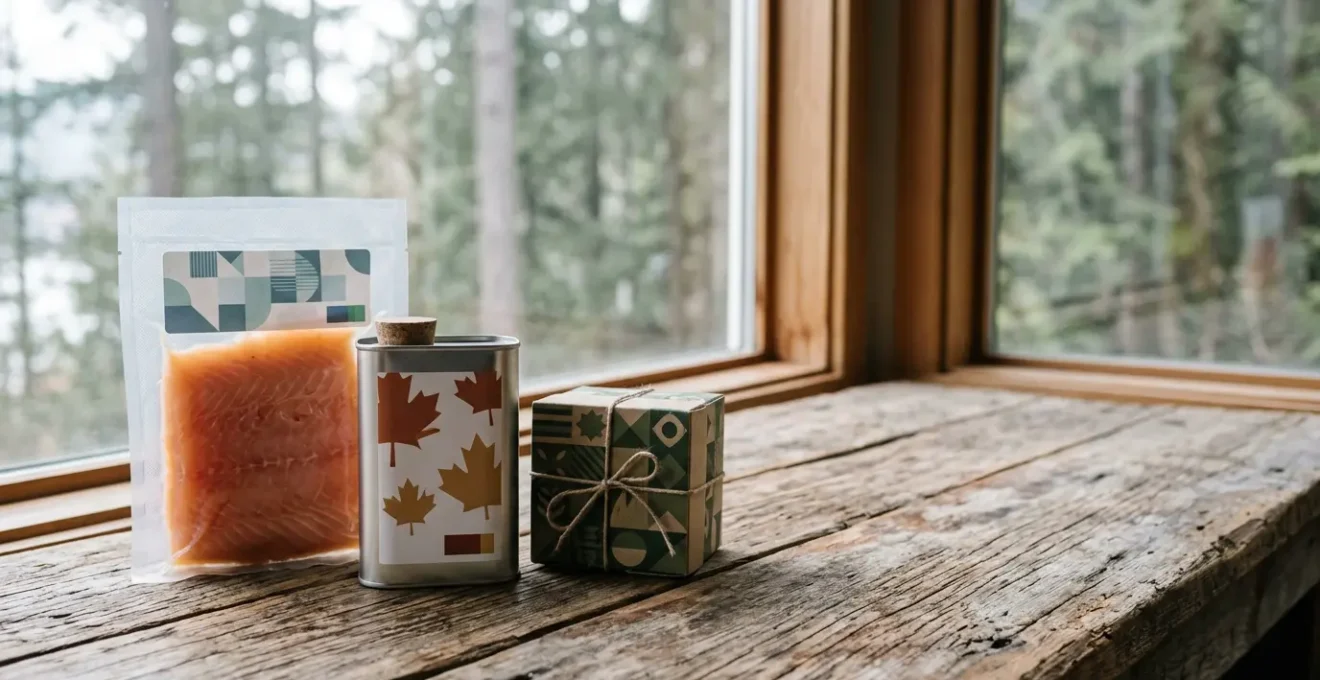
The primary challenge of buying Vancouver souvenirs isn’t choosing what you like, but choosing what will legally and physically survive the journey home.
- Shelf-stable and commercially processed foods (like retort-pouch salmon) are your safest bet for clearing US customs.
- The structural and thermal integrity of packaging is paramount; metal tins for syrup and insulated packing for perishables are non-negotiable.
Recommendation: Prioritize items based on their “travel-readiness”—a combination of regulatory compliance, durability, and thermal stability—to ensure your souvenirs arrive intact.
The scene is a familiar one for any tourist: standing in a Gastown gift shop, a beautiful piece of smoked salmon in one hand and a jug of maple syrup in the other. Your suitcase is half-full, your flight is tomorrow, and a wave of anxiety hits. Will this salmon spoil? Will this jug leak? Will a US customs officer confiscate it all? The joy of finding the perfect memento is quickly replaced by logistical dread. Most travel guides offer simple lists of what to buy, but they ignore the most critical questions about spoilage, breakage, and legality.
The standard advice to “pack it well” is vague and unhelpful when you’re dealing with the realities of air pressure changes, baggage handling, and international border regulations. This is where a shift in perspective is needed. The key isn’t just about what you buy; it’s about how that item is prepared and packaged for the journey. It’s about understanding its travel-readiness from a regulatory, thermal, and structural standpoint.
But what if the real secret wasn’t a packing tip, but a purchasing strategy? Instead of worrying about how to protect a fragile item, what if you chose an inherently robust one from the start? This guide moves beyond the generic souvenir list. Drawing from the dual perspective of a foodie and a customs-savvy pragmatist, we will analyze Vancouver’s most iconic souvenirs not just for their taste or beauty, but for their ability to survive your trip home. We’ll assess their regulatory compliance for crossing the US border, their thermal integrity against airport tarmacs, and their structural durability in checked luggage.
This article provides a structured analysis of Vancouver’s most popular souvenirs, breaking down the specific factors that determine whether they are a safe bet for travel or a potential disappointment. Follow this guide to make informed choices and ensure your memories of British Columbia arrive home as perfectly as you remember them.
Contents: Your Expert Guide to Packing Vancouver Souvenirs
- Retort Pouch vs Frozen: Which Salmon Can You Legally Bring into the USA?
- The Nanaimo Bar Quest: Where to Buy a Box That Won’t Melt on the Plane?
- BC Jade: How to Tell Real Nephrite from Dyed Glass?
- Douglas Coupland to Emily Carr: Which Vancouver Author Makes the Best Gift?
- The Yaletown Distillery Rule: Can You Buy a Bottle on Sunday?
- Dry Ice Packing: How Long Can Frozen Salmon Stay Cold in Luggage?
- Glass vs Plastic Jug: Which Container Survives a 10-Hour Flight?
- Hudson’s Bay Point Blanket: Why Is This $300 Wool Blanket Iconic?
Retort Pouch vs Frozen: Which Salmon Can You Legally Bring into the USA?
For tourists, BC smoked salmon is a quintessential souvenir. However, the type of processing it undergoes is the single most important factor determining its legality for entry into the United States. US Customs and Border Protection (CBP) regulations are strict regarding perishable food items. The key distinction is between commercially sterile, shelf-stable products and those requiring refrigeration. Frozen smoked salmon, while delicious, is considered a perishable item and can face scrutiny or refusal at the border unless it’s for personal consumption and declared properly.
The unequivocally safer choice is salmon in a thermally processed retort pouch. This is the soft, vacuum-sealed, foil-like packaging that doesn’t require refrigeration. This method makes the product commercially sterile and shelf-stable, placing it in the same category as canned goods, which are generally admissible. When choosing your salmon, look for clear labeling that indicates it is “shelf-stable” or “no refrigeration required.” Furthermore, selecting a product from a reputable source is crucial; in 2024, an assessment recommended 14 BC salmon fisheries as sustainable under the Ocean Wise program, a label that often indicates high-quality processing standards.
Case Study: Steveston Village’s Travel-Ready Salmon
The historic fishing village of Steveston in Richmond is the heart of BC’s fishing industry. Vendors at Fisherman’s Wharf and local shops have generations of expertise, stemming from the area’s cannery heritage. They specialize in providing vacuum-sealed and retort-pouched salmon specifically designed for tourists. These packages are not only shelf-stable but are often labeled to meet international customs requirements, making them a low-risk, high-reward souvenir for those crossing the US border.
The Nanaimo Bar Quest: Where to Buy a Box That Won’t Melt on the Plane?
The Nanaimo bar, a legendary three-layer confection of coconut-graham crust, custard icing, and chocolate ganache, is a delicious but delicate souvenir. Its primary vulnerability is its low melting point. The butter-based custard filling and chocolate topping lack thermal integrity, making them highly susceptible to temperature fluctuations during travel, especially on a warm tarmac or in a hot car. A standard bakery-fresh Nanaimo bar will likely become a melted mess in your luggage.
The solution lies in seeking out specialty confectioners who have engineered a more travel-ready version. These producers often adjust the recipe to increase stability. According to Vancouver-based Northern Bars, a producer of travel-focused versions, their Nanaimo bars can remain stable under 20°C (68°F) and have a shelf life of up to five months without refrigeration. This is achieved by using fats with higher melting points and professional packaging. When shopping, ask the vendor specifically about the bar’s stability and look for sealed, gift-box packaging rather than a simple clamshell from a café display case. For best results, transport the bars in your carry-on to maintain a more controlled temperature.
BC Jade: How to Tell Real Nephrite from Dyed Glass?
British Columbia is one of the world’s primary sources of nephrite jade, making it a beautiful and authentic souvenir. However, the market is rife with imitations, often made from dyed glass, serpentine, or resin. For a tourist, distinguishing genuine nephrite from a fake in a gift shop can be daunting. The value of the souvenir lies in its authenticity, so conducting a few simple, non-destructive tests before purchasing is crucial. You can use your smartphone and your senses to perform a quick quality check.
Genuine nephrite jade has specific physical properties that fakes cannot replicate. It possesses a unique density, thermal conductivity, and internal fibrous structure. While you cannot perform a scratch test in a store, you can assess its translucency, temperature, and even the sound it makes. These quick assessments can dramatically increase your chances of buying a real piece of British Columbia’s provincial stone instead of a worthless imitation. This is not about being a gemologist; it’s about being an informed consumer.
In-Store Smartphone Authenticity Tests for BC Nephrite Jade
- Flashlight Translucency Check: Shine your phone’s flashlight through the stone. Genuine nephrite will show a subtle light transmission with visible fibrous inclusions, while glass will be uniformly translucent or completely opaque.
- Surface Temperature Test: Hold the stone against your cheek. Real jade feels characteristically cool to the touch and warms up slowly. Glass or resin will warm up almost instantly.
- Clink Test: Gently tap the stone against a known glass object (like your phone’s screen, carefully). Nephrite produces a high-pitched, musical, bell-like tone. Dyed glass or plastic will sound dull and flat.
- Edge Inspection: Use your phone’s camera zoom to examine any carved edges or details. Nephrite will often show a slightly rough, fibrous, or granular texture under magnification. Glass will appear perfectly smooth, possibly with tiny air bubbles trapped inside.
Douglas Coupland to Emily Carr: Which Vancouver Author Makes the Best Gift?
A book by a local author is a lightweight, durable, and deeply meaningful souvenir that captures the spirit of Vancouver. Unlike food items, books have no expiry date and face zero customs restrictions. The choice of author can reflect the version of Vancouver you want to remember. For a modern, satirical take on the city’s culture, an early novel by Douglas Coupland (like Generation X or Microserfs) is an excellent choice. For a connection to the region’s artistic soul and natural landscapes, a book of writings or biographies of iconic painter Emily Carr is a timeless gift.
From a practical travel perspective, the format of the book matters. A paperback is always superior to a hardcover for a souvenir. It is significantly lighter, more flexible for packing, and less prone to damage. The best places to find these are Vancouver’s beloved independent bookstores, such as Massy Books or The Paper Hound, where staff can offer personalized recommendations for other local authors representing the city’s diverse voices. A book is more than an object; it’s a portable piece of the city’s intellectual and cultural landscape.
The Yaletown Distillery Rule: Can You Buy a Bottle on Sunday?
A bottle of locally crafted gin or whisky from one of Vancouver’s acclaimed distilleries makes an excellent souvenir. However, British Columbia’s liquor laws can be confusing for visitors, especially regarding Sunday purchases. The ability to buy alcohol depends entirely on the type of vendor. While many government-run BC Liquor Stores have limited hours or are closed on Sundays, the city’s private liquor stores and distillery tasting rooms offer more flexible options.
From a regulatory standpoint, distillery tasting rooms are often your best bet for a Sunday purchase. Under BC law, most craft distilleries and breweries are permitted to sell their own products directly to consumers seven days a week, typically in the afternoon and early evening. This not only solves the Sunday problem but also provides a better souvenir experience, often including a tasting and the opportunity to buy unique, small-batch products not available in government stores. The following table breaks down your options.
| Vendor Type | Sunday Hours | Availability | Best For |
|---|---|---|---|
| BC Liquor Stores (Government) | 11:00 AM – 6:00 PM (limited locations) | Limited | Wide selection, standardized pricing |
| Private Wine/Beer Stores | Varies by location, often 11:00 AM – 9:00 PM | Good | Extended hours, convenient locations |
| Distillery/Brewery Tasting Rooms | 12:00 PM – 8:00 PM (most open) | Best | Unique local products, direct from producer, tastings included |
Dry Ice Packing: How Long Can Frozen Salmon Stay Cold in Luggage?
Transporting frozen salmon requires maintaining its thermal integrity below 0°C (32°F) for the duration of your travel. While dry ice is an effective coolant, it is classified as a hazardous material for air travel. Both FAA and Transport Canada regulations are strict, with most airlines enforcing the rule that allows a maximum of 2.5 kg (5.5 lbs) of dry ice per passenger in a properly vented container. For many travelers, acquiring and packing dry ice is a logistical hassle.
A more practical, regulation-free approach is the “insulation sandwich” method using clothing and a hardshell suitcase. This technique relies on trapping cold air and using the high thermal mass of the frozen fish and the insulating properties of fabric to slow down the thawing process. This method can typically keep a well-frozen, vacuum-sealed package of salmon frozen or safely cold for 8-12 hours, sufficient for most flights to the US. The key is to eliminate air gaps, as air is the primary medium of heat transfer.
Here is a step-by-step guide to the insulation sandwich method:
- Wrap the core: Tightly wrap the frozen, vacuum-sealed salmon package in a thick, insulating layer like a wool sweater or fleece jacket.
- Center the package: Place the wrapped salmon in the absolute center of a hardshell suitcase, equidistant from all six walls.
- Build the buffer: Surround the central package on all sides (top, bottom, and all four sides) with densely rolled clothing like jeans and towels to create a thick buffer zone.
- Eliminate air gaps: Fill any remaining empty spaces in the suitcase with soft items like t-shirts and socks. A tightly packed case has better thermal performance.
- Keep the suitcase sealed: Do not open the suitcase until you reach your final destination. Every time it is opened, the cold air is replaced with warm air, drastically reducing insulation time.
Glass vs Plastic Jug: Which Container Survives a 10-Hour Flight?
Maple syrup is a dense, viscous liquid, and the primary travel risk is not spoilage but leakage or breakage due to pressure changes and rough baggage handling. The choice of container is therefore a critical decision of structural integrity. The classic glass bottle, while aesthetically pleasing, is the highest-risk option. It is heavy, fragile, and its seal can be compromised by pressure changes in the cargo hold. The common plastic jug is lightweight and less prone to breaking, but it can expand or contract with pressure, potentially weakening the cap’s seal.
The superior choice for air travel is the traditional metal tin or can. This container format offers the optimal combination of durability, light weight, and security. Metal is highly resistant to puncture and crushing. More importantly, its rigid structure and hermetic seal are virtually immune to the pressure fluctuations experienced during a flight, making the risk of leaks negligible. While it may lack the transparent appeal of glass, the metal tin embodies a rustic, authentic Canadian heritage and guarantees your sweet souvenir arrives without coating the contents of your suitcase.
The following table provides a clear comparison of travel performance for each container type.
| Container Type | Weight | Leak Risk | Breakage Risk | Canadian Aesthetic | Verdict |
|---|---|---|---|---|---|
| Glass Bottle | Heavy (adds 200-300g) | Medium (pressure changes) | High (fragile) | High (premium look) | Best for display, risky for travel |
| Plastic Jug | Light (under 50g) | Low-Medium (can expand) | Low | Low (generic) | Safe but lacks charm |
| Metal Tin/Can (Traditional) | Light (100-150g) | Very Low (rigid, pressure-proof) | Very Low (dent-resistant) | Very High (rustic Canadian heritage) | Optimal for travel – lightweight, durable, authentic |
Key Takeaways
- Smoked Salmon: Choose thermally-processed retort pouches over frozen for guaranteed customs compliance.
- Sweet Treats: Nanaimo bars require temperature control; metal tins are the superior choice for maple syrup’s structural integrity on flights.
- Authentic Gifts: Use in-store tests to verify BC Jade and consider a Coast Salish woven blanket as a meaningful alternative to mass-produced icons.
Hudson’s Bay Point Blanket: Why Is This $300 Wool Blanket Iconic?
The Hudson’s Bay Point Blanket is arguably one of Canada’s most iconic non-edible souvenirs. Its history is deeply intertwined with the nation’s fur-trading past, and its distinctive green, red, yellow, and indigo stripes are instantly recognizable. The high price tag, often exceeding $300, can be a shock, but it reflects the blanket’s quality and heritage. Made from 100% wool, it is incredibly durable, warm, and water-resistant. The investment is one of longevity; with proper care, these blankets can last for over 50 years, making the cost-per-year of use remarkably low. For many, it’s a family heirloom in the making.
However, the blanket’s history with the Hudson’s Bay Company is also complex and tied to colonial trade. For travelers seeking a meaningful souvenir with a more direct and positive connection to the Vancouver region, there is a powerful alternative. This provides an opportunity to support local Indigenous communities and acquire a piece with deep cultural authenticity.
Alternative Case: The Coast Salish Woven Blanket
As an authentic, Vancouver-region alternative, consider a hand-woven wool blanket from a Coast Salish artist. Available at Indigenous-owned galleries in Vancouver, these blankets feature traditional motifs and weaving techniques specific to the Pacific Northwest. Purchasing directly from First Nations artists or cooperatives ensures the money supports the local community. These pieces often come with certificates of authenticity and artist attribution, fulfilling the desire for a meaningful souvenir while addressing the ethical complexities that can accompany the Hudson’s Bay blanket.
Now that you’re equipped with this regulatory and practical knowledge, you can shop for your Vancouver souvenirs with confidence, ensuring your chosen treasures arrive home safely and legally.