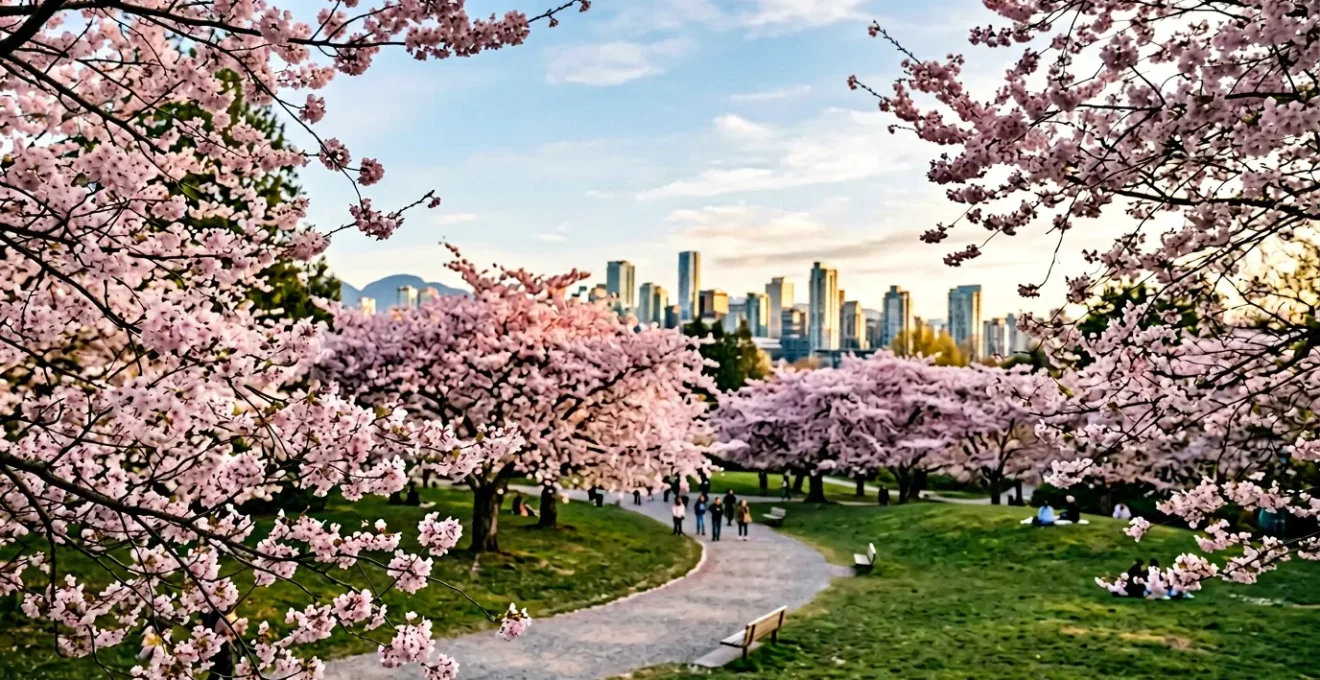
Predicting the perfect cherry blossom shot isn’t about a fixed date; it’s about understanding the park’s botanical sequence and microclimates to forecast the bloom.
- Early-blooming ‘Akebono’ trees are the primary indicator for the main spectacle at Queen Elizabeth Park.
- The park’s elevation creates staggered blooming, offering multiple photographic opportunities if you know where to look.
Recommendation: Stop relying on generic “late March” predictions. Start tracking the ‘Akebono’ bud stages in the second week of March to pinpoint the exact week of peak bloom for your photoshoot.
For photographers and influencers, capturing the ephemeral beauty of Vancouver’s cherry blossoms is an annual pilgrimage. The desire for that perfect shot—a cascade of pink petals against the city skyline—often leads to a frantic search for one single answer: when is the peak bloom? Most guides will offer a generic “late March to early April,” a frustratingly vague window for those who need to plan. This approach treats the sakura season as a single event, when in reality, it’s a complex, rolling spectacle driven by biology and climate.
The common advice to simply show up at Queen Elizabeth Park and hope for the best is a recipe for missed opportunities. You might arrive too early to a sea of closed buds or too late, finding more petals on the ground than on the branches. True success in capturing this fleeting moment doesn’t come from a calendar date. It comes from adopting the predictive mindset of a horticulturalist. It requires understanding the specific varieties that create the iconic display, reading the subtle cues of the park’s unique topography, and knowing how to compose shots with the surrounding native flora.
This guide moves beyond dates and into a strategy of observation and prediction. We will deconstruct the bloom sequence at Queen Elizabeth Park, focusing on the key tree varieties and environmental indicators that allow you to forecast the perfect photographic window. We’ll explore how to leverage the park’s other botanical assets for unique compositions and create a plan that ensures you capture stunning images, even if you just miss the absolute peak. This is your guide to shooting smarter, not just harder.
To help you navigate this botanical journey, we’ve structured this guide to cover every aspect of your photographic mission, from identifying the right trees to planning a full day of shooting across the city.
Summary: A Photographer’s Guide to Vancouver’s Cherry Blossom Season
- Akebono vs Kanzan: Which Cherry Tree Has the Fluffier Pink Petals?
- The Cherry Blossom Festival: Do You Need Tickets for the Big Picnic?
- The Graveley Street Arch: How to Photograph It Without Blocking Traffic?
- The Pink Croissant: Where to Find Cherry Blossom Flavored Desserts?
- The Slippery Sidewalk: Why Are Wet Cherry Petals Dangerous for Cyclists?
- Douglas Fir vs Western Red Cedar: How to Tell Them Apart by Bark?
- When to Visit the VanDusen Botanical Garden Maze for Bloom Season?
- Night Photography: How to Capture Neon Signs in Chinatown Safely?
Akebono vs Kanzan: Which Cherry Tree Has the Fluffier Pink Petals?
For a photographer, understanding the difference between ‘Akebono’ and ‘Kanzan’ cherry trees is the first step to predicting the bloom at Queen Elizabeth Park. These are not just two types of trees; they are two distinct acts in the spring drama. The ‘Akebono’ (Prunus × yedoensis ‘Akebono’) is the star of the early season. Its blossoms are delicate, single-layered, and open as a pale pink that fades to near-white. This is the variety that creates the iconic, cloud-like canopies at QE Park and David Lam Park. Crucially, these are your primary indicators for the main event.
In contrast, the ‘Kanzan’ (Prunus ‘Kanzan’) is the grand finale. Its flowers are dense, multi-petaled, and a much deeper, more vibrant shade of pink. These are the “fluffy” blossoms often seen lining residential streets. Botanically, they are a completely different show. According to Vancouver cherry blossom variety guides, ‘Akebono’ typically blooms in late March to early April, while ‘Kanzan’ follows much later, from late April into May. For a QE Park shoot, you must focus your predictions on the ‘Akebono’ schedule.
This timing is also in flux, adding a layer of complexity and underscoring the need for observation over calendars. As climate patterns shift, so does the trees’ internal clock, a field of study known as phenology. According to Dr. Elizabeth Wolkovich, a UBC associate professor of forest and conservation sciences, this is a measurable trend.
The cherry blossom season, on average, has begun earlier and earlier over the past four decades, with some plants or locations having advanced two or three weeks.
– Dr. Elizabeth Wolkovich, UBC climate change research on cherry blossom phenology
This scientific observation confirms the photographer’s challenge: historical dates are becoming less reliable. The key is to watch the ‘Akebono’ buds at QE Park. When they begin to swell and show color, your peak photographic window is approximately 7-10 days away.
The Cherry Blossom Festival: Do You Need Tickets for the Big Picnic?
Once you’ve forecast the bloom, the next step is to plan your visit around the city’s celebrations. The Vancouver Cherry Blossom Festival (VCBF) organizes numerous events, but for a photographer focused on capturing the moment, it’s crucial to distinguish between spontaneous gatherings and structured, ticketed affairs. The flagship event for casual enjoyment is The Big Picnic at David Lam Park, home to a stunning grove of 100 ‘Akebono’ trees.
A common question is whether you need tickets for this popular event. The answer is a resounding no. The Big Picnic is designed as a free, public celebration of *hanami* (flower viewing). You can simply arrive and find a spot. However, “free” also means popular, and planning is still required. For photographers, this means considering crowd management, light direction, and transportation. Arriving early (around 10:30 AM when it opens) or staying later in the afternoon can help you avoid the densest crowds.
For those seeking a more structured cultural experience, the festival offers ticketed events like the Sakura Days Japan Fair. This provides a different kind of photographic opportunity, rich with cultural performances and workshops, but it comes at a cost and with significantly larger, concentrated crowds. The following table breaks down the key differences to help you decide which experience aligns with your photographic goals.
| Feature | The Big Picnic (David Lam Park) | Sakura Days Japan Fair (VanDusen) |
|---|---|---|
| Cost | FREE – No tickets needed | $20-31 adults (early bird pricing) |
| Location | David Lam Park, Yaletown | VanDusen Botanical Garden |
| Dates 2026 | March 28-29 | April 11-12 |
| Experience Type | Spontaneous picnic, art workshops, Pet Parade (Sunday) | Japanese tea ceremony, sake sampling, traditional performances, origami workshops |
| Crowd Level | 500-1,000 people at any given time | Thousands of attendees (most popular ticketed event) |
| Best For | Flexible, free, family-friendly hanami experience | Deep dive into Japanese culture, diverse botanical collection (24+ cherry varieties) |
The Graveley Street Arch: How to Photograph It Without Blocking Traffic?
While Queen Elizabeth Park offers majestic, sweeping views, no photographer’s sakura tour of Vancouver is complete without visiting one of the iconic “tree tunnels.” The most famous of these is the Graveley Street arch, between Lillooet and Windermere Street. This canopy of ‘Kanzan’ blossoms creates a breathtaking effect, but it also presents a significant challenge: it’s a residential street with active traffic and residents who deserve respect.
The temptation to stand in the middle of the road for the “perfect” symmetrical shot is strong, but it is dangerous, disruptive, and ultimately unnecessary. The key to capturing this location responsibly is to combine the right gear with the right etiquette. A telephoto lens (85mm or longer) is your most important tool here. It allows you to compress the perspective from a safe position on the sidewalk, making the blossom canopy appear dense and immersive without ever stepping into the roadway.
As the image demonstrates, a powerful composition is entirely possible from the safety of the curb. This approach not only ensures safety but also shows respect for the neighborhood. Remember, the best images often come from thoughtful composition, not risky behavior. To help you plan a respectful and successful shoot at this or other residential locations, follow this checklist.
Your Action Plan: Respectful Tree Tunnel Photography
- Timing is Everything: Visit during off-peak hours. A weekend morning around 7 AM offers the best light with minimal disruption to residents.
- Stay on the Sidewalk: Make it a strict rule. Never stand in the middle of the street to take a photo. Watch for cars and cyclists constantly.
- Use the Right Lens: Employ a telephoto lens (85mm or longer) to compress the canopy from a safe distance on the sidewalk.
- Be a Good Neighbor: This is a residential area. Keep noise levels to a minimum and never block driveways or pathways.
- Explore Alternatives: If Graveley is too crowded, scout other locations. Austrey Avenue or West 22nd Avenue offer similar, less congested tunnel effects.
The Pink Croissant: Where to Find Cherry Blossom Flavored Desserts?
Capturing the essence of sakura season in Vancouver extends beyond the visual. For a truly immersive experience, photographers and influencers often seek to document the flavors of the season as well. Local bakeries and restaurants embrace the bloom with a stunning array of limited-time, sakura-themed desserts, offering a perfect “prop” for lifestyle shots or a delicious reward after a long day of shooting. The challenge is that, like the blossoms themselves, these treats are ephemeral.
The key is to look for bakeries that go beyond simple pink food coloring and engage in true flavor innovation. They use ingredients like sakura-zuke (pickled cherry blossoms) or sakura powder to impart a subtle, unique floral and slightly salty flavor that is authentically Japanese. These creations not only taste better but also photograph beautifully, often featuring delicate, artisanal craftsmanship.
Case Study: Beaucoup Bakery’s Sakura Flavor Innovation
For the 2026 festival, Beaucoup Bakery in Vancouver demonstrated how to master seasonal offerings. They launched an entire collection dedicated to authentic cherry blossom flavors, including a standout sakura matcha cake made with genuine cherry blossom tea. Co-owners Betty and Jacky Hung focused on a balance of bright flavors and unique textures, combining French pastry techniques with Japanese seasonal ingredients. This approach shows how a local business can create a highly anticipated, photogenic, and delicious experience tied directly to the brief sakura window.
To help you find these treats, especially when you’re near the main photo-op at Queen Elizabeth Park, here is a map of top locations offering sakura-themed desserts, all within a short transit ride.
- Beaucoup Bakery (Broadway location): Just a 10-minute bus ride away, offering their famous sakura matcha cake and a full spring collection.
- Five Sails Restaurant (Pan Pacific Hotel): A 15-minute SkyTrain journey to a luxurious Cherry Blossom Afternoon Tea service on weekends.
- Fairmont Hotel Vancouver: Offering pre-order ‘Tea for Two’ boxes with Sakura Scones, perfect for taking to a picnic.
- Minami Restaurant (Yaletown): A short walk from the Canada Line, featuring a Sakura Berry Mochi dessert and takeout hanami bento boxes.
- DIY at Granville Island: Assemble your own sakura-themed picnic with items from Japanese grocers and fresh market strawberries.
The Slippery Sidewalk: Why Are Wet Cherry Petals Dangerous for Cyclists?
The photographic journey of the sakura season doesn’t end at peak bloom; it continues into the phase of petal fall. This can be one of the most magical times to shoot, with swirling pink “snow” and carpets of color on the ground. However, this beauty comes with a hidden and highly localized Vancouver hazard, particularly for cyclists and pedestrians: the slippery sidewalk. When cherry petals accumulate and mix with Vancouver’s characteristic rain, they create a surprisingly treacherous surface.
The physics of the hazard is simple but effective. The delicate petals break down into a slick, organic pulp. This layer functions like a lubricant between a tire and the pavement, dramatically reducing friction—often more so than wet leaves, which have more structure. This is especially dangerous on the smooth, painted surfaces of dedicated bike lanes or the sloped pathways of parks. Areas with dense canopies, such as the Arbutus Greenway or sections of the Stanley Park Seawall, become high-risk zones after a spring shower during late March and April.
For photographers, this means two things. First, it’s an opportunity for a unique shot—the vibrant pink carpet—but it requires caution. Second, it’s a matter of civic awareness. If you’re cycling between photo locations, you must be prepared to adjust your riding. Pedestrians, especially on the sloped paths of Queen Elizabeth Park, should also exercise caution, as the petal pulp can be just as slippery for shoes, strollers, and mobility aids. Being aware of this final stage of the bloom is part of truly understanding the full life cycle of the season.
Your Safety Guide: Navigating Petal-Fall Hazard Zones
- Identify High-Risk Routes: Be extra cautious on paths with heavy blossom coverage like the Arbutus Greenway or West 22nd Avenue after it rains.
- Understand the Danger: Recognize that wet petals create a pulp-like layer that is more slippery than wet leaves, especially on painted bike lanes.
- Adjust Your Technique: Significantly reduce your speed when approaching blossom-covered paths. Avoid sudden turns or hard braking on the petal surface.
- Check Your Gear: Ensure your brakes are in good working order. Slightly lowering tire pressure can increase your tire’s contact patch and improve traction.
- Plan Your Timing: Cycle these routes in the early morning before heavy petal accumulation or wait a few days after a major petal-fall event for paths to be cleared.
Douglas Fir vs Western Red Cedar: How to Tell Them Apart by Bark?
A master photographer doesn’t just see the subject; they see the entire composition. At Queen Elizabeth Park, the delicate cherry blossoms are set against a dramatic backdrop of towering native British Columbia conifers. Learning to identify and use these giants—specifically the Douglas Fir and Western Red Cedar—can elevate your blossom photography from simple snapshots to powerful, layered environmental portraits.
The key to telling them apart lies in their bark. A Douglas Fir (Pseudotsuga menziesii) has thick, corky, grey-brown bark with deep vertical furrows. It feels hard and rugged. In contrast, a Western Red Cedar (Thuja plicata) has reddish-brown to grey bark that is fibrous and shreds in long, vertical strips. It feels soft and stringy to the touch. The arboretum section of QE Park, particularly near the Bloedel Conservatory, has labeled examples of both, providing a perfect opportunity to practice your identification skills.
Why does this matter for a cherry blossom photographer? Because these barks offer two distinct compositional tools. The dark, deeply textured bark of a Douglas Fir creates a powerful natural frame. By positioning yourself to shoot with a fir trunk in the foreground, you can use its rugged darkness to create a stunning contrast that makes the delicate pink blossoms in the background appear even more vibrant and ethereal. The reddish, stringy bark of the cedar provides a warmer, softer frame. Furthermore, after a rain, the scent from the cedar groves adds another sensory layer to the experience, a rich, earthy aroma that mixes with the light floral notes of the sakura.
Here’s a quick field guide to use on your next visit to the park:
- Douglas Fir: Look for thick ridges, deep furrows, and a dark grey, cork-like texture. Find them near the park’s fountain area.
- Western Red Cedar: Identify by its shredding, fibrous, stringy bark in reddish-brown tones. Common in the arboretum sections.
- The Tactile Test: A fir feels hard and solid, while a cedar feels soft and fibrous, easily peeling in strips.
- The Photography Tip: Use the dark, furrowed fir bark as a high-contrast foreground element to make the pink blossoms pop.
When to Visit the VanDusen Botanical Garden Maze for Bloom Season?
Even the best-laid plans of a predictive photographer can be upended by a sudden heatwave or a prolonged cold snap. What happens if you miss the narrow peak bloom window at Queen Elizabeth Park? This is where a strategic backup plan is essential. For Vancouver photographers, that insurance policy is the VanDusen Botanical Garden.
While QE Park’s beauty lies in its vast, naturalistic groves of a few key varieties, VanDusen’s strength is its incredible botanical diversity. The garden is home to over 100 cherry blossom trees representing more than 24 different varieties. This curated collection includes early, mid, and late-season bloomers, effectively creating a staggered and significantly extended bloom window that runs from late February to early May. If the ‘Akebono’ at QE Park have already dropped their petals, there’s a very good chance the weeping cherries or other late-blooming cultivars at VanDusen are just hitting their stride.
Beyond being a backup, VanDusen offers a different photographic experience. The curated garden settings, including the Korean Pavilion and the famous Elizabethan Maze, provide unique architectural and structural elements to incorporate into your shots. The maze, in particular, offers a strategic retreat from the main crowds, allowing for more intimate and creative compositions. The decision of where to focus your time comes down to a strategic choice between two different types of experiences.
| Feature | Queen Elizabeth Park | VanDusen Botanical Garden |
|---|---|---|
| Admission | FREE (parking fees may apply) | Ticketed ($16-20, varies by member status) |
| Cherry Varieties | Several varieties (Akebono, Umineko, Somei-yoshino primary) | 24+ varieties including rare cultivars |
| Bloom Window | Concentrated: early March to late April | Extended/staggered: late February to early May |
| Experience Type | Panoramic city views, ‘wilder’ naturalistic blooms, highest point in Vancouver (125m elevation) | Curated botanical collection, Elizabethan Maze, Korean Pavilion, weeping cherries, 7,500+ plant species |
| Crowd Strategy | Peak crowds during main bloom (late March) | Maze offers strategic retreat from crowds; weekday visits less crowded |
| Best For | Free access, iconic Vancouver skyline backdrop, spontaneous visits | Botanical diversity, extended bloom insurance if you miss peak, cultural garden settings |
| Photography | Epic cityscape + blossom combos, wide environmental shots | Intimate garden compositions, weeping cherry cascades, architectural elements (pavilions) |
Key Takeaways
- The key to timing your shoot is to track specific tree varieties: early ‘Akebono’ for QE Park’s main event, and later ‘Kanzan’ for street tunnels.
- Elevate your photography by using the park’s native conifers, like the dark Douglas Fir, as natural, high-contrast frames for delicate blossoms.
- Always have a backup plan. The botanical diversity at VanDusen Garden provides an “insurance policy” with a staggered, extended bloom season if you miss the peak elsewhere.
Night Photography: How to Capture Neon Signs in Chinatown Safely?
A truly dedicated photographer knows that the shoot doesn’t have to end when the sun goes down. In fact, you can plan a full day that transitions from the soft, natural light of the sakura season to the vibrant, electric glow of the city at night. This “Sakura to Neon” itinerary is a uniquely Vancouver experience, combining two of the city’s most iconic visual signatures into one epic day of photography.
The plan begins with a golden hour and sunset shoot at Queen Elizabeth Park. The low, warm light is perfect for capturing soft, dreamy blossom images, and the park’s high vantage point allows for stunning silhouettes against the evening sky. Once the light fades, the mission transitions. A quick ride on the Canada Line SkyTrain from King Edward Station takes you directly to the edge of Chinatown, where a completely different world of light awaits.
Chinatown’s historic neon signs offer a rich palette for night photography. However, this transition requires both a technical and a safety-conscious mindset. Technically, you’ll need to adjust your camera settings dramatically—moving from a low ISO and wider aperture for daylight blossoms to a much higher ISO (1600-3200) and a slower shutter speed, likely requiring a tripod or excellent image stabilization. Safety is paramount. While Chinatown’s main streets like Pender and Keefer are generally well-lit and busy, it’s wise to stay aware of your surroundings, especially given the proximity to the Downtown Eastside (DTES). Using a buddy system and keeping expensive gear packed away between shots are smart protocols.
Your Plan: The ‘Sakura to Neon’ Full-Day Photo Itinerary
- 4:00-6:30 PM (Golden Hour): Start at Queen Elizabeth Park for soft, warm-lit cherry blossom photos. Park on Dinmont Avenue for easier access.
- 6:30-7:00 PM (Sunset): Move to the highest viewpoint in QE Park to capture blossom silhouettes against the Vancouver skyline.
- 7:15 PM (Transit): Take the Canada Line SkyTrain from King Edward Station to Stadium-Chinatown Station. It’s a quick 15-minute journey.
- 7:30-9:30 PM (Night Shoot): Focus your photography on Chinatown’s main, well-lit streets (Pender, Keefer, Main) to capture the vibrant neon signage.
- Safety First: Always stay on well-lit main streets, use a buddy system if possible, and be aware of your surroundings. Avoid displaying expensive camera gear openly when not actively shooting.
This itinerary transforms a day of flower photography into a comprehensive urban visual narrative. For those wanting a different kind of illuminated blossom experience, the festival’s Blossoms After Dark event offers a chance to see cherry trees themselves glow with stunning lights in David Lam Park, providing another fantastic night-time subject.
Armed with this botanical knowledge and strategic planning, your next step is to get out there. Begin observing the bud stages, scout your locations, and plan your shoot not by the calendar, but by the rhythm of nature itself. This is how you move from taking a picture to truly capturing the season.