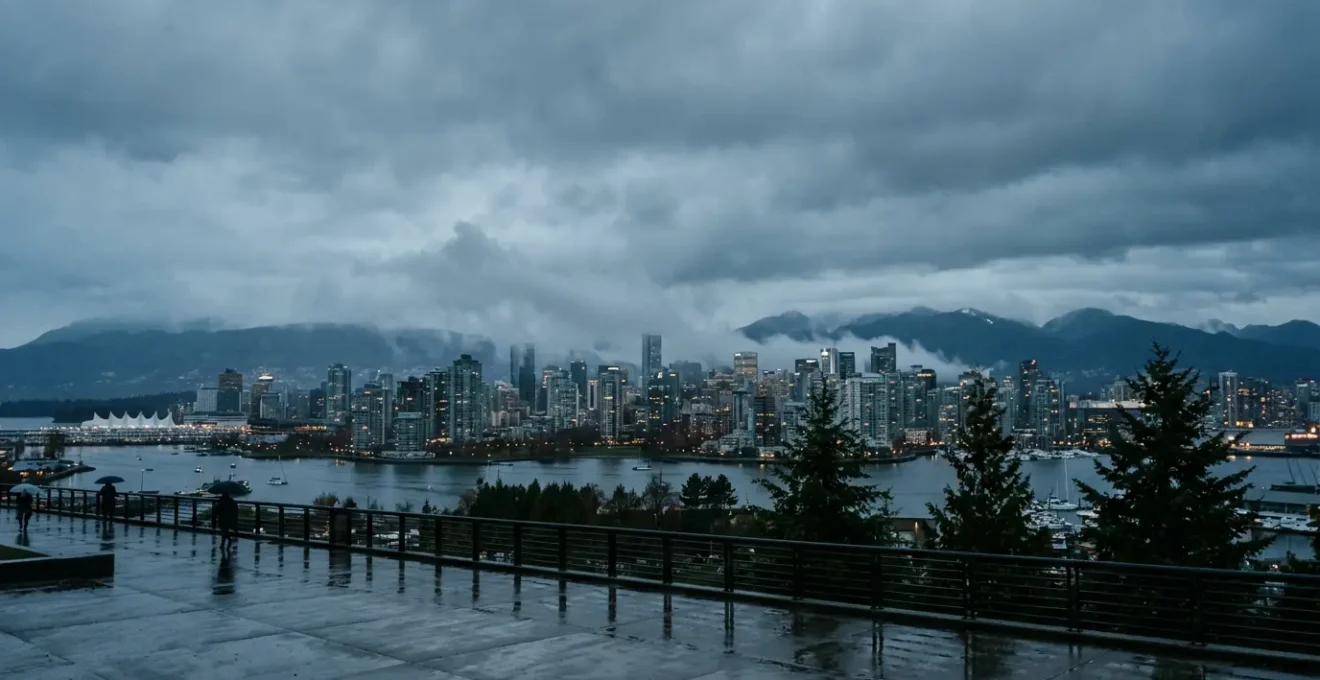
Visiting Vancouver in November isn’t a weather compromise; it’s a calculated financial arbitrage that unlocks the city’s best value.
- Predictable rain drives hotel and flight rates down significantly, a discount far steeper than in other shoulder seasons.
- Zero wildfire risk and fewer crowds create a more relaxed, accessible experience compared to peak summer months.
Recommendation: Treat the weather as an economic factor, not a deterrent. Invest in proper waterproof gear and plan your itinerary to maximize your “experience-per-dollar” ratio.
The common wisdom about visiting Vancouver is to aim for the sun-drenched, glorious days of summer. But for the budget-conscious traveler, this advice is financially flawed. The premium paid for July and August is substantial, not just in cost but in crowds and potential wildfire smoke. Many suggest the shoulder seasons of May or September as a compromise, offering pleasant weather with slightly lower prices. This perspective, however, misses the single greatest financial opportunity on the Vancouver travel calendar.
The key isn’t to avoid the rain; it’s to leverage it. November presents a unique economic proposition. The city’s wettest month creates a predictable downturn in demand that savvy travelers can exploit. This isn’t about enduring a miserable trip; it’s about making a strategic investment. By understanding the market dynamics, accepting the weather as a fixed variable, and planning accordingly, you can unlock access to Vancouver at a fraction of its peak-season cost.
This guide reframes a November visit from a weather-based compromise to a calculated financial decision. We will analyze the data behind the discounts, provide a strategic framework for planning around the rain and early sunsets, and compare the value proposition against other times of the year. Forget chasing the sun; we’re here to harvest the discounts that fall with the rain.
This article provides a complete financial and logistical breakdown for planning a trip to Vancouver. We’ll explore everything from the necessary gear to survive the rain to the best strategies for sightseeing, day trips, and even navigating the infamous Sea-to-Sky Highway traffic.
Summary: A Financial Guide to Visiting Vancouver Off-Peak
- Waterproof vs Water-Resistant: What Jacket Grade Do You Need for November?
- The Wildfire Risk: Should You Cancel Your Trip in August?
- May or September: Which Month Has Better Weather and Fewer Crowds?
- Spring Skiing: Can You Golf and Ski on the Same Day in April?
- The 4 PM Sunset: How to Plan Sightseeing When It Gets Dark Early?
- Squamish or Harrison Hot Springs: Which Day Trip Fits a Rainy Forecast?
- Boxing Day or Black Friday: When Do Boutiques Offer the Deepest Discounts?
- Sea-to-Sky Highway: How to Drive to Whistler Without Getting Stuck in Traffic?
Waterproof vs Water-Resistant: What Jacket Grade Do You Need for November?
The single most important investment for a November trip to Vancouver is not a hotel or a tour, but high-quality outerwear. This is not a matter of comfort, but of trip viability. Understanding the difference between “water-resistant” and “waterproof” is critical when facing Vancouver’s climate. Water-resistant gear will fail. November in Vancouver isn’t a light drizzle; it’s a month characterized by persistent, atmospheric rivers that deliver a significant volume of precipitation. The financial play of saving on flights and hotels is immediately negated if you are too cold and wet to leave your room.
The numbers are clear: the city sees an average of 344 mm (14 inches) of rain over 20 days in November. This requires a jacket with a high waterproof rating (ideally 10,000mm or more) and, just as importantly, sealed or taped seams. Without sealed seams, water will penetrate the stitching, compromising the entire garment. This level of technical gear is the non-negotiable cost of entry to unlock the November discount. Think of it as insurance for your trip; a one-time capital expenditure that guarantees your ability to be outdoors and enjoy the city.
A strategic layering system is the most effective way to manage this environment. It allows you to adapt to changing conditions, from the cold, wet outdoors to the warm, dry indoors of a coffee shop or museum. The goal is to manage both external moisture (rain) and internal moisture (sweat) to stay comfortable and functional. This approach maximizes the value of your time, ensuring the weather doesn’t dictate your plans.
Vancouver Layering System Essentials for November
- Base layer: A moisture-wicking thermal underlayer is essential to pull sweat away from your skin, keeping you dry from the inside.
- Mid layer: A fleece or other insulated layer provides warmth. Choose something that is easy to remove and pack away when you go indoors.
- Outer shell: Your most critical piece. A fully waterproof jacket with a hood and sealed seams is mandatory.
- Footwear: Waterproof boots, not just shoes, are necessary. You will encounter deep puddles and consistently wet pavement.
- Accessories: Waterproof gloves and quick-dry pants are highly recommended for all-day comfort, along with a scarf or neck gaiter.
The Wildfire Risk: Should You Cancel Your Trip in August?
Evaluating November as a travel option requires a risk-adjusted comparison to the peak season. While summer, particularly August, promises warm weather, it carries a significant and unpredictable risk: wildfire smoke. In recent years, late summer in British Columbia has been plagued by wildfires, which can blanket Vancouver in a thick haze, severely impacting air quality and obscuring the city’s famous mountain views. This turns a premium-priced trip into a compromised experience.
The Air Quality Health Index (AQHI) can quickly reach hazardous levels, leading to public health advisories recommending against strenuous outdoor activity. For a traveler, this means that the very things you paid a premium for—hiking, cycling the seawall, enjoying panoramic viewpoints—may be off-limits or unpleasant. The economic calculation is stark: you pay the highest prices of the year for a trip that could be ruined by an external factor beyond your control. This is a high-risk, high-cost investment.
This photograph captures the essence of the threat, showing how atmospheric particulates can degrade the environment, a common occurrence during wildfire season.
Conversely, November offers a zero-percent chance of wildfire smoke. The rainy season completely eliminates this risk. While you trade sunny skies for grey ones, you gain certainty. The views you get, framed by dramatic clouds, will be crisp and clear. From a travel economist’s perspective, November offers a low-risk, low-cost investment profile. You know exactly what you’re getting: a wet but clear environment, perfect for moody photography and enjoying the city’s indoor and outdoor attractions without the threat of a health hazard.
May or September: Which Month Has Better Weather and Fewer Crowds?
For travelers seeking a middle ground, the shoulder months of May and September are often recommended as the “best” time to visit Vancouver. They offer a perceived balance of better-than-winter weather and smaller-than-summer crowds. However, from a purely financial standpoint, they represent a different value proposition than November. They are a compromise, not a strategic arbitrage. A closer look at the data reveals the nuances.
September often emerges as the superior of the two shoulder months. It benefits from the “September Summer” phenomenon, where stable, warm, and sunny weather patterns frequently extend into the month, while crowds drop significantly after Labour Day. May can still be unpredictable, with lingering “April showers” and more variable temperatures. The experience-per-dollar ratio in September is high, but the discount compared to summer is moderate, not drastic.
This is reinforced by local sentiment, as one Vancouver resident noted in a travel forum. As a local expert on the TripAdvisor Vancouver Forum discussion stated, “September has that lovely golden light that enhance picture-taking. The sun is warm, but the air temperature a little cool, particularly at night.” This qualitative benefit is real, but it comes at a price that is still significantly higher than November’s rock-bottom rates.
The following table, based on an analysis of Vancouver’s seasonal weather, breaks down the key differences between these two popular shoulder months.
| Weather Factor | May | September |
|---|---|---|
| Average High Temperature | 63°F (17°C) | 66°F (19°C) |
| Average Rainfall | 104-120 mm | Moderate, lower than May |
| Weather Pattern | Variable ‘April showers’ remnants | Stable ‘September Summer’ phenomenon |
| Natural Highlights | Cherry blossom end, vibrant green parks | Golden hour light, fall foliage, salmon run begins |
| Crowd Level | Moderate, pre-cruise season | Lower after Labour Day weekend |
| Major Events | BMO Vancouver Marathon | Vancouver International Film Festival (VIFF) |
While September offers an excellent travel experience, it does not offer the profound budget advantage of November. The choice depends on your primary goal: if you want a near-summer experience with a small discount, choose September. If you want the maximum possible savings and are willing to invest in the right gear, November remains the superior financial choice.
Spring Skiing: Can You Golf and Ski on the Same Day in April?
To fully grasp November’s unique financial position, it’s useful to compare it to another niche season: spring. April in Vancouver offers a one-of-a-kind recreational opportunity known as the “Vancouver Double”—the ability to ski in the mountains in the morning and golf in the city in the afternoon. This highlights how different months provide different types of value. April’s value is experiential; November’s is financial.
The feasibility of the Vancouver Double is not a myth. Local mountains like Cypress are strategically positioned to make it possible.
Case Study: Cypress Mountain’s Spring Operations
Cypress Mountain, just 30 minutes from downtown, typically extends its ski season into early April. The resort adapts its hours for spring conditions, opening its main Eagle Express chairlift at 9 a.m. to capture the best morning snow. This schedule is explicitly designed to allow skiers to enjoy the slopes when temperatures are cool and then head down to the city for afternoon activities like golf as the snow becomes slushy. This logistical planning makes the “Vancouver Double” a real and achievable goal for visitors in April.
Achieving this unique feat requires precise logistical planning. It’s an activity for a traveler who values novelty and is willing to coordinate a tight schedule. The experience is memorable, but it comes with its own set of conditions, namely dealing with “hero snow”—the wet, heavy slush common in spring—rather than mid-winter powder.
Action Plan: Executing the Ski-and-Golf “Vancouver Double”
- Timing is Everything: Be at Cypress Mountain for the 9 a.m. opening of the Eagle Express chair. Plan to finish skiing by 1 p.m. to allow ample time for travel and your golf tee time.
- Equipment Strategy: Rent ski gear on the mountain to avoid hauling it. Keep your golf clubs in your rental car, or rent them at a course like the Stanley Park Pitch & Putt, which is only a 30-40 minute drive from Cypress.
- Dual-Weather Check: Before committing, verify both the snow report on the mountain and the weather forecast in the city. Spring conditions can change rapidly in both locations.
- Set Expectations: Be prepared for spring skiing conditions. The snow will be wet and slushy, not powder. Dress in layers you can shed easily for your warmer afternoon on the golf course.
- Course Booking: Book a late afternoon tee time (around 3 p.m.) to give yourself a comfortable buffer for travel, changing, and grabbing a quick lunch.
April offers a unique activity-based value. November, in contrast, offers a powerful, straightforward financial value. There is no complex logistical puzzle to solve, only a simple equation: rain equals massive savings. For the pure budget-opportunist, the choice is clear.
The 4 PM Sunset: How to Plan Sightseeing When It Gets Dark Early?
The second major variable of a November trip, after the rain, is the limited daylight. With the sun setting early, planning your itinerary becomes an exercise in managing a scarce resource: what we’ll call “Daylight Capital.” Acknowledging this constraint is the first step toward building a highly efficient, high-value travel plan. Data shows the challenge is real, with the sun setting around 4:20 PM for much of the month.
Wasting daylight on inefficient travel or poorly timed activities is the biggest potential pitfall. A strategic itinerary must front-load all light-dependent activities. This means prioritizing things like visiting Stanley Park, walking the Seawall, or taking in the views from Grouse Mountain or Queen Elizabeth Park in the morning and early afternoon. Any activity that relies on natural light and panoramic views must be completed by approximately 3:30 PM.
The early sunset, however, is not just a limitation; it creates its own unique opportunities. The period from 4:00 PM to 5:00 PM is the “blue hour,” a magical time for photography, where the city lights begin to glow against a deep blue twilight sky. This is the perfect time to be positioned at a key vantage point, like the Cambie Bridge or on a False Creek ferry, to capture stunning images of the city’s skyline. As darkness falls, the itinerary pivots to experiences that are enhanced by the night: exploring the historic, lamp-lit streets of Gastown, finding a cozy pub with a fireplace, or visiting the Vancouver Art Gallery.
Here is a strategic framework for allocating your Daylight Capital:
- Morning & Early Afternoon (9:00 AM – 3:30 PM): Dedicate this prime time to your highest-priority outdoor activities. This is when you hike, bike, and visit viewpoints.
- Transition Period (3:30 PM – 4:00 PM): Shift from outdoor locations to indoor ones. This is the time to head to Granville Island for its indoor market or to a museum.
- Blue Hour (4:00 PM – 4:45 PM): Be in position for photography. Capture the transition from day to night from a scenic overlook or a downtown bridge.
- Evening (After 5:00 PM): Embrace the darkness. Focus on attractions that come alive at night, such as Gastown’s historic district, live music venues, or, in late November, the first of the season’s holiday light displays at Canada Place.
Squamish or Harrison Hot Springs: Which Day Trip Fits a Rainy Forecast?
A rainy forecast in Vancouver doesn’t mean being confined to the city. It means making a strategic choice for your day trip. Your decision should be guided by a simple philosophy: do you want to embrace the rain or escape it? Two excellent day trips, Squamish and Harrison Hot Springs, offer perfect examples of each approach. The “best” choice depends entirely on the experience you’re seeking, and a rainy day can actually enhance one of these options.
Squamish, located along the stunning Sea-to-Sky Highway, is a destination for those who want to embrace the moody, atmospheric beauty of the Pacific Northwest. The rain and low-hanging clouds add a dramatic, mystical quality to the towering granite cliffs and lush rainforests. Activities here are well-suited to wet weather, from the largely underground Britannia Mine Museum to the culturally rich Squamish Lil’wat Cultural Centre. A post-exploration visit to a local craft brewery like Howe Sound Brewing feels even cozier on a rainy day.
Harrison Hot Springs, on the other hand, is the quintessential escape. The entire purpose of this trip is to find literal warmth and shelter from the cold and rain. The main attraction is the public hot springs pool, where you can soak in geothermally heated mineral water while the rain falls around you. It’s an experience built around relaxation and comfort, making it an ideal sanctuary for a cold November day.
The following comparison, informed by insights from travel guides like an itinerary for a November Vancouver trip, highlights the strategic trade-offs.
| Comparison Factor | Squamish (Embrace the Rain) | Harrison Hot Springs (Escape the Rain) |
|---|---|---|
| Primary Attraction | Moody Pacific Northwest atmosphere, storm watching | Thermal hot springs – literal warmth escape |
| Indoor/Covered Activities | Britannia Mine Museum (largely underground), Squamish Lil’wat Cultural Centre, Howe Sound Brewing | Hot springs pools, small-town cafes, Sasquatch Museum |
| Drive Conditions | Sea-to-Sky Highway – stunning but requires careful driving in rain | Fraser Valley route – flatter terrain but can be foggy |
| Distance from Vancouver | ~65 km (1 hour) | ~130 km (1.5-2 hours) |
| Best For | Adventure seekers, brewery enthusiasts, cultural experiences | Relaxation seekers, families, those wanting warmth |
Choosing between them is a weather-hedging strategy. If you’re equipped with the right gear and attitude, Squamish offers a more profound, region-specific experience *because* of the rain. If your goal is pure comfort and escape, Harrison offers a guaranteed respite. Both are excellent uses of a November day.
Key Takeaways
- November’s value is financial arbitrage; predictable rain creates steep discounts on hotels and flights.
- Investing in high-grade waterproof gear (not water-resistant) is non-negotiable to make the trip viable.
- A November trip has zero wildfire smoke risk, offering certainty over the unpredictable, high-cost summer season.
Boxing Day or Black Friday: When Do Boutiques Offer the Deepest Discounts?
For the traveler whose itinerary includes shopping, a November visit offers a significant financial advantage: Black Friday. While Canada is famous for its Boxing Day sales on December 26th, the American tradition of Black Friday has become a major retail event in Vancouver. Timing your trip to include the fourth Friday in November allows you to engage in “discount harvesting” at the start of the holiday season, rather than at the end.
From a strategic perspective, Black Friday is often superior for a visitor. Boxing Day is known for deep, final-clearance discounts, but it also features massive crowds of locals returning gift cards and a more frantic, picked-over atmosphere. Product selection can be limited. Black Friday, in contrast, marks the *kick-off* of the holiday shopping season. Retailers use it to drive traffic with significant, but often store-wide, discounts on new, in-season inventory. For a traveler seeking specific items or a more pleasant shopping experience in Vancouver’s charming boutiques in areas like Gastown or Kitsilano, Black Friday is the more opportune moment.
The ambiance of late November shopping is one of festive anticipation, a stark contrast to the post-holiday rush of Boxing Day. The city’s stores are beautifully decorated, creating a magical atmosphere for browsing.
The economic choice is clear. A tourist is unlikely to return for Boxing Day, making it an irrelevant data point. A trip in late November, however, allows you to stack discounts: you’ve already saved significantly on your travel costs, and now you can access one of the year’s biggest retail sales events. This further enhances the overall experience-per-dollar ratio of your trip, turning a simple vacation into a highly efficient and financially savvy venture.
Sea-to-Sky Highway: How to Drive to Whistler Without Getting Stuck in Traffic?
A day trip to Whistler is a classic Vancouver experience, but the journey itself—via the Sea-to-Sky Highway (Highway 99)—is a major logistical hurdle, especially for visitors. Getting this part of the plan wrong can lead to hours wasted in traffic, negating the value of the trip. From a travel economist’s perspective, time is a valuable asset, and managing the risk of traffic congestion is paramount.
The primary challenge is the mass exodus from the city on Friday evenings and Saturday mornings, and the subsequent mass return on Sunday afternoons. Driving during these peak windows is a guaranteed way to find yourself in a stressful, slow-moving crawl. The key to a successful drive is a counter-cyclical approach: travel when everyone else is not. For a November trip, this is compounded by a crucial legal requirement: all vehicles on the Sea-to-Sky Highway must be equipped with winter tires (displaying the M+S or three-peaked mountain snowflake symbol) from October 1st to March 31st. This is a non-negotiable safety and legal mandate.
Sea-to-Sky Highway Traffic Avoidance Strategy
- Weekend Departure from Vancouver: Leave before 6:30 AM to get ahead of the main rush, or wait until after 10:00 AM once the initial peak has subsided.
- Weekend Return from Whistler: To avoid the notorious Sunday afternoon gridlock, plan to depart Whistler either before 2:00 PM or after 7:00 PM.
- Verify Your Rental: If renting a car, you MUST confirm with the agency that it is equipped with compliant winter tires. Do not assume this is standard.
For many visitors, the stress and liability of winter driving and traffic are risks not worth taking. A financially and logistically sound alternative is to offload this risk entirely by using a shuttle service.
Case Study: The Public Transit Alternative
For tourists anxious about winter driving conditions, services like the YVR Skylynx and Epic Rides offer a reliable and stress-free alternative. These companies run express shuttles from various points in Vancouver, including the airport and downtown, directly to Whistler Village. The cost of a shuttle ticket is often comparable to or less than a single day’s car rental plus gas. More importantly, it eliminates all concerns about winter tire compliance, navigating potentially challenging road conditions, finding parking in Whistler, and, most critically, sitting in traffic. You can simply relax and enjoy the spectacular mountain scenery.
Ultimately, a November trip to Vancouver is a masterclass in strategic travel. By embracing the city’s predictable “flaws”—the rain and the early sunset—you unlock an economic advantage unavailable at any other time of year. Evaluate your travel goals, invest in the right gear, and build a plan that treats your time and money as the valuable assets they are.