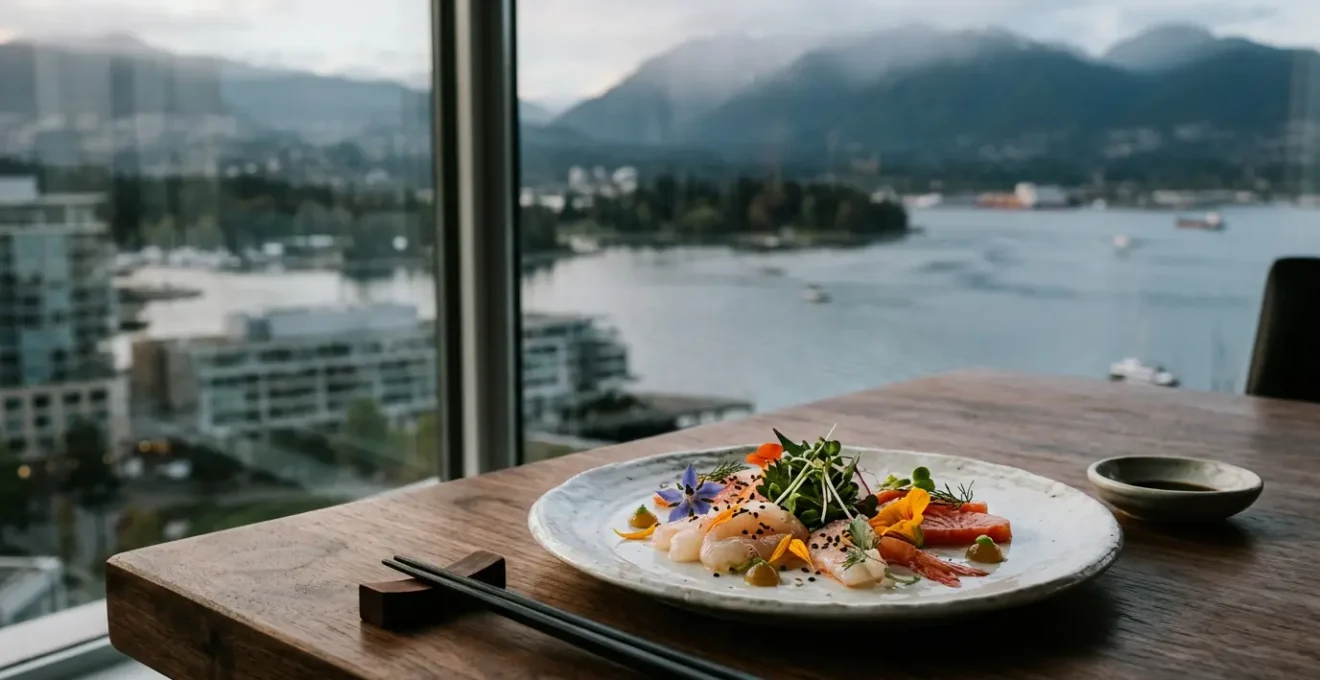
For a special occasion in Vancouver, a $200 tasting menu’s value lies not in the food alone, but in its calculated return on experience, especially for American visitors.
- The final bill for a tasting menu experience is often 30-40% higher than the menu price after tax and gratuity.
- The strong US dollar creates a “culinary arbitrage” situation, making Vancouver’s luxury dining 20-25% more affordable than comparable US cities.
Recommendation: Shift your mindset from “cost per plate” to “investment per memory.” Choose omakase for culinary theatre and prix fixe for curated consistency, but always factor in the total experiential value.
The question looms over your anniversary plans: a meticulously choreographed French prix fixe or the spontaneous artistry of a Japanese omakase? In a city like Vancouver, where culinary ambition is a point of pride, the $200-per-person tasting menu has become a celebratory benchmark. For a couple seeking a truly memorable evening, the dilemma isn’t just about food preference; it’s about value. It’s easy to get lost in generic advice about “quality ingredients” or the “unique experience.” Most will tell you it’s worth it if you can afford it, a platitude that offers no real guidance.
But what if the true worth of such a splurge isn’t on the plate, but in the calculus of the entire evening? The real value is a blend of performance, pacing, and even favourable economics. This is not a simple transaction for a meal. It’s an investment in a three-hour, multi-sensory performance. The key is to move beyond the sticker price and deconstruct its hidden components: the service choreography, the theatricality of the chef’s counter, and the significant financial advantage Vancouver offers, particularly to American visitors. This is the concept of culinary arbitrage—achieving a world-class experience at a fraction of the cost you’d find in other global hubs.
This guide will equip you with a discerning critic’s framework. We’ll dissect every component of the high-end tasting menu, from the beverage pairing to the unspoken rules of dress code. By the end, you won’t just have an answer to whether it’s “worth it”; you will have a clear understanding of how to calculate its true value for your unique celebration, ensuring your investment yields an exceptional Return on Experience (ROX).
To help you navigate this decision, we’ve structured this analysis to cover every angle of the luxury dining experience in Vancouver. The following sections will provide a detailed breakdown of costs, customs, and strategies to maximize the value of your special night out.
Summary: Deconstructing the Value of a Vancouver Tasting Menu
- The Pairing Upgrade: Should You Add the $100 Beverage Pairing?
- The Chef’s Table: How to Request the Best Seat at Tojo’s?
- The “No Onion” Request: Can You Modify a Tasting Menu?
- Jacket Required: Do Vancouver Fine Dining Spots Enforce Dress Codes?
- The 3-Hour Dinner: How to Pace Yourself Through 12 Courses?
- Dine Out Vancouver: Is the $40 Menu Actually a Deal?
- Strong US Dollar: Is Buying Luxury Goods Cheaper in Vancouver for Americans?
- Alberni Street: Why Is This “Mini-Rodeo Drive” Vancouver’s Luxury Hub?
The Pairing Upgrade: Should You Add the $100 Beverage Pairing?
The first upsell you’ll encounter is the beverage pairing, often presented as an integral part of the chef’s vision. A $100 price tag seems steep, but its purpose is to elevate each course, creating synergistic flavour moments you couldn’t replicate by ordering a single bottle. However, the sticker price is just the starting point. To assess its true value, you must calculate the all-in cost, a crucial step for any discerning diner. This means factoring in Vancouver’s local taxes and the standard gratuity expected for high-end service.
For an American couple, this calculation has an additional, favourable layer: the exchange rate. What appears as a significant splurge in Canadian dollars often translates into a surprisingly reasonable figure in US currency. It’s the first hint of the culinary arbitrage at play. Understanding this true, final cost is essential to deciding whether the curated journey offered by the sommelier is a worthy enhancement to your anniversary dinner or an unnecessary expense. Here is a step-by-step breakdown to reveal the actual price you’ll pay.
- Base Pairing Price: $100 CAD
- Add BC Taxes: Factor in the combined 12% PST and GST, bringing the total to $112 CAD.
- Add Standard Gratuity: A tip of 18-20% on the post-tax total is standard for this level of service, resulting in a final cost of approximately $132-$134 CAD.
- Convert for US Visitors: At a typical exchange rate of ~0.73, the all-in cost translates to roughly $97-$98 USD, a figure that lands much closer to the original menu price.
This calculation demonstrates that while the initial price is augmented by local costs, the currency conversion provides a significant buffer for American visitors, making the curated pairing a more compelling value proposition than it first appears.
The Chef’s Table: How to Request the Best Seat at Tojo’s?
For an omakase experience, not all seats are created equal. The ultimate value lies at the sushi counter, often called the “chef’s table.” This is not just about proximity to the food’s source; it’s about securing a front-row seat to a culinary performance. You are paying for the theatrics of the counter, the direct interaction with a master artisan, and the narrative that unfolds as each piece is crafted before your eyes. At a legendary establishment like Tojo’s Restaurant in Vancouver, this premium experience is quantified.
This paragraph introduces the concept of the chef’s table. For a better understanding, the image below captures the intimacy and artistry involved in such an experience.
As the image suggests, this vantage point transforms a meal into an immersive event. The difference in price between a standard table and a seat at the bar is your ticket to this performance. It’s a tangible upgrade in your Return on Experience. Securing these coveted seats, however, requires more than a simple online reservation. It demands a direct, personal approach, signaling to the restaurant that you understand and value the unique experience they offer.
Case Study: Tojo’s Sushi Bar Premium Experience
At Tojo’s Restaurant, the value of proximity is clear. The standard omakase experience is priced at $220 per person. However, the exclusive sushi bar seats, where Chef Tojo prepares dishes directly for guests, command a premium price of $330 per person. This $110 difference buys an unparalleled experience: direct interaction with the legendary chef and an immersive culinary theater. Availability is extremely limited, and booking these specific seats requires advance planning and a credit card guarantee, underscoring their exclusivity and high demand.
To request the best seats, call the restaurant directly well in advance. State your occasion—the anniversary—and explicitly express your desire for a seat at the sushi counter to “enjoy the chef’s artistry.” This language demonstrates you’re an informed diner, not just looking for any table. Be prepared to be flexible with dates and provide a credit card to secure the booking, as this is standard practice for high-demand experiences.
The “No Onion” Request: Can You Modify a Tasting Menu?
A tasting menu, especially an omakase, is presented as a complete, unalterable work of art. The chef has painstakingly designed a narrative arc of flavours and textures. This purist philosophy is often at odds with the practical needs of diners, from serious medical allergies to simple, strong preferences. The question of modifications is therefore a delicate one. As the team at Tojo’s famously advises, the ideal approach is one of total surrender.
Leave your expectations at the door and put yourself in Chef Tojo’s hands. There are surprises in store.
– Tojo’s Restaurant Official, Tojo’s Restaurant Vancouver Official Website
This sentiment captures the essence of omakase: trust. However, fine dining establishments are also businesses rooted in hospitality. While they may not entertain requests to swap a dish due to preference (“I don’t like mushrooms”), they take life-threatening allergies very seriously. The key is communication, and it must happen long before you arrive. A last-minute “no onion” request for a menu built around alliums is unlikely to be accommodated. A clear, professional, and timely inquiry is your only tool for navigating this. You must distinguish between a dietary preference, which you should be prepared to set aside, and a genuine medical necessity, which the restaurant needs to know about to ensure your safety.
Your Action Plan: Verifying Dietary Accommodations
- Points of Contact: Call the restaurant directly. Identify yourself and your reservation details before raising the issue of restrictions. Email is a less effective channel for nuanced conversations.
- Information Gathering: Clearly state the nature of the restriction. It is critical to distinguish between a medical allergy (e.g., celiac disease, shellfish) and a dietary preference (e.g., vegetarian, no raw fish).
- Coherence Check: Ask respectfully: “Given the nature of your tasting menu, I wanted to inquire if the kitchen is able to accommodate a [specific medical allergy] with advance notice?” This shows you respect their format.
- Ensuring a Smooth Experience: If they can accommodate the request, ask for the required notice period. “Is 48 hours sufficient notice for the kitchen to prepare?” This frames the request as a desire to help them plan.
- Creating a Plan: Conclude the call by noting the name of the staff member you spoke with and confirming the details of the accommodation in your reservation notes. This creates a clear record and prevents miscommunication.
Ultimately, a prix fixe menu from a French or contemporary restaurant often offers more flexibility for modifications than a traditional Japanese omakase. If you or your partner have significant dietary restrictions, this factor could be decisive in your choice.
Jacket Required: Do Vancouver Fine Dining Spots Enforce Dress Codes?
Nothing dampens a celebratory mood faster than feeling out of place. The question of what to wear is a practical one, yet it speaks to the culture of a city’s dining scene. Unlike New York or London with their more rigid traditions, Vancouver’s luxury aesthetic is deeply influenced by its “West Coast casual” ethos. You will rarely find a “jacket required” policy strictly enforced. Instead, the expectation is one of casual elegance and personal style. For men, a blazer or sport coat is always appropriate but seldom mandatory; for women, a stylish dress or sophisticated separates fit the bill perfectly.
The unwritten rule is to show respect for the establishment, the chef, and the occasion. While you can likely get away with less, dressing with intention enhances your own experience and contributes to the restaurant’s ambiance. According to restaurant industry analysis in Vancouver, a standard of smart-casual to business-casual is the norm. This means avoiding items like baseball caps, athletic wear, and torn denim. The goal is to look polished and put-together, not necessarily formal.
To provide a concrete guide for your anniversary dinner, the following table compares the official (and unofficial) dress codes at several notable Vancouver fine dining restaurants. This illustrates the spectrum from relaxed to more traditional expectations.
As detailed in a comparative guide from Destination Vancouver, the city’s approach to dress codes is nuanced, prioritizing style over strict formality.
| Restaurant | Official Dress Code | Discouraged Items | Enforcement Level |
|---|---|---|---|
| Acquafarina | Business Casual | Baseball caps, torn denim, running shoes, flip-flops | Moderate (Requested) |
| Five Sails | Smart Casual / Jacket Preferred | Jeans, t-shirts, athletic wear | High (Traditional) |
| Burdock & Co | No Official Code | None specified | Relaxed (Casual-chic welcome) |
| Kissa Tanto | Casual-Elegant | Overly casual sportswear | Low (Style encouraged, not enforced) |
For your anniversary, erring on the side of “smart casual” is the safest and most respectful approach. It ensures you will feel comfortable and appropriate in any of Vancouver’s top-tier establishments, allowing you to focus entirely on the celebration.
The 3-Hour Dinner: How to Pace Yourself Through 12 Courses?
A multi-course tasting menu is a marathon, not a sprint. The experience is designed to last two to three hours, a deliberate “service choreography” that unfolds with theatrical timing. The most common mistake diners make is succumbing to the first act: the bread service. That basket of warm, artisanal sourdough with house-cultured butter is a delicious trap, designed to occupy you while the kitchen prepares your opening courses. Overindulging here is the fastest way to encounter palate fatigue before the main events even arrive.
This image of a perfect bread service represents the first test of a diner’s discipline during a long tasting menu.
Pacing is an active skill. It involves more than just restraint; it requires engaging with the service team as partners in your experience. A professional sommelier or front-of-house manager’s role extends beyond pouring wine and describing dishes. They are experts in gauging guest energy and adjusting the tempo of the meal. Using them as a ‘pacing partner’ is a pro-move that transforms your experience from a passive reception of plates to an interactive, comfortable journey. Don’t be afraid to signal that you need a moment between courses. It’s a sign of an engaged diner, not a complaint.
To maintain your energy and appetite throughout a lengthy and rich meal, consider a more strategic approach to the beverage service as well. Here are several sommelier-approved tactics for managing a long tasting menu:
- Request Half-Pours: Asking for smaller pours for your wine pairings is a common and accepted practice. It reduces overall alcohol consumption, keeping your palate sharp and preventing fatigue over a 2-3 hour period.
- Introduce Water Breaks: Actively ask the sommelier to build in water breaks, especially after particularly rich dishes or more robust wine pairings. This cleanses the palate and aids digestion.
- Signal for Slower Pacing: If you feel rushed, a simple, polite “We’d love to take a few extra moments to savour this” is all that’s needed. The sommelier can communicate with the kitchen to extend the interval before the next course.
- Alternate Sake and Wine: If both are offered, ask to alternate between them rather than doubling up. This provides variety and helps manage the cumulative effect of the alcohol.
- Lean on Their Expertise: Explicitly tell your sommelier at the beginning, “We’re excited for the journey and would love your help in pacing ourselves.” This invites them to be your partner for the evening.
Dine Out Vancouver: Is the $40 Menu Actually a Deal?
Every winter, the Dine Out Vancouver Festival transforms the city’s culinary landscape, offering prix fixe menus at accessible price points. For a couple debating a splurge, it can seem like the perfect solution: a chance to sample a high-end restaurant without committing to the full tasting menu price. During the 2024 Dine Out Vancouver Festival, 289 restaurants participated, offering menus from a modest $20 to a more substantial $65. The question is whether these deals represent true value or a compromised, “lite” version of the restaurant’s potential.
The answer is nuanced. For top-tier establishments, a Dine Out menu is often a strategic “scouting mission” for diners. It’s an opportunity to experience the ambiance, service level, and a curated sample of the chef’s style at a lower entry point. For example, the Dine Out menu at Monarca Cocina Mexicana provided a moderate discount on signature dishes, effectively acting as an enticing preview for a future, full-priced visit. However, these menus are often created with cost-effectiveness in mind, potentially featuring less premium ingredients or smaller portions than their à la carte counterparts.
The real value of Dine Out lies in identifying the sweet spots—restaurants that use the festival to showcase their full capabilities. To determine if a specific menu is a genuine deal, a bit of pre-festival research is necessary. The following table provides a value analysis from a recent Dine Out festival, showing how savings can vary dramatically.
An analysis of past Dine Out offerings reveals where the most significant value can be found, often in upscale venues where the entry price is substantially reduced.
| Restaurant | Dine Out 3-Course Price | Estimated À La Carte Equivalent | Savings | Hidden Considerations |
|---|---|---|---|---|
| Maenam (Dinner) | $65 | $75-85 | ~$10-20 | Family-style format, 18 options |
| Arike | $65 | $90-110 | ~$25-45 | 6-course tasting (exceptional value) |
| Boulevard Kitchen | $65 (+$5 wagyu upgrade) | $85-100 | ~$20-35 | Upscale venue access at lower entry price |
| Nuba (Kits) | $38 | $45-55 | ~$7-17 | Good intro, but regular menu more flexible |
For an anniversary celebration, Dine Out can be a savvy choice if you select a restaurant known for offering exceptional value, like Arike’s 6-course tasting. However, for a truly uncompromised, peak experience, the restaurant’s regular tasting menu, created without festival constraints, remains the superior option.
Key Takeaways
- The true cost of a tasting menu experience in Vancouver is the menu price plus ~30-40% for tax and gratuity.
- The value of an omakase is tied to the “culinary theatre” of the chef’s counter, which often commands a quantifiable price premium.
- For American visitors, the strong USD creates a “culinary arbitrage,” making Vancouver’s luxury dining significantly more affordable than in comparable US cities.
Strong US Dollar: Is Buying Luxury Goods Cheaper in Vancouver for Americans?
This is where the value proposition for an American couple celebrating in Vancouver becomes undeniable. The concept of “culinary arbitrage” moves from theoretical to tangible. Due to the consistently strong US dollar relative to the Canadian dollar, every price tag in Vancouver comes with an automatic, built-in discount of 25-30%. This applies not just to dining, but to all luxury goods and experiences. While a $200 CAD tasting menu might sound comparable to a $200 USD menu in Seattle or San Francisco, the reality is vastly different.
The key is to perform a full “all-in” cost calculation, converting the final Canadian dollar price—including all taxes and tip—into US dollars. In British Columbia, you must account for the 12% combined PST+GST on most purchases, and a standard gratuity of 18-20% is expected in fine dining. Even with these additions, the final USD cost is often substantially lower than a comparable experience south of the border. This financial advantage is the single most compelling argument for a US-based couple to choose Vancouver for a celebratory splurge.
Let’s walk through the real-world math for a typical high-end dinner for two:
- Base Menu Cost: A $200 CAD tasting menu at an approximate 0.73 exchange rate starts at just $146 USD.
- Factor in Taxes: Add the 12% BC tax (PST+GST) to the CAD price, which equals $224 CAD, or about $163.52 USD.
- Include Gratuity: A 19% tip on the total CAD amount brings the final bill to ~$266.50 CAD. This converts to an all-in cost of approximately $195 USD.
- US Comparison: An equivalent $200 USD menu in a major US city would typically cost $240-$250 USD after tax and a similar tip.
- Net Savings: The final calculation reveals a net savings of approximately 20-25% for Americans dining at the high end in Vancouver versus a comparable US city.
This isn’t a minor discount; it’s a fundamental value shift. It means you can afford a higher tier of restaurant, add the wine pairing without hesitation, or simply enjoy the fact that your top-tier anniversary dinner costs significantly less than it would at home.
Alberni Street: Why Is This “Mini-Rodeo Drive” Vancouver’s Luxury Hub?
Your anniversary dinner doesn’t happen in a vacuum. It’s framed by the city’s atmosphere, and in Vancouver, the heart of that luxury atmosphere is Alberni Street. Dubbed the city’s “mini-Rodeo Drive,” this corridor is more than just a collection of high-end retailers like Tiffany & Co., Rolex, and Hermès. It is the center of an entire luxury ecosystem that includes five-star hotels, flagship automotive showrooms, and, crucially, some of the city’s most acclaimed fine dining restaurants. This concentration creates a powerful sense of occasion before you even step through the restaurant door.
The ambiance of this district is one of sophisticated, contemporary Pacific Rim luxury, reflecting the architectural and natural beauty of the city.
Choosing a restaurant on or near Alberni Street means you are participating in this concentrated world of aspirational living. A pre-dinner stroll past glowing shop windows or a post-dinner cocktail at a chic hotel bar becomes part of the evening’s narrative. This context elevates the meal itself, embedding it within a larger story of celebration and indulgence. It contributes to the Return on Experience, making the memory more vivid and complete. The convenience of having world-class dining, accommodation, and shopping in one walkable, elegant neighborhood is a significant part of Vancouver’s appeal as a luxury destination.
This geographic anchor is what solidifies the value proposition. You aren’t just paying for a meal; you’re buying into an immersive environment tailor-made for special occasions. The synergy between the high-end restaurants and the surrounding luxury infrastructure makes the entire experience feel more cohesive and special, justifying the splurge in a way a standalone restaurant in a less distinguished location cannot.
Ultimately, whether you choose the curated narrative of a prix fixe or the spontaneous performance of an omakase, the decision rests on how you define value. By moving beyond the menu price to calculate the true all-in cost, leveraging the powerful culinary arbitrage offered by the US dollar, and embracing the entire environmental experience, you can ensure your anniversary splurge in Vancouver is not just a meal, but a sound investment in a priceless memory. To apply these principles effectively, the next logical step is to research and select a restaurant that aligns perfectly with your desired experience and budget.