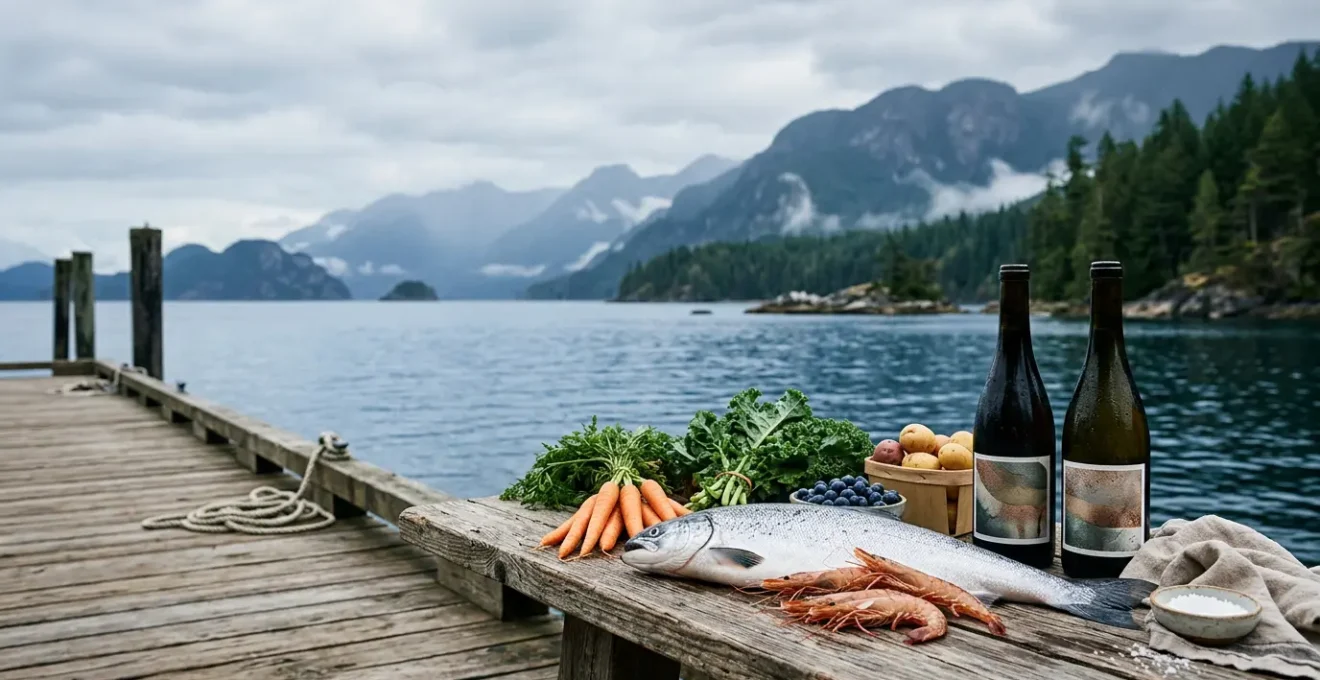
The superior taste of British Columbia’s food isn’t just about ‘freshness’; it’s a direct expression of the province’s unique and often challenging micro-terroirs.
- Ephemeral seasons, like the six-week spot prawn harvest, concentrate both flavour and value.
- Climatic stress, from Okanagan cold snaps to wildfire smoke, forges unparalleled character in ingredients like wine grapes.
- A specific geography, whether a coastal island or a forested valley, imprints a unique taste signature on everything from cheese to mushrooms.
Recommendation: To truly taste BC, look for the story and the place behind each ingredient, from the Ocean Wise symbol on seafood to the specific valley a wine comes from.
As a chef in Vancouver, I see the term “local” on every menu, often attached to a price tag that gives diners pause. A simple tomato salad for $24? A glass of wine from a vineyard just a few hours’ drive away that costs more than an import? The common explanation is that it’s “fresh,” but that word falls short. It doesn’t capture the essence of what makes a Fraser Valley duck or an Okanagan peach taste not just fresh, but profoundly, irreplaceably *better*.
The real answer isn’t a simple marketing term. It’s a complex and beautiful story written in the soil, the water, and the very air of this province. It’s the story of micro-terroir—the idea that a specific place, with its unique climate and geology, imparts a flavour signature you can’t replicate anywhere else. The secret isn’t just in the freshness; it’s in the struggle. It’s in the climatic tension, the short and intense seasons, and the deep connection between the ingredient and its environment.
This guide isn’t just a list of ingredients. It’s a journey into the heart of British Columbia’s flavour. We’ll explore why that six-week spot prawn season is so magical, how a Nanaimo Bar became a cultural icon, and what makes a wild-foraged mushroom a treasure. We will uncover the geographic signature that makes our food taste like nowhere else on Earth.
This article explores the distinct flavours shaped by British Columbia’s unique geography, providing a roadmap for the discerning diner. The following summary outlines the key ingredients and concepts we will delve into.
Summary: A Chef’s Tour of British Columbia’s Essential Flavours
- The 6-Week Window: When Can You Eat Live Spot Prawns in Vancouver?
- Merlot or Pinot Noir: Which Red Wine Is the Okanagan Famous For?
- Chanterelle vs Pine Mushroom: What to Look for at Fall Farmers Markets?
- The 3 Layers: What Makes a Nanaimo Bar “Authentic” BC Style?
- Salt Spring Island Cheese: Where to Buy It Without Taking a Ferry?
- Why Does a Tomato Salad Cost $24 in August?
- Ocean Wise Symbol: Why You Should Look for It on Every Menu?
- Farm to Table in Winter: How Do Vancouver Restaurants Source Local Ingredients in January?
The 6-Week Window: When Can You Eat Live Spot Prawns in Vancouver?
Every May, a palpable excitement ripples through Vancouver’s food scene. It’s the beginning of the spot prawn season, an intense, six-week-long celebration of one of the world’s finest seafoods. This short window is the very definition of ephemeral bounty. The prawns’ firm, sweet, and clean flavour is a direct result of the cold, clear Pacific waters they inhabit. Their taste is a pure expression of our coastline.
But their exquisite flavour is also a function of their rarity. The season is brief, and the demand is global. In fact, it’s a little-known secret that locals are competing with a massive international market; over 90% of BC’s commercial spot prawn catch is traditionally destined for Japan and other parts of Asia, where their quality is revered. This intense demand is why you’ll see crowds lining up at Fisherman’s Wharf, ready to pay a premium to get them straight off the boat.
This is not just a commercial product; it’s a cultural event and a significant economic driver. The fishery represents a massive industry, bringing immense value to the province’s economy. This value underscores the need for sustainable management to protect the very resource that makes this seasonal ritual possible, ensuring future generations can taste this unique marine jewel.
Merlot or Pinot Noir: Which Red Wine Is the Okanagan Famous For?
The Okanagan Valley is a paradox. It’s a sun-drenched, desert-like region carved into the mountains, a place that shouldn’t, by all rights, produce world-class wine. Yet it does. While many varietals thrive, Merlot has historically been the king of reds here, producing bold, fruit-forward wines. However, the true story of Okanagan wine is one of climatic tension—the constant battle against nature that forges incredible character in the grapes.
This tension is not just poetic; it’s a harsh reality. Winemakers face extreme heat, wildfire smoke, and sudden, devastating cold. The impact of these events can be catastrophic, as seen when a brutal cold snap in January 2024 wiped out close to 98% of the grape harvest in the valley. Events like these, while heartbreaking for producers, mean the surviving grapes from other vintages have a story of resilience. The vines that endure these extremes often yield fruit with more concentrated flavours and complexity.
This struggle is also tasted in another way. As local climate scientists have pointed out, the terroir is now influenced by the pervasive threat of wildfires.
As climate change continues to intensify wildfire season in British Columbia, the heavy smoke that frequently settles over vineyards can seep into the grapes and create ashy, smoky or medicinal-tasting wine.
– Dr. Wesley Zandberg, UBC Okanagan Research on Smoke Taint
This “smoke taint” is a direct imprint of the environment on the wine, a challenging but undeniable part of the modern Okanagan’s geographic signature. When you drink a BC wine, you are tasting that sun, that soil, and increasingly, that struggle.
Chanterelle vs Pine Mushroom: What to Look for at Fall Farmers Markets?
When autumn arrives in British Columbia, the focus shifts from the open field to the forest floor. The mushroom hunt begins, and at farmers markets across Vancouver, you’ll find baskets overflowing with foraged treasures. The most common and beloved is the golden chanterelle, with its delicate, apricot-like aroma. It’s the friendly, accessible face of BC’s wild fungi.
But for the true connoisseur, the ultimate prize is the pine mushroom, or Matsutake. Unlike the chanterelle, the pine mushroom has a powerful, spicy, and deeply earthy aroma that is utterly unique. It embodies its geographic signature; it cannot be cultivated and only grows in specific, old-growth forests, in a symbiotic relationship with pine trees. Finding one is like finding a piece of the forest’s soul.
This rarity and unique flavour profile make pine mushrooms a highly prized commodity, not just locally but internationally. Historically, most of the commercial harvest has been exported to Japan, where matsutake are a revered delicacy commanding incredibly high prices. This puts local shoppers in a similar position to those seeking spot prawns: competing with a global market for a taste of our own backyard. When you see a pine mushroom at a local market, you are looking at a true luxury item, a direct product of a healthy, mature coastal rainforest.
Your Farmer’s Market Terroir Checklist
- Engage the Grower: Don’t just buy; ask questions. “Which valley did this apple come from?” “What was the weather like this season?” This connects you to the ingredient’s narrative.
- Look for Imperfections: Uniformity is often a sign of industrial agriculture. An oddly shaped heirloom tomato or a carrot with character often has a more concentrated flavour.
- Taste the Variation: Buy the same vegetable from two different farms. Can you taste the difference in the soil and microclimate? This is tasting the terroir.
- Follow the Seasons Religiously: Don’t look for strawberries in September. Ask what’s at its absolute peak *this week*. That’s where you’ll find the most explosive flavour.
- Identify the Origin: Is it “Fraser Valley” or a specific farm in Pemberton? The more precise the location, the stronger the connection to a unique micro-terroir.
The 3 Layers: What Makes a Nanaimo Bar “Authentic” BC Style?
Not all terroir is born from the soil. Some is born from culture, tradition, and a fiercely protected recipe. Enter the Nanaimo Bar, British Columbia’s most famous confectionary export and a perfect example of a “man-made terroir.” While you can find variations across the world, an authentic Nanaimo Bar is defined by a precise architecture of three distinct layers, each with a specific role and texture.
First is the base: a dense, chewy, and rich foundation of chocolate, graham cracker crumbs, coconut, and walnuts. It’s not a baked brownie; it’s a no-bake press-in crust that provides a satisfyingly firm texture. Above this sits the heart of the bar: the middle layer of smooth, sweet, butter-yellow custard, thickened with a specific custard powder (Bird’s is traditional) that gives it its signature flavour. Finally, the bar is crowned with a crisp, snappy layer of semi-sweet chocolate that provides a perfect textural contrast to the soft custard and chewy base.
The question of “authenticity” is not taken lightly in its hometown. The city of Nanaimo itself has canonized the perfect recipe.
In 1986, Nanaimo Mayor Graeme Roberts, in conjunction with Harbour Park Mall, initiated a contest to find the ultimate Nanaimo Bar Recipe. During the four-week long contest, almost 100 different variations of the famous confection were submitted. The winner: Joyce Hardcastle.
– City of Nanaimo, The Legendary Nanaimo Bar – Official Website
That winning recipe is now considered the gold standard. It’s this commitment to a specific formula that makes the Nanaimo Bar an icon. To taste an authentic one is to taste a piece of BC’s cultural history.
Salt Spring Island Cheese: Where to Buy It Without Taking a Ferry?
The Gulf Islands are the jewels of the Salish Sea, and Salt Spring Island has a flavour all its own. This is a place where the micro-terroir is so distinct you can taste it in the air—a mix of salty sea spray, sun-warmed meadows, and evergreen forests. This unique environment is perfectly captured in the island’s famous artisanal cheeses, particularly those made from goat and sheep’s milk.
The secret is in the pasture. The mild coastal climate allows the animals to graze year-round on a diverse diet of grasses, herbs, and flowers that are subtly influenced by the saline environment. This complex diet translates directly into the milk, giving it a richness and a delicate, nuanced flavour profile that is impossible to replicate on the mainland. The cheeses are often bright, tangy, and have a subtle herbaceousness that speaks directly of their island origin.
For a Vancouver-based gourmet, the challenge used to be access. But you no longer need to board a BC Ferry to enjoy this taste of Salt Spring. The best place to start your search is the Granville Island Market. Vendors there often have direct relationships with the island’s cheesemakers. Beyond the market, high-end cheese shops and specialty grocers in neighbourhoods like Kitsilano and South Granville are your best bet. Look for names like Salt Spring Island Cheese Company, and don’t hesitate to ask the cheesemonger for a taste. They can guide you to the cheese that best expresses the island’s unique character.
Why Does a Tomato Salad Cost $24 in August?
It’s peak summer. A Vancouver restaurant menu lists “Heirloom Tomato Salad – $24.” It’s a moment of sticker shock for many. How can a few slices of tomato and some basil command such a price? The answer is that you are not paying for a tomato; you are paying for an ingredient narrative. You’re paying for the place, the time, the risk, and the skill that brought that perfect tomato to your plate.
First, consider the land. Farmland in and around the Lower Mainland is some of the most expensive in North America. That cost is factored into every seed sown. Second, think of the labour. A perfect heirloom tomato isn’t mass-produced; it’s grown on a small-scale farm, monitored daily, and hand-picked at the precise moment of ripeness. It hasn’t been shipped green from thousands of miles away; it was likely on the vine that very morning. This immediacy is a luxury.
Third, you’re paying for the chef’s expertise and the restaurant’s overhead. The chef has built a relationship with that farmer, selected the best of the best, and knows how to treat that perfect tomato with the respect it deserves—often with little more than good olive oil, sea salt, and fresh herbs to let its natural flavour shine. This philosophy applies across the board, from produce to seafood. The high price of dock-fresh seafood, like the $25 per pound often seen for spot prawns at Fisherman’s Wharf, reflects the same principle: you’re paying for unparalleled freshness and a direct connection to the source.
Ocean Wise Symbol: Why You Should Look for It on Every Menu?
Tasting the terroir of British Columbia isn’t just about enjoying the flavour; it’s about ensuring that flavour exists for generations to come. The health of our oceans, rivers, and lakes is the foundation of our seafood’s quality. This is where the Ocean Wise program becomes an essential tool for any conscious diner. When you see that small, circular fish symbol next to a menu item, it’s more than just a logo; it’s a guarantee.
Started by the Vancouver Aquarium, the Ocean Wise program is a conservation initiative that helps chefs and consumers identify sustainable seafood choices. For an item to be recommended as Ocean Wise, it must come from a species that is abundant, resilient to fishing pressures, and harvested using methods that minimize bycatch and damage to marine habitats. It is a science-based system that takes the guesswork out of making an environmentally responsible choice.
By choosing Ocean Wise dishes, you are directly supporting the fisheries and fish farms that are working to protect our aquatic ecosystems. You’re voting with your wallet for a future where we can continue to enjoy local treasures. It’s no surprise that many of BC’s most iconic species, including the celebrated BC Spot Prawns, are recognized by the program. According to Fisheries and Oceans Canada, BC Spot Prawns are a sustainable choice recognized by the Ocean Wise program, a testament to the careful management of the fishery.
Key Takeaways
- BC’s superior flavour comes from its specific micro-terroirs and the unique story of each ingredient, not just ‘freshness’.
- Climatic challenges, like cold snaps and wildfire smoke in the Okanagan, paradoxically forge deeper character and complexity in local products.
- Look for certifications like Ocean Wise and ask about an ingredient’s origin to ensure you’re tasting an authentic, sustainable product that supports local ecosystems.
Farm to Table in Winter: How Do Vancouver Restaurants Source Local Ingredients in January?
The farm-to-table philosophy is easy to champion in the bountiful days of August, but the true test of a chef’s commitment comes in the dark, rainy days of January. How do you maintain a menu focused on BC’s terroir when the fields are dormant? This is where creativity, foresight, and a deep understanding of the land come into play. Winter sourcing is an art form, a testament to the resilience of both our farmers and our chefs.
The first line of defense is preservation. Throughout the summer and fall, restaurant kitchens are buzzing with canning, pickling, fermenting, and drying. The vibrant flavours of summer berries are transformed into jams and compotes, cucumbers become pickles, and cabbage becomes kimchi or sauerkraut. These preserved items are not a sad substitute; they are a different expression of the harvest, offering new, concentrated, and often complex flavours.
Secondly, chefs rely on winter-hardy crops. The lower Fraser Valley and the province’s interior are home to farms specializing in root vegetables like carrots, parsnips, and beets, which can be stored for months in root cellars. Hearty greens like kale and winter brassicas can be harvested well into the colder months. Finally, a growing number of BC farms are using greenhouses to extend the growing season for more delicate greens and herbs. By combining these strategies, a dedicated chef can craft a menu that remains deeply rooted in British Columbia’s geographic signature, even in the depths of winter.
The next time you dine out in winter, look closer at the menu. Ask where those roasted carrots came from or how the jam with your cheese was made. By doing so, you’re not just having a meal; you’re participating in the enduring and delicious story of British Columbia’s land.