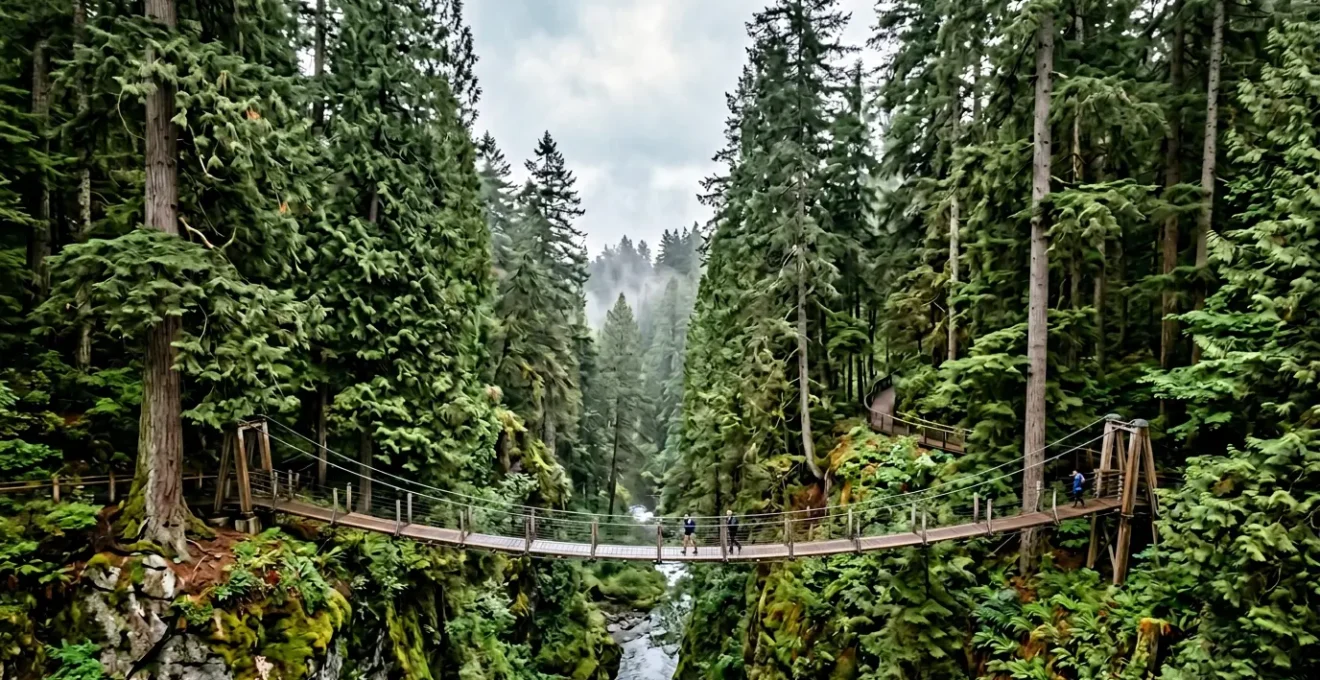
The real choice isn’t about choosing the free park over the expensive one—it’s about which experience delivers the highest ‘Authenticity ROI’ for a budget-conscious explorer.
- Lynn Canyon offers a more rugged, authentic, and less crowded rainforest experience at zero admission cost, making it the clear winner on a pure ‘experience-per-dollar’ metric.
- Capilano’s high price is justified by more polished attractions and accessibility, but its value proposition is completely transformed for locals via the BC Resident Pass.
Recommendation: For the savvy backpacker, a strategic combination of the free Lynn Canyon and another urban nature spot like the False Creek Seawall offers far greater value and variety than a single, expensive ticket to Capilano.
You’ve seen the photos: a breathtaking suspension bridge swaying gently amidst a sea of emerald green, a quintessential Vancouver moment. You type “Vancouver suspension bridge” into your phone, and your heart soars. Then you see the price tag for the Capilano Suspension Bridge, and your wallet screams. This is the classic backpacker’s dilemma: a desire for majestic nature clashing with a budget that’s tighter than a new pair of hiking boots. The immediate alternative that pops up is Lynn Canyon, a local favorite that’s famously free.
But a simple “free vs. expensive” comparison is a trap. It’s the most common platitude you’ll find online, and it misses the entire point. A truly savvy explorer doesn’t just look at the cost; they analyze the value. This isn’t just about saving money, it’s about investing your limited time and energy wisely. Is the curated, commercialized polish of Capilano a better use of your afternoon than the wild, untamed trails of Lynn Canyon? Does one offer a more authentic connection to the Pacific Northwest rainforest?
Forget the surface-level debate. The key to making the right choice lies in a deeper concept: value density. It’s about how much awe, authenticity, and memorable experience you can pack into every dollar and every hour. This guide abandons the generic tourist advice and instead adopts the mindset of a frugal local. We will dissect the real value of each park, analyzing everything from ecological authenticity and crowd avoidance to bear safety and the truth about those giant trees. By the end, you won’t just know which park is cheaper; you’ll know which one is smarter for you.
This comprehensive breakdown will guide you through the critical factors that determine the true value of your rainforest adventure. We’ll compare the ecosystems, the practicalities for different types of visitors, and even delve into expert tips that go far beyond the official brochures.
Summary: A Frugal Explorer’s Guide to Vancouver’s Suspension Bridges
- The Ecology Showdown: Authentic Wilderness vs. Curated Park
- The Family-Friendliness Factor: Strollers, Snacks, and Sanity
- Capturing the Canopy: A Photographer’s Guide to the Green Room
- The Bear-Aware Picnic Test: Don’t Be That Tourist
- Mastering the Clock and the Crowd: When to Go for Solitude
- The Local’s Secret Weapon: The BC Resident Pass
- Expanding the Definition of “Free” Nature: The Seawall Alternative
- The Old-Growth Myth: Where to *Actually* Find Giant Trees
The Ecology Showdown: Authentic Wilderness vs. Curated Park
At first glance, both parks offer a similar product: a temperate rainforest experience. However, the difference in their ecological soul is vast, and this is where the concept of “authenticity ROI” begins. Capilano is a privately owned commercial attraction built on a patch of forest. It’s beautiful, but it’s a managed, manicured version of nature. In contrast, Lynn Canyon Park is a protected municipal park. Its very purpose is conservation.
The difference is tangible. While Capilano is impressive, Lynn Canyon Park encompasses 617 acres of land protected under Metro Vancouver Regional Park bylaws. This large, contiguous ecosystem consists of a typical coastal British Columbia mix of Douglas fir, western red cedar, and western hemlock. This means the forest you experience at Lynn Canyon is a more genuine representation of the region’s natural state. It’s a living, breathing ecosystem, not just a backdrop for an attraction. You’ll find more biodiversity, more rugged trails, and a stronger sense of being immersed in true wilderness.
This isn’t to say Capilano is ‘fake’ nature, but it is ‘curated’ nature. The forest there is primarily second-growth and carefully managed for visitor safety and aesthetic appeal. For the backpacker seeking a genuine connection with the legendary BC rainforest, Lynn Canyon delivers a significantly higher return on authenticity for a zero-dollar investment. It’s the difference between visiting a world-class zoo and going on a real safari; both have animals, but the experience is fundamentally different. For those prioritizing raw, untamed beauty, the ecological integrity of Lynn Canyon makes it the clear front-runner.
The Family-Friendliness Factor: Strollers, Snacks, and Sanity
While a solo backpacker might revel in rugged terrain, the “value” calculation changes dramatically if you’re traveling with small children. Here, the polished, well-equipped nature of Capilano can start to look like a very good investment. The paths are generally more accessible, facilities are plentiful, and structured activities can be a lifesaver. Lynn Canyon, while wonderful, demands more self-sufficiency.
The bridge experiences themselves highlight this contrast. As one expert notes, “Lynn Canyon is more narrow and has more of a hanging dip to it. As a result, if you’re looking for a bit of sway, you’ll get more at Lynn Canyon. Since it’s not watched over, there are no ‘bridge lifeguards’ to prevent people from swaying it.” For a thrill-seeker, this is a plus. For a parent with a nervous toddler, it’s a major consideration. The wider, more stable, and supervised bridge at Capilano provides peace of mind that has its own value.
To break it down for those with little ones in tow, this scorecard clarifies where each park wins and loses in the battle for family-friendliness.
| Factor | Lynn Canyon (Free) | Capilano ($80 CAD) |
|---|---|---|
| Stroller Accessibility | Limited – rugged trails, baby carrier recommended | Paved paths, but still carrier-only on bridge/cliffwalk |
| Queue/Wait Time Risk | Low – fewer crowds, especially weekdays | High – major tourist attraction with long waits |
| Overstimulation Risk | Low – natural, quiet environment | High – crowds, commercial atmosphere, Cliffwalk |
| Facilities (Snacks/Bathrooms) | Basic – Lynn Canyon Cafe, limited bathrooms | Excellent – Multiple food outlets, well-maintained facilities |
| Trail Hazards | Higher – exposed roots, rocks, uneven terrain | Lower – well-maintained boardwalks and paths |
| Engagement for Kids | Ecology Centre (by donation), 30-Foot Pool for summer | Scavenger hunts, Canyon Lights seasonal event, structured activities |
Ultimately, for families, the high price of Capilano buys convenience, safety, and amenities. For the budget-conscious backpacker, these are luxuries that may not be worth the cost, but for parents, they can be the difference between a magical day out and a complete meltdown.
Capturing the Canopy: A Photographer’s Guide to the Green Room
For many travelers, the photos are a huge part of the experience. A great shot of the rainforest is a trophy. However, the dense, dark, and often damp canopy of a Vancouver rainforest is one of the most challenging environments for photography. Here, knowing a few technical tricks can drastically improve your “photographic ROI,” and each park presents unique opportunities and challenges.
The key challenge is light—or the lack thereof. Your camera’s automatic mode will likely struggle, producing grainy, blurry images. At Lynn Canyon, the advantage is fewer people and more time. You can focus on the intimate details: the texture of moss, water droplets on ferns, the intricate patterns of bark. At Capilano, the challenge is capturing the grand scale of the main attractions amidst a sea of other visitors. The swaying of the bridge, in particular, requires a specific strategy to avoid motion blur.
Whether you’re at the bustling Capilano or the more serene Lynn Canyon, the right techniques are essential for turning a frustrating photo session into a successful one. Don’t just point and shoot; approach it with a plan to conquer the dim light and capture the true magic of the forest.
Your Checklist for North Shore Rainforest Photography
- Use Burst Mode on Capilano’s swaying bridge with a shutter speed of 1/250s or faster to freeze motion from the crowds.
- At Lynn Canyon’s less-crowded bridge, bring a travel tripod to use a slower shutter speed (1/15s-1/30s) for a silky water effect in the canyon below.
- Invest in a circular polarizing filter; it’s essential in Vancouver’s wet climate to cut glare from damp leaves and boost color saturation.
- Shoot in RAW and keep your ISO between 400-800 to avoid excessive grain, pushing exposure compensation by +0.7 to +1.0 stops to brighten the scene.
- For trophy shots at Capilano, arrive at opening or after 5 PM. For Lynn Canyon, embrace the lack of crowds and focus on intimate forest details anytime.
By mastering these simple settings, you can ensure your photos reflect the stunning reality of the environment, giving you lasting memories that are as rich and detailed as the forest itself.
The Bear-Aware Picnic Test: Don’t Be That Tourist
Nothing says “frugal backpacker” like packing your own lunch. A simple sandwich by a rushing creek seems idyllic. However, in both Lynn Canyon and the surrounding North Shore mountains, this simple act comes with a serious responsibility: bear safety. This isn’t a theoretical warning; conservation officers have expressed concerns about active black bear populations in the area, often attracted by improperly stored food from visitors.
The “sandwich mistake” is thinking that only the food itself is the problem. In reality, bears have an incredible sense of smell. That means everything from your half-eaten apple core to the scented hand sanitizer in your bag can be an attractant. While Capilano’s highly managed environment and large crowds reduce the likelihood of an encounter in its main areas, the risk is very real on the quieter trails of Lynn Canyon. As Kirstin Takashiba of the North Shore Black Bear Society warns, you should “Never leave food unattended. Ideally pack in, pack out, because parks are dealing with a pile of garbage.”
Being bear-aware is non-negotiable and a sign of a respectful and smart traveler. It protects both you and the wildlife. Before you pack your picnic, make sure you’re not making any of these common, and potentially dangerous, mistakes.
- Remove ALL Scented Items: This goes beyond food. It includes trail mix, fruit peels, gum, scented sunscreen, lip balm, and toiletries. If it has a smell, a bear might investigate.
- Use Proper Containers: Backpacks and soft coolers are not bear-proof. Store all food in sealed, hard-sided containers to minimize odors.
- Practice ‘Bare Campsite’ Principles: Never leave your food unattended on a picnic table. If you’re not actively eating, it should be packed away and sealed.
- Dispose of Waste Correctly: Use the designated bear-proof bins available (though they can be limited at Lynn Canyon) or, even better, pack all of your garbage out with you. Never bury food scraps.
- Carry Bear Spray: On the less-trafficked trails of Lynn Canyon, carrying bear spray and knowing how to use it is a wise precaution. Keep it accessible on your hip, not buried in your pack.
This isn’t about fear; it’s about respect and co-existence. A bear-safe picnic is a successful picnic, allowing you to enjoy your budget-friendly meal with peace of mind.
Mastering the Clock and the Crowd: When to Go for Solitude
For a frugal explorer, time is as valuable a resource as money. An experience’s value is drastically diminished if it’s spent shuffling in a queue or fighting for a clear view. This is where the two parks diverge most dramatically. With Capilano Suspension Bridge attracting 1.1 million visitors annually, it is a machine built to process crowds. Lynn Canyon, while popular with locals, sees a fraction of that traffic.
The “crowd calculus” is simple: the presence of other people almost always detracts from a nature experience. The quiet reverence of a forest is shattered by the constant chatter and selfie-sticks. Therefore, a key part of maximizing your value is strategic timing. At Capilano, this means actively working to avoid the peak times when tour buses unload their contents. At Lynn Canyon, it means being aware of the rhythms of local life, like school groups or the after-work dog-walking rush.
Beating the crowds isn’t luck; it’s a strategy. By thinking counter-intuitively, you can often find moments of solitude even in popular places. A little bit of rain, for example, is the Vancouver tourist’s kryptonite, but for a prepared local, it’s an opportunity for a quiet, atmospheric walk under the shelter of the canopy. Here are some proven tactics:
- The Early Bird: Arrive at either park right at opening time, especially on weekdays. Before 10 AM is the golden window.
- The Latecomer (at Capilano): Most tour buses depart by late afternoon. Arriving after 5 PM can mean significantly fewer people and sometimes even discounted evening rates.
- The Rain-Chaser: A classic Vancouver drizzle is your best friend. It deters casual visitors at both parks, leaving the trails to the prepared.
- The Holiday Avoider: Avoid statutory holiday weekends like the plague. If you must go, be there before 9 AM or not at all.
- The Cruise Ship Detective: Check the Port of Vancouver’s cruise calendar online. On days with multiple large ships in port, Capilano (a top shore excursion) will be swamped. That’s your cue to head to Lynn Canyon.
- The Winter Wanderer: Outside of Capilano’s Canyon Lights event, winter weekdays (November-February) offer the deepest solitude and a uniquely moody rainforest experience.
By treating the time of your visit as a strategic choice, you can dramatically increase the quality and value of your experience, turning a potentially frustrating outing into a peaceful immersion in nature.
The Local’s Secret Weapon: The BC Resident Pass
For a tourist, the math is simple: Lynn Canyon is free, and Capilano is expensive. General admission tickets for adults at Capilano start at $80 CAD, a steep price for a one-time visit. However, for anyone living in British Columbia, a little-known “secret weapon” completely flips this value equation on its head: the BC Resident Annual Pass.
The deal is astonishingly good and a cornerstone of the frugal local’s playbook. When a BC resident purchases a single regular day pass directly from Capilano, they can convert it into an annual pass for a full 365 days of unlimited entry—for free. All you need to do is present a valid BC Driver’s License or BC Services Card at Guest Services on the day of your visit. Suddenly, that $80 fee is no longer a one-off expense but an investment in a year’s worth of access.
This fundamentally changes the Lynn Canyon vs. Capilano debate for locals. The ability to pop into Capilano for a quick evening stroll during Canyon Lights, to bring visiting family, or to just enjoy a quiet weekday morning makes the park a recurring part of life rather than a one-time tourist stop. The pass also comes with perks, like 10% off at the gift shop and restaurants, and 15% off regular admission for guests you bring with you. It’s crucial to note, however, that this offer is only valid for tickets purchased directly from the park’s official website or entrance; tickets from third-party vendors are not eligible for the upgrade.
For the backpacker just passing through, this information might seem irrelevant. But it’s a critical piece of the puzzle for understanding the local perspective. It explains why many Vancouverites happily frequent Capilano despite the price tag. For them, the cost-per-visit quickly drops to mere dollars, making it an incredible value proposition over the course of a year and a powerful reason to choose it over Lynn Canyon for repeat visits.
Expanding the Definition of “Free” Nature: The Seawall Alternative
The debate often frames the choice as a binary: one forest or the other. But a truly savvy, frugal explorer knows that Vancouver’s greatest asset is the diversity of its free natural spaces. Why limit yourself? Instead of asking “Lynn Canyon OR Capilano?”, a better question is “What’s the ultimate ‘value combo’ for a day of free nature?” This is where you can combine the deep forest immersion of Lynn Canyon with a completely different, yet equally iconic, Vancouver experience: the False Creek Seawall.
The Seawall offers a stunning contrast. It’s approximately 10 kilometers of flat, paved, and fully accessible waterfront path that showcases the city’s famous urban-nature interface. You get breathtaking views of the downtown skyline, public art installations, and the majestic North Shore mountains (including the very area you were just exploring) as a backdrop. It’s bustling with the energy of cyclists, runners, and walkers, offering a vibrant social atmosphere that the quiet forests lack.
Consider this strategic itinerary: start your day early with a 90-minute immersive hike at Lynn Canyon. Arrive before 10 AM to secure easy parking and enjoy the suspension bridge and trails in relative peace. You get your dose of vertical, old-forest wilderness. Then, head back downtown for an afternoon stroll or bike ride along the horizontal, open-air expanse of the False Creek Seawall. This “surf and turf” approach to nature delivers incredible variety. You experience both the intimate, enclosed majesty of the rainforest and the sweeping, panoramic beauty of the waterfront—all for the cost of a few dollars in gas or bus fare.
This combination offers far superior value for a budget traveler than spending $80 on a single type of experience at Capilano. It maximizes both your ‘majesty per dollar’ and ‘variety per hour,’ giving you a much richer and more comprehensive taste of what makes Vancouver’s natural landscape so unique.
Key Takeaways
- For a budget traveler, Lynn Canyon offers a more authentic rainforest experience and superior ‘authenticity-per-dollar’ value.
- The BC Resident Pass completely changes the cost equation for Capilano, making it an excellent long-term value for locals.
- The most pervasive myth is that you need to go to a paid park to see giant trees; true old-growth remnants are accessible for free nearby.
The Old-Growth Myth: Where to *Actually* Find Giant Trees
Here is the final, and perhaps most important, piece of a local’s inside knowledge: the great old-growth myth. Many visitors come to these parks expecting to be humbled by 500-year-old giant Douglas Firs, the titans of the BC coast. The marketing materials certainly cultivate this image. The truth, however, is a bit more complicated and debunks a major selling point for paying a premium.
Neither Lynn Canyon nor Capilano’s main visitor areas feature true, ancient old-growth forest in the way most people imagine it. Historically, as the Squamish people who called the area X̱á7elcha knew, this entire region was once ancient forest. But as settlers arrived, the area was heavily logged. What stands today in both parks is primarily mature second-growth forest. It’s beautiful, impressive, and ecologically valuable, but it’s not the ancient, untouched wilderness many believe they are paying to see. For the authenticity-seeking backpacker, this is a crucial distinction.
I previously did both Lynn Canyon and Capilano to compare the two and I would choose Lynn Canyon any time. It’s far less crowded and you don’t need to pay to enjoy the natural beauty of the place. This is a gorgeous and tranquil place filled with the best of nature that you will see in your time in Vancouver.
– Visitor review on TripAdvisor
So where can you hug a 500-year-old tree? The secret is that you don’t need to pay an entry fee. For the most authentic old-growth remnants near the city, you can explore the Lower Seymour Conservation Reserve. The best part? It’s accessible from trailheads adjacent to Lynn Canyon and is entirely, unequivocally free. By combining a visit to Lynn Canyon’s bridge and pools with a short hike into the Seymour Reserve, you can get the suspension bridge experience *and* the genuine old-growth encounter, all without spending a dime on admission.
This is the ultimate value proposition. You get the thrill, the tranquility, and the towering, ancient trees, bypassing the commercialism and the cost. It requires a bit more planning and a willingness to hike a little further, but the reward is an experience that is both more authentic and infinitely more valuable to the frugal explorer.
So, the decision rests with you. Capilano offers undeniable convenience, polish, and a wider array of structured attractions—a value proposition that is excellent for families or those with limited mobility. Lynn Canyon, paired with a little extra exploration, offers a deeper, more rugged, and arguably more authentic connection to the wild heart of British Columbia. For the budget-conscious backpacker whose currency is not just dollars but authenticity, the choice is clear. The smartest investment is not in a ticket, but in the time taken to discover the real, untamed beauty that lies just beyond the beaten path.
Frequently Asked Questions about BC Resident Pass
What proof of residency is required for the BC Resident Pass?
You must present a valid BC Driver’s License or BC Services Card at Guest Services. The conversion must happen on the same day you purchase your regular admission ticket.
How does the BC Resident Pass change the cost equation?
For tourists, Capilano is a one-time expense of approximately $80 CAD. For BC residents, you purchase one regular day pass and receive unlimited visits for 365 days, making repeat visits completely free and fundamentally changing the Lynn Canyon vs Capilano value comparison for locals.
What are the hidden benefits beyond free entry?
BC Annual Passholders receive 10% off all regular-priced items at Trading Post Gift Shop, 10% off food and beverage at all park restaurants, 15% off regular admission for accompanying guests, and access to seasonal events including Canyon Lights (limited availability, reservation required).
Can I get the BC Resident Pass if I buy tickets through a third-party vendor?
No. The BC Resident Annual Pass is only available when tickets are purchased directly from Capilano Suspension Bridge Park’s official website or at the park entrance. Third-party vendor tickets are ineligible for the annual pass upgrade.