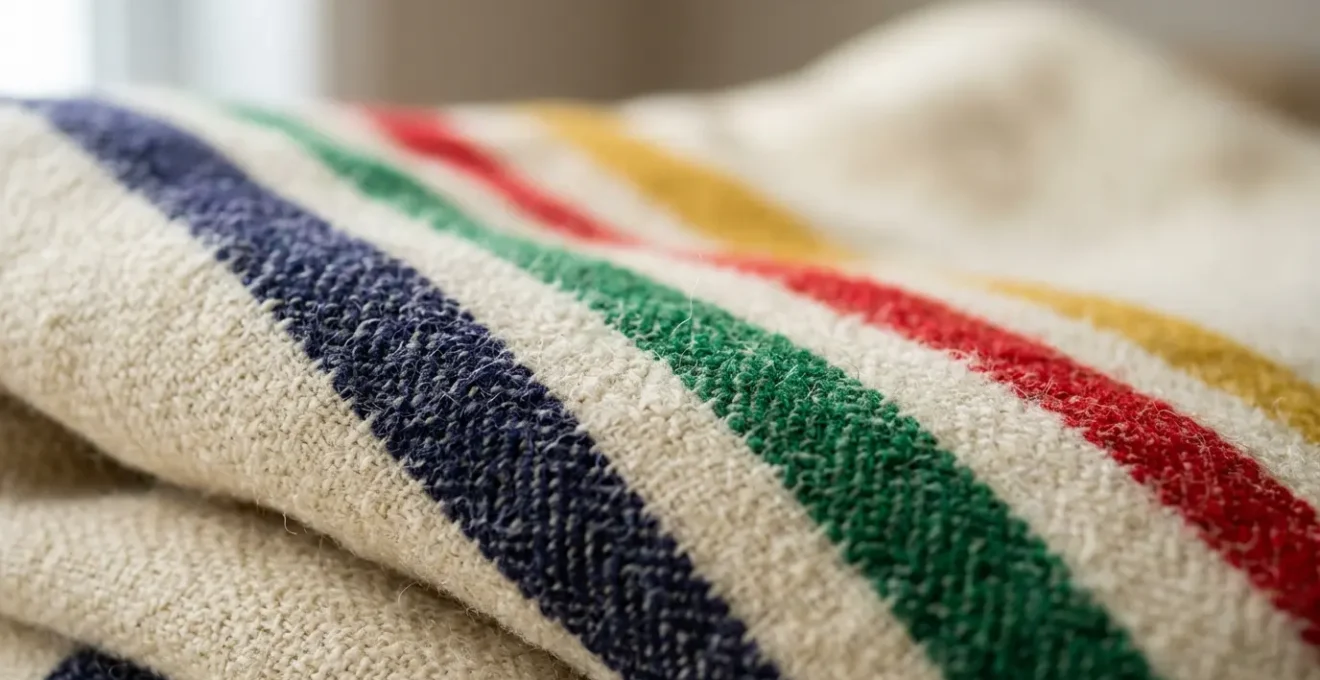
The Hudson’s Bay Point Blanket’s high price reflects its status as a “heritage benchmark”—a standard of quality, story, and authenticity against which all other Canadian souvenirs are measured.
- Its value is built on verifiable material integrity (100% wool, time-tested weave) and a deep, complex narrative embedded in Canada’s history.
- Unlike regional souvenirs, its story transcends locality, making it a uniquely national emblem.
Recommendation: To truly assess its worth, learn to recognize the markers of authenticity in other Canadian crafts; you’ll see the same principles of value reflected in the Point Blanket, but on a national scale.
You’re standing in the flagship Hudson’s Bay store in downtown Vancouver, the expansive building a landmark in itself. Before you is a stack of the famous Point Blankets, their bold, primary-coloured stripes a vibrant slash against the creamy wool. You run a hand over the thick, slightly coarse fabric. It feels substantial, historic. Then you see the price tag—upwards of $300. The question immediately forms: is it truly worth it? Is this just an overpriced tourist item, or are you holding a genuine piece of Canadian heritage?
In a city brimming with keepsakes, from artisan markets on Granville Island to galleries showcasing Indigenous art, the choice can be overwhelming. Many guides will tell you the history of the fur trade or explain what the coloured stripes—green, red, yellow, and indigo—represent. They might even explain the “point” system that denotes the blanket’s size. But this information, while interesting, doesn’t answer the core question of value for a discerning shopper. It doesn’t help you weigh the blanket against a hand-knit Cowichan sweater or a bottle of precious Okanagan ice wine.
The truth is, to understand the worth of the Hudson’s Bay Point Blanket, you can’t look at it in isolation. Its iconic status and premium price are best understood by using it as a lens—a heritage benchmark—through which we can examine the entire landscape of Canadian souvenirs. What separates a genuine, valuable keepsake from a mass-produced trinket? The answer lies in a combination of material integrity, authentic craftsmanship, and the power of a story well told.
This guide will take you on that journey. We will explore the markers of authenticity in various iconic British Columbian and Canadian souvenirs, from hand-carved art to locally produced delicacies. By learning to see the value in these items, you will gain the tools to look at that Point Blanket with new eyes and finally decide for yourself if it’s the right piece of Canada to take home.
Summary: Hudson’s Bay Point Blanket: Why Is This $300 Wool Blanket Iconic?
- Stone vs Resin: How to Tell if Your Inukshuk Souvenir Is Hand-Carved?
- The Weekender Bag: Is Roots Leather Still Made in Canada?
- The Red Mittens: Can You Still Buy Vancouver 2010 Gear Today?
- How to Pack a Cowichan Sweater to Save Space in Your Carry-On?
- VQA Symbol: What Does It Guarantee on a Bottle of Ice Wine?
- Douglas Coupland to Emily Carr: Which Vancouver Author Makes the Best Gift?
- How to Order a Custom Leather Bag from a Granville Island Artisan?
- Smoked Salmon or Maple Syrup: Which Edible Souvenir Travels Best?
Stone vs Resin: How to Tell if Your Inukshuk Souvenir Is Hand-Carved?
The first lesson in souvenir value begins with materiality. An Inukshuk, the stone figures built by Inuit and other peoples of the Arctic region, is a powerful symbol of the Canadian North. Yet, countless gift shops are filled with lightweight, perfectly uniform resin replicas. The difference in value is not just sentimental; it’s tangible. A genuine, hand-carved stone piece holds the cold, dense weight of its origin. It has irregularities and a unique character that speaks to the artist’s hand. A resin fake feels warm, light, and hollow—a ghost of the real thing.
This distinction is so crucial that the Inuit Art Foundation now manages the “Igloo Tag” trademark, a certification of authenticity for Inuit art. The presence of this tag is a guarantee of provenance and craftsmanship. In fact, a 2017 economic study found that this certification adds an average of $117.23 in perceived value to a piece. This is our first marker of value: verifiable authenticity. Just as the points on a Bay Blanket once certified its size and quality to fur traders, the Igloo Tag certifies the cultural and material integrity of an Inuit carving. To spot the difference, you must engage your senses and your knowledge:
- The Touch Test: Real stone (like soapstone or serpentine) feels cool and heavy. Resin often feels slightly warmer to the touch and unnaturally light for its size.
- The Symmetry Test: Mass-produced fakes are often perfectly symmetrical. A hand-carved piece will have subtle, unique imperfections that are a sign of its authenticity.
- The Colour Test: Be wary of overly bright or unnatural colours. Authentic pieces utilize the natural tones of the stone—greys, greens, and blacks.
- The Documentation Check: Reputable galleries will provide the artist’s name and community of origin, connecting the object back to a person and a place.
Thinking about the Bay Blanket, we see a parallel. Its 100% wool composition is a non-negotiable material fact. It’s not a wool-blend or a synthetic replica; its value starts with the integrity of its core material, a principle that holds true for a hand-carved Inukshuk.
The Weekender Bag: Is Roots Leather Still Made in Canada?
Our journey into Canadian icons continues with Roots, a brand whose leather goods are as synonymous with Canada as the maple leaf. But in a globalized world, the “Made in Canada” label can be complex. Is a Roots weekender bag still the epitome of Canadian craftsmanship? The answer, much like with the Hudson’s Bay Blanket, is nuanced and reveals our second marker of value: a tangible connection to a legacy of production.
Roots’ Toronto Leather Factory: Three Generations of Canadian Craftsmanship
Located in Toronto, Roots’ leather factory is a testament to this legacy. As detailed in their company history, the facility has been operated by three generations of the Kowalewski family. It is here that many of their most iconic leather goods are still designed and produced, with each bag passing through the hands of at least 20 artisans. However, the company also sources products internationally, creating what one might call the “Hudson’s Bay Blanket paradox”: an iconically Canadian brand with a complex global production story. This blend of domestic heritage and global sourcing is a modern reality for many legacy brands, including the one that makes the Point Blanket.
This paradox is where true value is revealed. While some Roots items are made overseas, the heart of their leather craft—the design, the expertise, and the production of their signature bags—remains firmly planted in their Toronto factory. This isn’t just a marketing story; it’s a living workshop where skills are passed down. For the discerning shopper, the value lies in purchasing a piece from that specific heritage collection, knowing it was crafted in the Toronto facility.
The Point Blanket shares this narrative. While the raw wool has been sourced from various places over the centuries, it has been consistently woven in the same English mill for over 200 years. The value is not just in the “Made in England” tag, but in the unbroken chain of production expertise. It’s a story of consistency and specialized craftsmanship that defines its character and justifies its cost, much like a bag from the Roots leather factory.
The Red Mittens: Can You Still Buy Vancouver 2010 Gear Today?
Not all icons are centuries old. Some are born from a singular, unifying moment in time. Such is the case with the Vancouver 2010 Red Mittens, an item that transformed from a simple $10 souvenir into a national phenomenon. This introduces our third marker of value: the power of a shared collective story.
The Hudson’s Bay Company, the very same institution behind the Point Blanket, was the official outfitter for the 2010 Winter Olympics. They created the red mittens, featuring a large white maple leaf on the palm. The public response was explosive. They became the must-have item of the Games, a symbol of national pride and support for Canadian athletes. By the end of the Olympics, an incredible 3 million pairs had been sold, raising millions for Canada’s Own the Podium program.
Today, an original pair of 2010 mittens is a collector’s item. You won’t find them new on store shelves. Their value is now determined by scarcity and nostalgia, traded in thrift stores and online marketplaces across Metro Vancouver. While HBC continues to release new versions for each Olympic cycle, the 2010 originals hold a special place. They don’t just keep your hands warm; they hold the memory of a time when the nation, and the world, came together in Vancouver.
The value here is not in the material (they are simple acrylic knits) but in the embedded narrative. They are a wearable memory. This is a powerful lesson when considering the Point Blanket. For centuries, the blanket was a trade good, a utility item woven into the very fabric of Canada’s founding and expansion. It was present at trading posts, in settlers’ cabins, and in Indigenous communities. Its stripes and points weren’t just design; they were a language of commerce. Owning one today is not just owning a blanket; it’s owning a tangible piece of that vast, complex, and sometimes difficult national story.
How to Pack a Cowichan Sweater to Save Space in Your Carry-On?
The question of how to pack a bulky Cowichan sweater—the answer is to roll it tightly, never fold—quickly gives way to a more important consideration: ensuring the sweater you’re packing is authentic. A genuine Cowichan sweater, handcrafted by Coast Salish artisans, is a masterpiece of textile art and a national treasure. This brings us to our fourth marker of value: protected cultural heritage and irrefutable craftsmanship.
In 2011, the Canadian government designated the Cowichan sweater an event of national historical significance.
– Canadian Encyclopedia, Cowichan Sweater: National Historical Recognition
This official recognition underscores its importance. Only sweaters made by Coast Salish knitters using specific techniques and materials can legally be called “Genuine Cowichan.” Anything else is merely “Cowichan-style.” The authentic sweaters are hand-knit in the round from thick, undyed, hand-spun sheep’s wool. The high lanolin content of the wool makes them naturally water-repellent and exceptionally warm. The iconic patterns—often depicting eagles, whales, or geometric designs—are not just decorative but are part of a rich artistic tradition.
To buy a genuine Cowichan is to support an artist and a living culture. It is an investment in a garment that can last a lifetime, becoming a family heirloom. The price reflects the countless hours of skilled labor, the quality of the unique materials, and the cultural significance of the design. Much like telling a real Inukshuk from a fake, identifying a real Cowichan sweater requires looking for key indicators: the seamless, tubular construction; the natural, oily feel of the lanolin-rich wool; and a tag verifying its origin from a Coast Salish knitter.
Here, the parallel with the Point Blanket is at its strongest. Both are textile icons defined by their material and construction. The Point Blanket’s durability comes from its tightly woven, felted 100% wool construction, a process perfected over centuries to withstand the harsh Canadian climate. A Cowichan sweater’s value lies in its hand-spun, water-resistant wool and seamless knitting. In both cases, the form and material are inseparable from their function and story, creating an object of enduring, generational worth.
VQA Symbol: What Does It Guarantee on a Bottle of Ice Wine?
From woven wool to pressed grapes, our search for value takes us to the vineyards of British Columbia’s Okanagan Valley. Ice wine, that luscious dessert wine made from grapes frozen on the vine, is a uniquely Canadian luxury. But as with any premium product, imitations exist. This is where the VQA symbol comes in, representing our fifth marker of value: a guarantee of quality through rigorous standards and a defined sense of place.
VQA stands for Vintners Quality Alliance, and the symbol on a bottle of BC wine is a legally binding seal of approval. For ice wine, it’s the difference between a true artisanal product and a cheap “icebox wine” made by artificially freezing grapes. The VQA certification guarantees that the wine in the bottle adheres to a strict set of rules that define its authenticity and quality. This commitment to standards directly translates to the product’s value and price.
The differences between a certified and non-certified product are stark, and understanding them is key to appreciating what you are paying for.
| Characteristic | BC VQA Certified Ice Wine | Non-Certified ‘Icebox Wine’ |
|---|---|---|
| Grape Origin | 100% British Columbia grapes (primarily Okanagan Valley) | May use imported grapes or juice from any region |
| Freezing Method | Grapes naturally frozen on the vine (minimum -8°C for 3 consecutive days) | Artificially frozen post-harvest in industrial freezers |
| Sugar Content | Minimum 125 grams per liter residual sugar (strict sweetness standards) | No regulated sweetness requirements |
| Quality Control | Independent laboratory testing and sensory evaluation by VQA panel | No mandatory third-party verification |
| Labeling Transparency | Must disclose vintage, grape variety, and specific growing region | Minimal disclosure requirements |
The VQA symbol, therefore, acts as a promise to the consumer. It promises a specific “terroir” or sense of place (100% BC grapes), a specific method (natural freezing), and a specific quality standard. The Hudson’s Bay Point Blanket operates on a similar, albeit more ancient, system of trust. The brand itself, the consistent quality of the wool, and the iconic stripes are its VQA. They are the symbols that have guaranteed its quality and authenticity for hundreds of years, long before formal certification bodies existed.
Douglas Coupland to Emily Carr: Which Vancouver Author Makes the Best Gift?
A souvenir doesn’t have to be an object you wear or display; it can be a story you carry with you. Vancouver has a rich literary tradition, from the iconic paintings and writings of Emily Carr to the generation-defining novels of Douglas Coupland. A book can be a profound souvenir, but which story offers the most authentic “sense of place”? This question leads us to another facet of value: the authenticity of the narrative itself.
While a novel by a famous Vancouver author is a fine gift, a deeper sense of connection can be found by seeking out the stories that are intrinsically tied to the land and its people. This is where places like Massy Books, an Indigenous-owned bookstore in Vancouver, become essential destinations for a souvenir hunter seeking meaning.
Massy Books: Vancouver’s First Indigenous-Owned Bookstore
As noted by local culture guides, Massy Books offers a profound alternative to mainstream bookshops. It provides deep, curated collections of Canadiana and local BC history, with a special focus on contemporary Indigenous authors from the region. Picking up a copy of Eden Robinson’s ‘Son of a Trickster’ or Lee Maracle’s ‘My Conversations with Canadians’ offers a more nuanced and authentic story of British Columbia than many settler-canon authors can provide. These stories are rooted in the very land on which Vancouver stands, offering a perspective that is both powerful and place-specific.
Choosing a book from an author like Eden Robinson over a more globally recognized name is an intentional act. It’s a choice to engage with a story that is not just set in a place but is *from* that place. It prioritizes an authentic, local voice over a generic bestseller. This act of conscious selection is a crucial skill for any discerning collector.
This connects directly back to the Hudson’s Bay Point Blanket. Its story is not simple or universally celebrated. It is a complex narrative intertwined with the history of colonization, trade, and the development of Canada. To buy the blanket without acknowledging this complex history is to miss the point of its iconic status. Its value lies not in a sanitized, simple story, but in its power to represent a deep, multi-layered, and essential Canadian narrative. Just as with literature, the most valuable stories are rarely the simplest ones.
How to Order a Custom Leather Bag from a Granville Island Artisan?
For the ultimate souvenir, some travelers seek to become part of the creation story itself. Granville Island, a hub of creativity in the heart of Vancouver, offers this opportunity. Here, you can walk into an artisan’s workshop and commission a custom piece, like a leather bag. This experience elevates a purchase into a collaboration, embedding your own story into the object. This is perhaps the most personal form of value: direct engagement with the creator.
Walking into a studio and speaking directly with the person who will be hand-crafting your bag is a powerful experience. It demystifies the process and creates a bond between owner and object. But to have a successful collaboration, you need to speak the language of the craft. Understanding a few key terms can transform the conversation from a simple transaction into a meaningful dialogue, ensuring the final product truly reflects your vision and the artisan’s skill.
Your Action Plan: Artisan Dialogue Mastery for Custom Leather Orders
- Full-Grain Leather: This is the highest quality, using the entire hide with its natural markings intact. Ask, “Is this full-grain or top-grain?” to understand the quality you are paying for and to show you’ve done your research.
- Vegetable-Tanned: This is a traditional, natural tanning process. This type of leather develops a rich ‘patina’ over time. Specify this if you want a bag that ages beautifully and tells a story of its use.
- Patina Development: This is the beautiful aging process where leather darkens and gains character. Discuss your expectations for how the bag will evolve, showing you appreciate it as a living object.
- Lead Time Expectations: Custom work takes time, often 4-8 weeks. Communicate your travel schedule upfront to manage expectations and discuss shipping options.
- Pacific Northwest Design Elements: Inquire about local inspiration. Ask if they draw on West Coast aesthetics—rainforest colours, coastal textures—to create a piece with an authentic, non-generic sense of place.
This process of co-creation is the antithesis of mass production. The final bag is not just a souvenir of Vancouver, but a souvenir of your interaction with a specific artist on a specific day. You know its story from the very beginning.
Granville Island Public Market consistently ranks as the top destination for authentic, locally-made gifts in Vancouver. … For custom leather work, visitors can interact directly with makers, turning the transaction into a memorable cultural exchange.
– Vancouver travel guides
While you can’t commission a custom-made Point Blanket at The Bay, understanding this level of personal value helps contextualize its price. The blanket’s value comes from a different kind of story—not a personal one, but a historical one. It’s the culmination of centuries of established quality, a story told so many times it has become a legend. It is the finished chapter, where a custom bag from Granville Island is the first page you help to write.
Key Takeaways
- Authenticity Has Markers: Genuine value in a souvenir, from an Inukshuk to a Cowichan sweater, is proven by verifiable details like material, construction, and official certification.
- Icons Carry Stories: The most enduring icons, like the 2010 Red Mittens or a book by an Indigenous author, derive their value from the powerful collective or cultural narratives they represent.
- A Sense of Place is Paramount: A souvenir’s connection to its specific origin—whether it’s the Okanagan Valley for ice wine or a Granville Island workshop for a leather bag—is a crucial component of its worth.
Smoked Salmon or Maple Syrup: Which Edible Souvenir Travels Best?
Our final stop is the delicatessen. For many, the taste of a place is the most powerful memory. In Vancouver, the quintessential edible souvenir is undoubtedly Pacific smoked salmon. But what about that other great Canadian classic, maple syrup? Comparing the two provides our final, crucial lesson in understanding value: regional authenticity versus national symbolism.
Both are delicious, but only one truly tells a West Coast story. Maple syrup is an Eastern Canadian icon, its production centered in Quebec and Ontario. While you can certainly buy it in Vancouver, it doesn’t speak to the city’s specific geography or culture. Smoked salmon, on the other hand, is intrinsically tied to the Pacific Northwest. It is a product of the local waters, a cornerstone of Indigenous cuisine and culture for millennia, and a modern artisanal delicacy.
For the traveler in Vancouver, choosing the right edible souvenir involves considering not just taste, but also practicality and authenticity, as this comparison shows.
| Factor | BC Smoked Salmon | Maple Syrup |
|---|---|---|
| Regional Authenticity | Highly authentic West Coast product; Pacific salmon is indigenous to Vancouver waters | Eastern Canadian icon; less representative of BC/Vancouver specifically |
| Travel-Safe Packaging | Retort-pouched (shelf-stable) salmon unrestricted in carry-on; cold-smoked or vacuum-sealed has specific rules | Bottles over 100ml must go in checked luggage; risk of breakage/leakage |
| YVR Airport Security (CATSA) | Shelf-stable retort pouches allowed in carry-on; canned items permitted but heavy; avoid wet/fresh smoked | Small bottles (≤100ml) allowed in carry-on liquids bag; larger bottles checked only |
| Product Varieties | Lox (cold-smoked, silky), candied salmon (sweet, jerky-like), retort-pouched (fully cooked, shelf-stable) | Various grades (Amber, Dark, Very Dark); minimal variety in travel context |
| Recommended Vendor | Granville Island Market: Longliner Seafoods and other specialty vendors offer travel-optimized packaging | Available at most tourist shops and grocery stores citywide |
The choice is clear: for a true taste of Vancouver, smoked salmon is the more authentic and meaningful choice. And this brings us full circle, back to the Hudson’s Bay Point Blanket. We have seen souvenirs that are deeply regional (salmon), culturally specific (Cowichan sweaters), and born of a moment (Red Mittens). The Point Blanket is unique because it is none of these things exclusively. Its story is not just of the West Coast or the East Coast, but of the entire breadth of the country. It was the currency of the fur trade from the Atlantic to the Pacific. It is, arguably, the only non-edible souvenir that can claim a truly national, pan-Canadian identity.
This is the ultimate justification for its price and status. It is not just a souvenir of Vancouver, but a souvenir of Canada itself. It embodies all the markers of value we have explored: unimpeachable material integrity, a centuries-long production legacy, a deep and complex national narrative, and a sense of place that is the entire nation. It is the benchmark against which all others are measured.
Now, go back to that stack of blankets. Feel the weight of the wool, but also the weight of its history. See the stripes not just as colours, but as a code. You are no longer just a shopper debating a price tag; you are a curator deciding whether to acquire a piece of a nation’s story. The choice is yours, but you now make it with the clear eyes of an informed connoisseur.