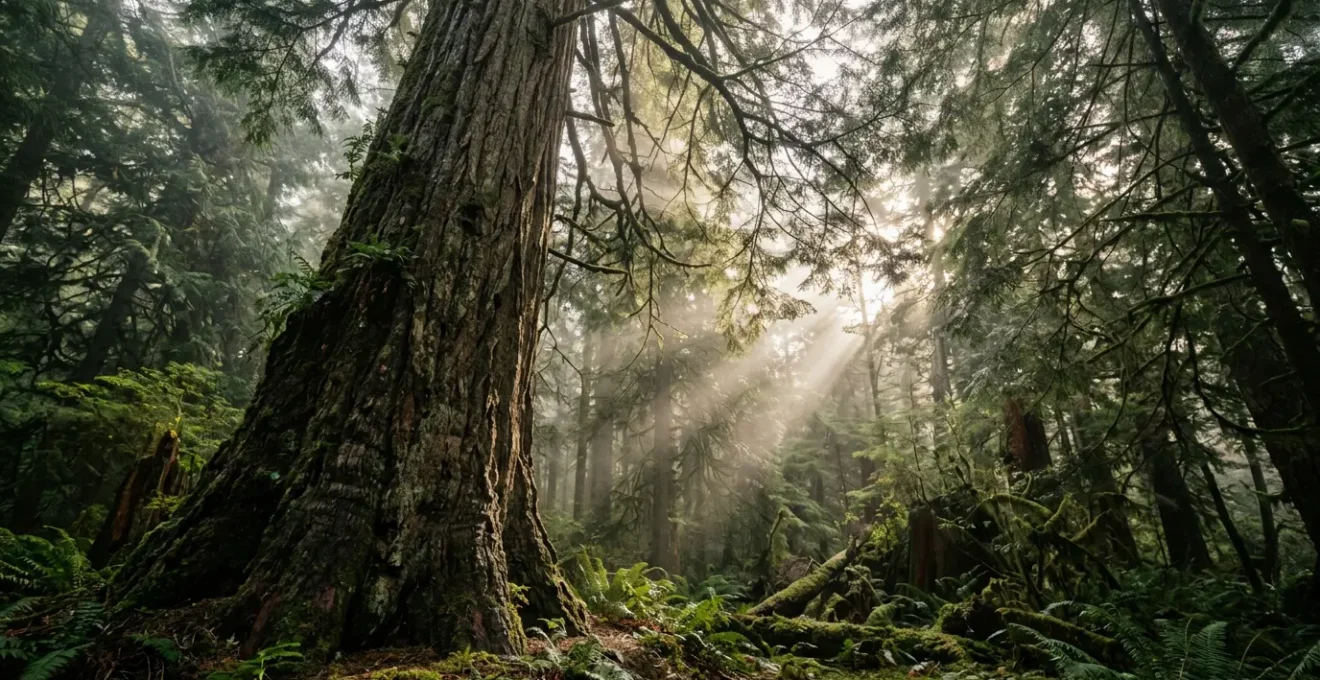
For nature lovers in Vancouver, the desire to stand in the presence of ancient trees doesn’t require a long trip to a remote grove. This guide reveals that the city’s parks are not just recreational spaces but living museums of colossal trees. By learning the language of the forest—distinguishing bark, understanding root systems, and practicing mindful photography—you can transform a simple walk into a profound connection with these urban giants, all accessible by public transit.
The question isn’t whether Vancouver has giant trees; it’s how to truly see them. For the nature lover without a car, the legendary Cathedral Grove on Vancouver Island feels a world away. The common advice is to simply “go to Stanley Park,” but this vast urban forest can be overwhelming. You might wander for hours and miss the very titans you came to see, or worse, see them without understanding the epic story they tell.
Most guides will point you to a famous landmark or a popular trail, but they stop short of giving you the tools for genuine appreciation. They don’t teach you the subtle art of telling a life-giving Cedar from a fire-resistant Douglas Fir by the texture of its bark. They don’t explain the invisible, continent-spanning drama happening beneath your feet, or how your every footstep matters. This guide is different. It’s an invitation to develop your “arboreal literacy.”
Forget aimless wandering. We will embark on a curated expedition, shifting your perspective from that of a tourist to that of an urban arborist. You will learn not just where to find these living monuments, but how to read their history, capture their immense scale with the phone in your pocket, and engage with them in a way that ensures their survival for centuries to come. This is your guide to connecting with the ancient, breathing heart of Vancouver, right within city limits.
This article provides a complete roadmap for your urban forest expedition. You’ll learn how to identify the giants, find their hidden groves, and make informed choices about supporting the ecosystems that sustain them. The following summary outlines the key knowledge you’ll gain.
Summary: A Walker’s Guide to Vancouver’s Urban Giants
- Douglas Fir vs Western Red Cedar: How to Tell Them Apart by Bark?
- The Stanley Park Hollow Tree: Is It Still Standing After the Storms?
- Vertical Panorama: How to Photograph a 60-Meter Tree with an iPhone?
- Why You Should Never Step on the Roots of Old Growth Trees?
- Which Trail in Stanley Park Has the Highest Concentration of Giants?
- Local Offsets: Which BC Conservation Projects Should You Donate To?
- The Graveley Street Arch: How to Photograph It Without Blocking Traffic?
- Lynn Canyon vs Capilano: Which Rainforest Experience Is Worth Your Time and Money?
Douglas Fir vs Western Red Cedar: How to Tell Them Apart by Bark?
Developing arboreal literacy begins with your senses. Before you can find the biggest trees, you must learn to recognize them. In Vancouver’s urban forests, the two dominant giants are the Douglas Fir and the Western Red Cedar. Telling them apart is a rewarding first step in reading the forest. It’s not just a visual exercise; it involves touch, smell, and understanding their ecological roles.
The Douglas Fir is a story of resilience. On an old specimen, the bark is its most telling feature: thick, deeply-furrowed, and almost cork-like. This impressive armor is fire-resistant, allowing mature trees to survive forest fires that clear out competitors. If you run your hand along it, you’ll feel rough, canyon-like furrows. On a warm day, the resin can even emit a subtle, vanilla-like scent.
In contrast, the Western Red Cedar, known as ‘xpey’ (the life-giver) to the Coast Salish peoples, tells a story of water and abundance. Its bark is fibrous, stringy, and reddish-brown, often peeling in long vertical strips. It feels much softer to the touch than a Douglas Fir’s. The most definitive test is olfactory: crush a small piece of its flat, scale-like foliage, and you’ll be met with a spicy, aromatic fragrance that is quintessentially the scent of a Pacific Northwest rainforest. Cedars thrive in damp, shaded ravines, the very places their counterpart, a pioneer species, might not.
The Stanley Park Hollow Tree: Is It Still Standing After the Storms?
Yes, and its story is a powerful testament to Vancouver’s dedication to its living monuments. The Stanley Park Hollow Tree, a massive stump of a Western Red Cedar, is not just a tree; it’s a cultural icon and a lesson in conservation engineering. For over a century, it was one of Vancouver’s most popular photographic subjects, a drive-through spectacle of nature’s grandeur. But time and weather took their toll.
The tree, already a hollowed-out stump when the park was created, suffered significant damage in the devastating windstorm of December 2006. The ancient cedar, estimated to be 700-800 years old and having survived the logging era of 1865-1885, was tilting precariously and deemed a safety hazard. Its removal seemed inevitable, an irreplaceable loss of a piece of the city’s soul.
Engineering the Hollow Tree Restoration: A Vancouver Conservation Milestone
In a remarkable display of civic will, the Stanley Park Hollow Tree Conservation Society was formed. The group raised $250,000 entirely through private donations to fund a groundbreaking stabilization project. Rather than let the icon fall, engineers designed an internal metal armature—a tubular steel frame—and a micropile foundation system. In a delicate operation in June 2009, the tilting structure was carefully realigned and lifted back to a vertical position. Completed in October 2011, the project transformed the Hollow Tree from a candidate for demolition into a stabilized, enduring monument to collaborative human-nature stewardship.
Today, while you can no longer drive a car through it, the Hollow Tree stands firm, supported by its hidden steel skeleton. It is a powerful symbol of a city that chose to invest in preserving its natural heritage, blending modern engineering with a deep reverence for its old-growth roots. Visiting it is more than a photo opportunity; it’s a pilgrimage to a site of successful conservation.
Vertical Panorama: How to Photograph a 60-Meter Tree with an iPhone?
Capturing the immense scale of a 60-meter (200-foot) urban giant with a small phone is a common challenge. The typical result is a photo of a massive trunk base with a disappearing wisp of green at the top. However, with the right techniques, your iPhone can become a powerful tool for conveying the vertical grandeur of these trees, all while practicing good ecological etiquette.
The key is to move beyond a simple point-and-shoot approach. You need to control your camera’s settings and, most importantly, your composition. The goal is not just to document the tree, but to tell a story about its size and its place in the forest. Light is often your biggest challenge under the dense canopy of a Vancouver rainforest. High-contrast scenes with bright sky and dark understory can fool your phone’s automatic settings, but there are ways to work around this.
By using your phone’s built-in features and thinking like a photographer, you can create a “vertical panorama” that truly does justice to these magnificent beings. It’s about finding the right angle, managing the light, and framing your shot to include elements that provide a sense of scale and context.
Your Action Plan: Capturing Giants with an iPhone
- Embrace the Dark: Use Night Mode even in daytime shade. Under a dense canopy, this feature helps capture rich detail in shadowed bark and the forest floor without blowing out the highlights in the sky.
- Master Exposure: Tap and hold the screen to lock focus on the tree trunk. Then, slide your finger down to slightly underexpose the shot. This preserves the intricate bark texture and prevents the sky from turning into a white, detail-less patch.
- Shoot Like a Pro: If your iPhone supports it, enable ProRAW format. This gives you maximum flexibility in editing later, allowing you to recover details from the brightest and darkest parts of your high-contrast forest scene.
- Find the Viewpoint: For a perfect, unobstructed vertical shot, head to the 600-year-old Douglas Fir near the junction of Bridle Path and Cathedral Trail. Approaching from the south gives you the best compositional opportunity.
- Frame with a Conscience: Tell a story of stewardship. Include a protective root fence or boardwalk in your foreground. Alternatively, position a person at least 10 feet back from the tree’s base to provide true scale without trampling the sensitive root zone.
These techniques not only improve your photos but also deepen your observation skills, forcing you to slow down and truly look at the tree from different perspectives. It’s a form of active appreciation.
Why You Should Never Step on the Roots of Old Growth Trees?
The instruction to “stay on the trail” is common hiking advice, but in the old-growth forests of Vancouver, it carries a profound ecological weight. Stepping on the exposed roots of a Douglas Fir or Western Red Cedar is not like stepping on a rock. You are treading on the lifelines of a fragile, ancient ecosystem. To understand why, we need to look beneath the soil.
The City of Vancouver prioritizes the health of these venerable trees, with monument trees prioritized in all Park Board operational activities. This protection extends from the canopy to the roots. Unlike trees in drier climates with deep taproots, coastal giants have wide, shallow, and incredibly sensitive superficial root systems. Soil compaction from foot traffic is a major threat, squeezing out the air and water pockets necessary for the tree’s health and damaging the delicate fungal network it depends on.
The Wood-Wide Web: Heeding Suzanne Simard’s Research
The forest floor is a living community. Groundbreaking research by UBC ecologist Suzanne Simard revealed the existence of a “wood-wide web”—a complex, underground mycorrhizal network connecting trees. This network is crucial for nutrient and water sharing, especially in the temperate rainforests of Stanley Park. When you step on the soil around a tree’s base, you risk damaging this intricate web, effectively cutting off communication and resource lines between trees. Simard’s work proves that “mother trees,” the ancient giants, use these networks to nurture younger trees, passing on nutrients and even defense signals. Protecting their root zones is paramount to ensuring the health and resilience of the entire forest community.
Therefore, practicing good ecological etiquette means seeing the forest floor as a living organism. When you see a boardwalk or a root fence, understand it as a sign of respect for this invisible, vital network. By staying on designated paths, you are not just protecting one tree; you are helping to preserve the integrity of the entire forest’s ancient social network.
Which Trail in Stanley Park Has the Highest Concentration of Giants?
For the car-less explorer on a mission to find urban giants, Stanley Park’s 27 kilometers of forest trails can be daunting. While monumental trees are scattered throughout, certain trails offer a higher concentration, creating a truly immersive old-growth experience. Pinpointing these hotspots allows you to maximize your time and witness the most impressive specimens the park has to offer.
The key is to head into the park’s interior, away from the bustling Seawall. The central trail system, particularly the area north of Beaver Lake, is where the forest feels most ancient and secluded. Here, a network of trails weaves through groves of giants that escaped the logger’s axe in the 19th century. Knowing exactly which junctions and paths to take is the secret to an efficient and awe-inspiring hike.
Your goal should be a circuit that connects several of these named giants. The following locations are the crown jewels of Stanley Park’s old-growth collection, all accessible via a moderate walk from the bus loop at the park’s entrance.
- The Famous Giant: Start at the intersection of Cathedral Trail and Bridle Path. Near the Lees Trail junction, you’ll find the park’s most celebrated accessible giant: a 600-year-old Douglas Fir standing over 60 meters tall with a diameter of 2.6 meters.
- The Maple Sanctuary: Wander along the Rawlings Trail (part of Lover’s Walk) to discover a magical Big Leaf Maple grove. This area is home to what is believed to be the largest maple tree in British Columbia, its sprawling limbs creating a hobbit-den-like atmosphere below.
- The Cedar Trio: A short walk from the Prospect Point parking area, the Thompson Trail leads to a “triple giant”—three massive Western Red Cedars growing in breathtaking proximity to one another.
- The Tallest Titan: For the dedicated hiker, the South Creek Trail towards Beaver Lake holds a secret. About 50 meters past the Wren Trail junction, look for a large stump on the right. From there, you can spot the “Second Chance Grove” containing Vancouver’s tallest tree, a skinny Douglas Fir reaching 63.6 meters (210 feet).
- The Historical Remnants: The Third Beach Trail area in the park’s southwest is another hotspot, home to various monument trees including the remnants of the famous National Geographic Tree, which was featured in a 1978 issue of the magazine.
By linking these points, you create a “greatest hits” tour of Stanley Park’s arboreal titans, a journey that reveals the true, wild heart of this urban oasis.
Local Offsets: Which BC Conservation Projects Should You Donate To?
After experiencing the profound presence of Vancouver’s urban giants, a common question arises: “How can I help protect them?” Moving beyond passive appreciation to active stewardship is a natural next step. For those who wish to give back, donating to local conservation organizations provides a direct and impactful way to support the ecosystems you’ve just enjoyed. Your contribution becomes a tangible “offset” for your presence, ensuring these forests thrive for future generations.
The key is to choose an organization whose mission aligns with your values. Some focus on province-wide policy and advocacy, while others work on the ground, conducting research and habitat restoration in the very parks you walk through. The Stanley Park Ecology Society (SPES), for example, engages hundreds of volunteers in restoration efforts across the park’s 404 hectares annually. Understanding the different approaches helps you make an informed decision.
The following table breaks down some of British Columbia’s key conservation players, allowing you to see where your support can make the biggest difference, whether it’s through funding scientific research, trail maintenance, or the protection of traditional ecological knowledge.
| Organization | Primary Mission | Geographic Focus | Key Programs | Experiential Giving |
|---|---|---|---|---|
| Stanley Park Ecology Society (SPES) | On-the-ground research, habitat restoration, and education in Stanley Park | Stanley Park, Vancouver | DIRT habitat restoration, Co-Existing with Coyotes, volunteer programs, Nature House education center | Volunteer in trail maintenance and planting events; donations fund specific trails and ecosystems you can visit |
| Ancient Forest Alliance | Policy advocacy and public awareness for old-growth forest protection | Province-wide British Columbia | Legislative campaigns, scientific research partnerships, public education on old-growth ecosystems | Support campaigns protecting specific old-growth groves; receive updates on conservation victories |
| Pacific Parklands Foundation | Broader regional park support and infrastructure funding | Metro Vancouver regional parks | Trail development, park facility enhancement, accessibility improvements | Donations tied to specific park infrastructure projects with visible outcomes |
| Indigenous-Led Initiatives (Musqueam, Squamish, Tsleil-Waututh Nations) | Traditional ecological knowledge integration and Indigenous sovereignty in conservation | Traditional territories in Lower Mainland | Salmon stream restoration, cultural forest stewardship, Indigenous-led land management | Support projects combining cultural preservation with ecosystem restoration you can witness |
Choosing to donate is an act of reciprocity. It acknowledges that these natural spaces are not just free amenities but precious, fragile systems that require active and ongoing support from the community that benefits from them.
The Graveley Street Arch: How to Photograph It Without Blocking Traffic?
While your quest may begin with ancient native giants, a true urban arborist appreciates all forms of remarkable tree phenomena. In East Vancouver, a different kind of arboreal wonder draws crowds every spring: the Graveley Street Arch. This is not old-growth; it’s a stunning canopy formed by Akebono cherry trees, a beloved, resident-maintained spectacle. Appreciating this arch requires a different kind of etiquette—one focused on urban safety and respect for a residential neighborhood.
The challenge here is not ecological but logistical. The perfect photo often seems to be from the middle of the street, but Graveley is a busy cycling route and residential road. Blocking traffic for a photo is dangerous, disrespectful, and misses the point of this community-nurtured landmark. The goal is to capture its beauty without becoming a nuisance, using photographic techniques and timing to your advantage.
Here is a safe and respectful strategy for photographing the Graveley Street Arch:
- Timing is Everything: Visit on a spring weekend morning between 7-8 am. You’ll be rewarded with the softest light and the lowest volume of vehicle and bike traffic. Weekday golden hour (late afternoon) is another good option.
- Use Your Zoom: Stand safely on the sidewalk and use your iPhone’s telephoto mode (3x zoom) or digital zoom. This compresses the perspective, making the arch of cherry blossoms look full and dense, without you ever setting foot on the roadway.
- Get Low: Position yourself on the grass verge at the edge of the street. Shooting from a low angle upwards creates a unique, dramatic perspective of the Akebono cherry canopy against the sky.
- Embrace Motion: Since Graveley is a designated bike route, consider capturing the scene as part of a cherry blossom bike tour. A motion-filled shot tells a more dynamic story than a static one.
- Tell the Right Story: Frame your composition to include some neighborhood context—a house, a fence, a bike rack. This helps differentiate the photo’s story from that of a wild, ancient forest and celebrates it for what it is: a beautiful urban, human-and-nature collaboration.
Respecting the Graveley Street Arch means appreciating it as a part of a living neighborhood, not just a backdrop for your social media feed. It’s a chance to practice a different kind of mindful observation.
Key Takeaways
- True appreciation of Vancouver’s giant trees goes beyond finding them; it involves learning to identify them by their unique characteristics.
- Many of Vancouver’s most iconic natural landmarks, like the Hollow Tree, are accessible and have powerful conservation stories.
- Practicing ecological etiquette, especially protecting fragile root systems by staying on trails, is crucial for preserving the health of the entire forest ecosystem.
Lynn Canyon vs Capilano: Which Rainforest Experience Is Worth Your Time and Money?
Once you’ve explored the accessible giants of Stanley Park, your curiosity may lead you to the famed suspension bridges of the North Shore. Here, the choice for a car-less, budget-conscious nature lover becomes stark: the world-famous Capilano Suspension Bridge Park versus the locally-loved Lynn Canyon Park. While both offer a thrilling walk above a forest canyon, they represent two fundamentally different philosophies of experiencing nature.
Capilano is a highly curated, world-class attraction. It offers a free shuttle from downtown, impeccable facilities, and a host of experiences like the Cliffwalk and Treetops Adventure. It’s an accessible, family-friendly, and magical experience, especially during the seasonal Canyon Lights event. However, this comes at a significant price. In contrast, Lynn Canyon Park offers a more rugged, authentic, and, crucially, free alternative. It’s a 617-acre municipal park that feels more like a wilderness area, beloved by locals for its hiking trails and swimming holes.
For the visitor seeking genuine forest immersion over amenities, the choice often comes down to value and authenticity. The cost difference is a major factor, with the $79 CAD adult admission at Capilano versus the $0 entry at Lynn Canyon (with only a small hourly parking fee if you were to drive). The decision hinges on what you are looking for: a polished theme-park-of-nature or a wilder, more personal encounter with the rainforest.
| Factor | Capilano Suspension Bridge Park | Lynn Canyon Park |
|---|---|---|
| Admission Cost | Adult: $79 CAD (2026 pricing); includes Treetops Adventure, Cliffwalk, seasonal events | Free entry; parking $3/hour (max 3-4 hours) |
| Bridge Specs | 460 feet long, wider walkway, professionally monitored with attendants to prevent swaying | 130 feet long (48m), narrower with more bounce/sway, unmonitored |
| Public Transit Access | Free shuttle bus from downtown Vancouver (Canada Place, Hyatt Regency); very easy access | Bus #228 from Lonsdale Quay requires transfer and 10-15 minute walk; more challenging without car |
| Experience Type | Curated ‘theme park’ with high-end interpretation, gift shops, Cliff House Restaurant, seasonal Canyon Lights events | Rugged, authentic hiker’s experience; 617-acre wilderness park with trails to Twin Falls and swimming holes (summer) |
| Old-Growth Access | 250-year-old Douglas Firs on Treetops Adventure; good interpretation but younger forest than free alternatives | Access to ancient trees along unmaintained west trail; 600+ year-old specimens comparable to or older than Capilano’s forest |
| Crowd Level | High traffic, especially during cruise ship port days and Canyon Lights season (Nov-Jan); best to visit right at opening | Smaller crowds, more locals; weekday mornings ideal for solitude; weekends can be busy at bridge |
| Best For | Families with children, accessibility needs, visitors wanting managed experience with amenities, Canyon Lights magic (seasonal) | Budget travelers, serious hikers, nature purists seeking authentic forest immersion and trail networks |
Ultimately, for the visitor who has learned to appreciate the quiet grandeur of Stanley Park’s giants, Lynn Canyon often feels like the more logical and rewarding next step. It trusts you with a wilder space, rewarding your effort with solitude and a deeper sense of discovery.
Your journey into Vancouver’s urban forests is just beginning. Use this guide as a starting point to cultivate your own relationship with these magnificent living beings, and continue your exploration with newfound knowledge and reverence.