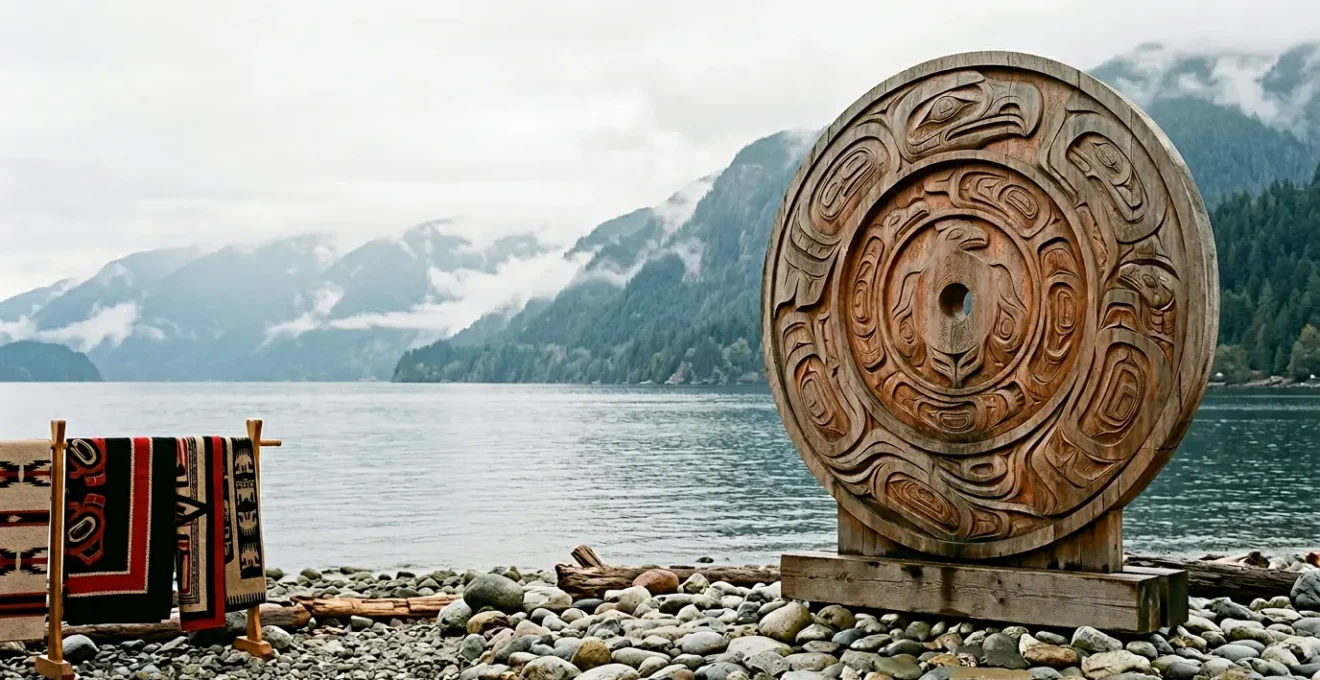
In summary:
- Shift your mindset from a cultural consumer to a respectful witness by learning and following local First Nations protocols.
- Actively support the Indigenous economy by learning how to identify and purchase authentic art and services from verified artists and businesses.
- Understand that land acknowledgements are an invitation to action; use them as a starting point for meaningful engagement, not a final step.
- Deepen your appreciation by learning the stories and meanings behind the art, such as totem poles and distinct regional styles.
You arrive in Vancouver, and the presence of Indigenous culture is immediate and powerful. Towering totem poles greet you in Stanley Park, the art in the airport tells a story, and you hear events begin with an acknowledgement of the Musqueam, Squamish, and Tsleil-Waututh Nations. You feel a deep sense of respect and a desire to learn more. But this desire is often followed by a wave of uncertainty, a quiet but persistent question: “How do I engage with this culture in a way that is honourable and not intrusive?”
Many visitors default to a simple checklist: see the poles, visit the museum, maybe buy a souvenir. While well-intentioned, this approach can miss the heart of the matter. The fear of committing a cultural faux pas, of being an appropriative tourist, is a valid concern. It stems from a recognition that this is not a historical theme park, but a collection of vibrant, living cultures on whose unceded lands you are a guest. The common advice to “be respectful” is true but unhelpful without a practical roadmap.
This guide provides that roadmap. The key is to shift your perspective from that of a consumer to that of a contributor and witness. It’s not about what you can take—photos, souvenirs, experiences—but about what you can give: your attention, your support, and your commitment to understanding. It’s about learning the protocols of engagement. We will move beyond the superficial, providing you with the tools to distinguish art styles, identify authentic works, understand powwow etiquette, and act meaningfully on the land acknowledgements you hear. This is how you transform from a passive tourist into a respectful guest, ensuring your visit contributes positively to the communities you wish to honour.
This article provides a detailed framework for respectful engagement. To help you navigate these important topics, here is a summary of the key areas we will explore.
Summary : A Visitor’s Guide to Honouring Indigenous Culture in Vancouver
- Coast Salish vs Haida: What Is the Difference in Art Styles?
- How to Navigate the Great Hall at MOA in Under 2 Hours?
- The “Made in China” Trap: Identifying Authentic Indigenous Souvenirs
- Powwow Etiquette: 5 Rules Guests Must Follow at Cultural Festivals
- Why Do Every Event in Vancouver Start with a Land Acknowledgment?
- Beyond Souvenirs: Where to Buy High-Fashion Indigenous Clothing?
- The Shoes-Off Rule: How to Visit the Temple Respectfully?
- How to Read a Totem Pole: Understanding the 3 Main Figures?
Coast Salish vs Haida: What Is the Difference in Art Styles?
A common mistake for visitors is to lump all Northwest Coast Indigenous art into a single “totem pole” style. In reality, the art you see in Vancouver represents distinct nations with unique visual languages. Understanding the difference between the local Coast Salish art and the more widely known northern styles like Haida is the first step toward deeper appreciation. Vancouver is located on the traditional, ancestral, and unceded territory of the Musqueam, Squamish, and Tsleil-Waututh—all Coast Salish peoples. Their art is therefore the host nation’s style.
However, as a major cultural and economic hub, Vancouver is also home to people and art from many other nations, including the Haida from Haida Gwaii. This creates a rich artistic tapestry where different styles coexist and can be compared side-by-side.
Case Study: Bill Reid’s Spirit of Haida Gwaii at YVR Airport
At Vancouver International Airport, visitors encounter Bill Reid’s iconic jade canoe sculpture—a masterpiece of Haida formline design—before even entering the city. Coast Salish art is distinct from the totem poles and face masks typical of more northern nations, and Vancouver is now seeing an explosion of interest in Coast Salish public installations. This provides a perfect contrast to the Coast Salish house posts by artists like Susan Point found elsewhere in the terminal, demonstrating why both artistic traditions coexist in the city: Vancouver is geographically on Coast Salish territory, yet serves as a cultural hub displaying the broader Northwest Coast artistic heritage.
The key difference lies in the design elements. Haida art is characterized by its strong, continuous, and flowing “formlines,” which outline subjects filled with iconic shapes like ovoids and U-forms. Coast Salish art, conversely, focuses on the balance between positive and negative space. It utilizes distinct elements like crescents, trigons, and ovals, often arranged within a circular spindle whorl motif, which pays homage to the cultural importance of weaving.
By learning to spot these differences, you move from passively viewing to actively seeing. You begin to recognize the specific visual dialect of the land you are on, while also appreciating the masterpieces from other nations that have found a home in the city.
How to Navigate the Great Hall at MOA in Under 2 Hours?
The Great Hall at the Museum of Anthropology (MOA) at UBC is an awe-inspiring but potentially overwhelming space. Faced with dozens of towering totem poles and massive carvings, many visitors wander aimlessly, snapping a few photos before feeling saturated. A strategic approach is needed to transform a visit from a visual overload into a meaningful experience. While museum guides recommend allocating two to three hours for a full visit, you can have a profound experience in less time by focusing your attention thematically.
Instead of trying to see everything, choose a “micro-tour” to guide your path. This allows you to follow a narrative thread through the hall, connecting pieces and building a deeper understanding. By focusing on a specific theme, you shift from consumption to contemplation, allowing the stories embedded in the carvings to reveal themselves.
Here are some thematic approaches to consider:
- The Host Nation’s Welcome (30 minutes): Begin with the Musqueam house posts and artifacts near the entrance. This grounds you in the specific territory you are on—the xʷməθkʷəy̓əm people’s ancestral land—before you explore art from other nations.
- The Trickster’s Trail (45 minutes): Follow the story of the Raven, a central Creator/Trickster figure, through 5-6 different poles and carvings. Observe how this powerful being is depicted in various forms and contexts.
- The Matriarch’s Path (30 minutes): Focus specifically on poles and figures that depict powerful women. This provides insight into the matrilineal traditions prevalent in many Northwest Coast cultures, where lineage and inheritance pass through the mother’s side.
- Then and Now Connection: Pair a historic pole in the Great Hall with work by a living artist featured elsewhere in MOA or a downtown gallery. This helps you understand that Indigenous culture is not static but a living, evolving tradition.
Perhaps the most powerful technique is the “Single-Pole Meditation.” Choose one pole that resonates with you. Sit nearby for ten minutes and simply observe. Notice the tool marks, the expressions on the figures, the texture of the wood. This simple act of focused attention is a profound form of respect and can be more rewarding than rushing to see every piece in the hall.
The “Made in China” Trap: Identifying Authentic Indigenous Souvenirs
Wanting to bring home a piece of art is a natural way to commemorate your visit and support artists. However, Vancouver’s souvenir shops are flooded with “Indigenous-style” items—often mass-produced overseas—that mimic authentic art but provide no benefit to Indigenous communities. Falling into this “Made in China” trap is a common fear for conscientious travelers. Learning to distinguish authentic work from imitations is a critical skill for respectful engagement and a direct way to participate in what is known as economic reconciliation.
When you purchase authentic art, you are doing more than acquiring an object; you are supporting an artist’s livelihood, validating a cultural tradition, and contributing to the economic sovereignty of a community. The price difference between a genuine, hand-crafted piece and a knock-off reflects this immense cultural and economic value. The key is to look for signs of authenticity that go beyond the artwork itself.
Case Study: Authentic Indigenous Designation Criteria in British Columbia
Indigenous Tourism BC’s ‘Authentic Indigenous’ Designation recognizes Indigenous-owned businesses that meet three crucial pillars: offering culturally authentic experiences, supporting community economic wellbeing, and making strong efforts to protect both culture and the environment. This certification, as detailed in the Authentic Indigenous criteria, ensures that your purchase directly contributes to cultural preservation and the economic sovereignty of First Nations communities. Choosing certified businesses transforms a simple transaction into an act of meaningful support.
Authentic pieces are almost always signed by the artist, often with their nation affiliation. The materials and craftsmanship will feel substantial. But the most reliable method is to follow a clear authentication process and shop at trusted venues.
Your Checklist for Authenticating Indigenous Art
- Look for the ‘Authentic Indigenous’ certification logo from Indigenous Tourism BC; this guarantees the item meets strict cultural authenticity criteria.
- Check for the artist’s name and nation on the piece or its tag. Authentic work always credits the creator, unlike generic “Indigenous-style” labels.
- Perform the “Digital Trail” test: Search the artist’s name online. A real Indigenous artist will typically have a verifiable presence, such as a website, gallery representation, or social media.
- Read labels meticulously to distinguish between “Made by an Indigenous artist” versus “Indigenous-inspired.” The latter is not authentic.
- Shop at verified locations like the Skwachàys Lodge gallery, the Bill Reid Gallery shop, or other businesses listed on the Indigenous Tourism BC directory.
Powwow Etiquette: 5 Rules Guests Must Follow at Cultural Festivals
Attending a powwow is a vibrant and powerful experience—a celebration of song, dance, and community. As a guest, you are being welcomed into a space that is both social and deeply sacred. To honour this invitation, it’s crucial to understand and follow the established etiquette. This is not a performance for tourists; it is a living cultural event with its own set of protocols. Your respectful observance is your most important contribution.
The Master of Ceremonies (MC) is your guide for the day. Listen closely to their announcements, as they will indicate when to stand, when it’s appropriate to take photos, and when guests are invited to dance. Their direction supersedes any general rule. The most fundamental principle is to approach the event with humility and a willingness to learn. As the Canadian Powwows Organization clearly states, this is a place of reverence.
A Pow Wow is a cultural event, not a party. Alcohol, drugs and firearms are never allowed on the premises.
– Canadian Powwows Organization, Powwow Etiquette Guidelines
To ensure your presence is a positive one, keep these five essential rules in mind:
- Use the word ‘regalia,’ never ‘costume.’ A dancer’s regalia is a collection of sacred, handmade items, often carrying deep personal and family history. It is not a costume. Never touch a dancer’s regalia, especially eagle feathers, or any ceremonial items like drums, without explicit permission.
- Stand and remove hats during sacred moments. This includes the Grand Entry (the opening procession), all prayer songs, and the Flag Song, which is an Indigenous national anthem. The MC will announce these moments.
- Ask permission before photographing individuals. While group shots of the Grand Entry are generally acceptable, taking pictures of individual dancers, especially children, requires their explicit consent. Photography is always forbidden during prayers and ceremonies.
- Participate only when invited. The MC will announce “Intertribal” dances, which are open to everyone—including non-Indigenous guests. This is your invitation to join the dance circle. Don’t worry about having the “right” steps; simply be mindful of the space and enjoy the spirit of the dance.
- Support the community. Powwows are often run by volunteers. Show your appreciation by purchasing food from vendors, buying art directly from artists at their booths, and participating in “blanket dances,” where you can make a monetary donation to help support the dancers and organizers.
Why Do Every Event in Vancouver Start with a Land Acknowledgment?
You’ll quickly notice that nearly every public event in Vancouver—from a hockey game to a city council meeting—begins with a land acknowledgement. A speaker will state that the event is taking place on the “traditional, ancestral, and unceded territories of the Musqueam, Squamish, and Tsleil-Waututh peoples.” For a visitor, this might seem like a formal, repetitive script. But for those who live here, it is a crucial and constant reminder of a fundamental truth about the land itself.
The key word is “unceded.” This means that these lands were never legally surrendered, sold, or won in a war by settlers or the Canadian government. The First Nations of this region never signed away their rights to the land through treaties. Therefore, the acknowledgement is a recognition of this fact and a sign of respect to the host nations who have stewarded this land for millennia. It is the first step in a long process of truth and reconciliation. With Vancouver has the third largest urban Indigenous population in Canada, this is not just a historical issue but a contemporary one.
However, for both locals and visitors, the acknowledgement cannot be the only step. It is meant to be a starting point, an invitation to learn more and take meaningful action. As a visitor, hearing a land acknowledgement is your cue to ask, “How can I honour this statement during my visit?” The answer lies in actively engaging with the cultures of the host nations.
Here’s how you can act on a land acknowledgement in Vancouver:
- Visit the Musqueam Cultural Centre Gallery: Go directly to the source. Learn about the art and history of the people on whose land much of southern Vancouver, including UBC and the airport, is located.
- Eat at Salmon n’ Bannock Bistro: Support the only Indigenous-owned and operated restaurant in Vancouver. Experience traditional ingredients and flavours of the West Coast.
- Book an Indigenous-led Tour: Experience the land through the eyes of its traditional stewards. Companies like Talaysay Tours (Squamish/Sechelt) and Takaya Tours (Tsleil-Waututh) offer walking, hiking, and canoe tours rich with traditional stories.
- Support Indigenous Businesses: Use the acknowledgement as a prompt to seek out and support Indigenous-owned galleries, shops, and services. This is how you turn a passive statement into an active contribution.
Beyond Souvenirs: Where to Buy High-Fashion Indigenous Clothing?
Indigenous artistry in Vancouver extends far beyond the carvings and prints found in gift shops. A powerful movement in contemporary Indigenous fashion, or “wearable art,” is thriving, blending traditional design principles with modern silhouettes. This is where culture becomes a vibrant, living statement, worn with pride by Indigenous and non-Indigenous people alike. For a visitor, purchasing a piece of high-fashion Indigenous clothing is a profound way to support a designer’s vision and carry a piece of contemporary culture home.
These garments are more than just clothing; they are stories woven into fabric. Designers often incorporate formline designs, Coast Salish spindle whorl motifs, or clan crests into their work, re-contextualizing ancient symbols for a modern world. This is not fast fashion. It is a deeply intentional act of cultural preservation and artistic expression. Finding these pieces requires looking beyond the main tourist drags and seeking out the galleries and boutiques that champion this work.
Case Study: Skwachàys Lodge: Indigenous Art Hotel and Fashion Hub
Located in Vancouver’s Gastown, Skwachàys Lodge is a unique social enterprise that functions as a boutique hotel, gallery, and residence for Indigenous artists. The gallery on the main floor is a crucial hub for high-fashion Indigenous designers. Here, visitors can find wearable art from local Coast Salish artists who skillfully incorporate traditional motifs into contemporary fashion. As highlighted by guides to Vancouver’s cultural landmarks, purchasing from the lodge directly supports the artists-in-residence program, acting as both an economic and cultural engine for the community.
To find these unique pieces, you need to know where to look. Here are some starting points for discovering high-fashion Indigenous designers in Vancouver:
- Gastown Galleries: Begin at the Skwachàys Lodge gallery and explore other Indigenous-owned shops in the area, which often feature designers who blend traditional patterns with modern styles.
- Bill Reid Gallery Gift Shop: The shop at this downtown gallery is expertly curated, featuring high-quality jewelry, textiles, and wearable art from established Northwest Coast artists.
- South Granville Galleries: The high-end art galleries in this neighbourhood sometimes feature contemporary Indigenous artists who work with textiles and fashion.
- Indigenous Cultural Events: Festivals like the Talking Stick Festival or National Indigenous Peoples Day celebrations often feature pop-up markets where emerging and established designers showcase their latest collections.
The Shoes-Off Rule: How to Visit the Temple Respectfully?
The “temple” in the context of Vancouver’s Indigenous cultures isn’t a single building but a worldview that holds certain places, objects, and even the land itself as sacred. Respecting these spaces requires a protocol that goes beyond what’s expected in a typical museum or gallery. The “shoes-off rule” is a literal practice in some spaces, like longhouses, but it serves as a powerful metaphor for the overall mindset required: tread lightly, speak softly, and act with intention.
This protocol stems from a worldview where the line between the physical and spiritual is porous. Certain masks are not just artifacts but are considered to have living spirits. Certain sites are not just scenic spots but places of ceremony and history. As a guest, your role is to be a quiet, respectful witness. This perspective is beautifully articulated by Destination Vancouver’s guide on Indigenous tourism.
From the rocks to the treetops and the creatures who walk, fly, crawl, and swim, Indigenous worldviews include all elements of territory as land.
– Destination Vancouver, Indigenous Tourism in Vancouver Guide
This understanding of land as sacred territory informs the protocol for various spaces. Here’s a practical guide:
- In a Longhouse: At a place like the Squamish Lil’wat Cultural Centre in Whistler (a common day trip from Vancouver), you will be asked to remove your shoes before entering the longhouse. This is a sign of respect for a ceremonial space. Speak in hushed tones and follow all staff guidance.
- In Galleries and Museums: Be aware of photography restrictions. At the Musqueam Cultural Centre, for example, you may be told not to photograph certain masks or artifacts. This is because they are considered living beings, not objects for consumption. Maintain a respectful distance and silence when viewing these items.
- In Friendship Centres: If you visit an urban Indigenous community space like a Friendship Centre, wait to be invited in. Do not touch drums, regalia, or other ceremonial items unless they are explicitly offered to you by your hosts.
- On the Land: When hiking in areas known to be culturally significant, the protocol is one of minimal impact. This means staying on trails, not climbing on certain rock formations, and not removing anything from the site—not even a stone. The land itself is the sacred space.
Key Takeaways
- The cornerstone of respectful engagement is shifting your mindset from a tourist consuming sights to a witness supporting a living culture.
- Authenticity is verifiable. Support the Indigenous economy by learning to identify genuine art through artist credits, certifications, and trusted vendors.
- Land acknowledgements are a call to action. Use them as a cue to actively support Indigenous-owned businesses, tours, and cultural centres.
How to Read a Totem Pole: Understanding the 3 Main Figures?
Totem poles are one of the most iconic symbols of the Northwest Coast, but they are often misunderstood. They are not religious idols, but magnificent monuments that tell stories, proclaim family lineages, and commemorate historical events. Learning to read a totem pole is less about deciphering a foreign language and more about recognizing a visual vocabulary of crests and figures. The most common misconception is that the figures’ importance is dictated by their position, encapsulated in the incorrect English phrase, “low man on the totem pole.”
In reality, the most important figure on a pole can be at the bottom (closest to the people), at the top (watching over all), or in the middle. The position is part of the artistic composition, not a hierarchy of power. As detailed by UBC’s Indigenous Foundations project, understanding the different types of poles is also crucial to reading them correctly. What a visitor sees in Stanley Park or at MOA is a collection of different kinds of monumental carvings, each with a distinct purpose.
| Pole Type | Purpose | Where to See in Vancouver | How to Identify |
|---|---|---|---|
| House Frontal Poles | Tell family history and display crests | MOA Great Hall Musqueam house posts | Wide, positioned at building entrances, often with an opening at base |
| Memorial Poles | Honor an individual or commemorate an event | Stanley Park collection | May feature specific regalia or symbols associated with the honored person |
| Mortuary Poles | Traditionally held remains of deceased | Historical examples at MOA | Cavity or box at top; rarely created in contemporary times |
| Welcome Figures | Coast Salish tradition of welcoming visitors | YVR Airport, Musqueam territory | Single standing figures with outstretched arms, distinct from northern totem poles |
While there are hundreds of figures, recognizing a few of the main characters can unlock the stories on many poles. Here is a quick guide to some of the most prominent figures:
- Raven (Creator/Trickster): The most common figure, identifiable by a long, straight beak. Raven is a magical being who can transform at will. He is a culture hero responsible for bringing light to the world, but he is also a trickster whose greed and antics get him into trouble.
- Eagle (Power/Prestige): A symbol of power and authority, distinguished by a short, sharply curved beak. Eagle is a noble creature who can travel between the physical and spiritual worlds, often representing a chief or high-ranking family.
- Bear (Family/Strength): Recognizable by a wide mouth, prominent teeth, rounded ears, and paws with claws. The Bear is a close relative of humans and represents family, strength, and the connection between the human and animal realms.
- Thunderbird (Supernatural Power): A massive, powerful supernatural bird with a curved beak and often depicted with outstretched wings or curled horns. The Thunderbird creates thunder by flapping its wings and lightning by blinking its eyes.
Your journey of respectful engagement begins not upon arrival at a sacred site, but in the quiet moments of learning beforehand. By internalizing these protocols and the reasons behind them, you transform your visit. You are no longer just a tourist looking at beautiful objects; you are a respectful guest honouring a living culture, supporting its artists, and contributing, in a small but meaningful way, to the ongoing story of this land. Start now by exploring the galleries, parks, and communities of Vancouver with this new understanding, confident that your presence, guided by respect, is a welcome one.