In summary:
- Gastown’s biggest tourist trap, the Steam Clock, is overwhelmed by cruise ship crowds; visit on weekday mornings or late evenings.
- For evening safety, always choose the well-lit, populated Water Street over the quieter, more exposed Cordova Street.
- The charming cobblestones are a genuine hazard; wear flat, waterproof shoes with good grip to avoid slips and twisted ankles.
- Understanding the “why” behind the high prices and local fashion is key to appreciating the neighbourhood’s authentic character.
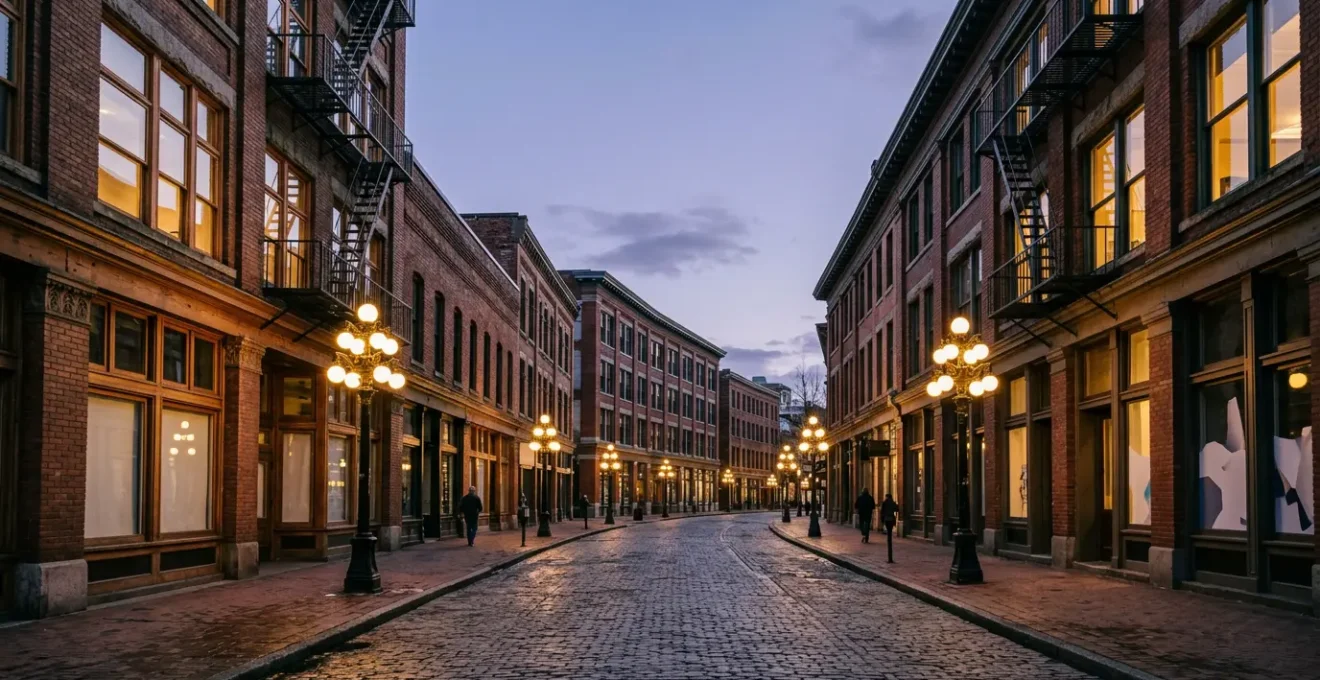
You’ve seen the pictures: a quaint cobblestone street, Victorian architecture, and a whimsical steam-belching clock. Gastown is the historic heart of Vancouver, a place every travel guide insists you must visit. But as a solo female traveler, you know the reality of an old urban neighbourhood can be more complex. The charming photos rarely show the crushing tourist crowds, the noise, or the proximity to the challenging realities of the Downtown Eastside. Generic advice like “be aware of your surroundings” isn’t just unhelpful; it’s insulting to your intelligence.
Most guides will give you a simple checklist: see the clock, walk the streets, visit a pub. They treat Gastown like a theme park. But what if the key to truly and safely enjoying this neighbourhood wasn’t just seeing the sights, but understanding the story behind them? The real Gastown exists in the tension between its carefully preserved past and its demanding urban present. It’s in knowing why the crowds flock to one spot at a specific time, why those brick lofts cost a fortune despite the street noise, and why everyone seems to be wearing high-tech rain gear to a fancy dinner.
This is not a typical tourist guide. This is a local’s briefing, designed to equip you with the “why” behind the “what.” We’ll deconstruct the common tourist experiences to give you the strategic knowledge needed to navigate Gastown with confidence. By understanding the neighbourhood’s rhythms, pressures, and unwritten rules, you can bypass the traps, stay safe, and connect with the authentic, resilient spirit of Vancouver’s birthplace.
To help you navigate this iconic area like an insider, we’ve broken down the essential knowledge you need. This guide will walk you through everything from timing your visits to decoding local culture, ensuring your experience is both memorable and secure.
Summary: Your Insider’s Map to Navigating Gastown’s Reality
- Why You Should Never Visit the Steam Clock at Noon on a Saturday?
- Brick and Beam: Why Are Gastown Lofts So Expensive despite the Noise?
- Water Street or Cordova: Which Route is Safer to Walk After Dinner?
- The 3 Boutiques in Gastown You Can’t Find anywhere Else in Canada
- The Great Fire of 1886: What Remains of the Original Gassy Jack Saloon?
- Gorpcore Chic: Why Does Everyone Wear Arc’teryx to Dinner?
- The “Hidden” Cost: How Much to Tip Your Food Guide in Vancouver?
- Why You Should Wear Flat Shoes When Visiting Water Street in Gastown?
Why You Should Never Visit the Steam Clock at Noon on a Saturday?
The number one rule for enjoying Gastown’s most famous landmark is to understand what drives the crowds. The answer isn’t just the clock’s charming whistle; it’s the massive influx of tourists from the nearby cruise ship terminal at Canada Place. A weekend visit, especially midday on a Saturday, means you’ll be competing for a view with thousands of passengers who have just disembarked. The Vancouver port is a major hub, and it’s not uncommon for its traffic to approach 1.32 million passengers in a peak season, with Saturdays being the busiest turnover day. This transforms the area around the clock into a congested, impersonal photo-op.
To experience the clock without the chaos, you need a strategy. The goal is to time your visit to avoid this predictable human tide. The most magical time to see the clock is actually after 9 PM. The crowds have thinned, the tour buses are gone, and the clock is beautifully illuminated against the dark brick buildings, creating a much more atmospheric and personal experience. If a nighttime visit doesn’t fit your schedule, the second-best option is an early weekday morning, between 7 and 9 AM. You’ll share the street with locals grabbing their morning coffee, not a sea of selfie sticks.
Your Steam Clock Strategy: A Local’s Guide to Timing
- Check the Vancouver Port cruise ship schedule before you go. The peak crowds directly correlate with docked ships, especially when multiple vessels arrive on a Saturday.
- Plan your visit for after 9 PM. The clock is beautifully lit, the tourist crowds have dispersed, and the atmosphere is far more peaceful and dramatic.
- Consider an early weekday morning visit (7-9 AM) to see the clock before the tour groups arrive from the cruise terminal.
- For a more authentic horological experience, focus on the neighbourhood’s character and architecture rather than waiting in a crowd for the brief steam-whistle show.
Ultimately, the Steam Clock is a novelty. Its true value is as a landmark that anchors you in a historic district. By treating it as a strategic point of interest rather than a must-see spectacle, you reclaim the experience and enjoy it on your own terms.
Brick and Beam: Why Are Gastown Lofts So Expensive despite the Noise?
Walking through Gastown, you’ll notice the stunning heritage lofts with their exposed brick walls and massive timber beams. You might also notice the street noise, the sirens, and the general hum of a dense urban core. This begs the question: why are these properties so expensive, with prices often ranging from $500,000 to over $1 million? The answer lies in a concept locals understand as the “heritage premium.” You’re not just paying for square footage; you’re paying for authenticity, character, and a piece of Vancouver’s history.
This premium is actively shaped by city policy. Following the Great Fire of 1886, a mandate for masonry construction created the architectural DNA of Gastown. Today, the city’s Heritage Revitalization Agreement (HRA) incentivizes the preservation of these historic buildings. This policy intentionally limits new construction supply while requiring costly conservation standards, which naturally drives up prices. Owners are essentially compensated for maintaining the neighbourhood’s character, and that cost is passed on to buyers and renters who value aesthetic history over modern, cookie-cutter condos.
As the case study below explains, this ecosystem attracts a specific demographic: creative-class professionals and entrepreneurs who see the value in this “Brick and Beam” aesthetic. For them, the history and character are not bugs; they are the primary features. Many of these lofts also have live/work zoning, allowing residents to justify the premium price by using the space for both their home and their business, further cementing Gastown’s status as a hub for the creative economy.
Case Study: The Heritage Premium in Action
Vancouver’s Heritage Revitalization Agreement (HRA) zoning specifically encourages the preservation of Gastown’s 1886-1914 era buildings. This policy-driven approach intentionally limits new supply while mandating expensive heritage conservation standards, directly driving up costs. The City’s Gastown Heritage Management Plan offers financial incentives to building owners for conservation, creating a ‘heritage premium’ that attracts creative-class professionals valuing aesthetic character over modern amenities. Many lofts feature live/work zoning, allowing entrepreneurs to justify premium pricing by using spaces for both residential and commercial purposes.
Water Street or Cordova: Which Route is Safer to Walk After Dinner?
This is one of the most practical and important questions for any solo traveler in Gastown. After a lovely dinner, you need to walk back to your transit stop or hotel. The two main east-west arteries are Water Street and Cordova Street, running parallel to each other. While only a block apart, they offer vastly different experiences and safety levels after dark. The unequivocal advice is to stick to Water Street.
Water Street is Gastown’s main tourist thoroughfare. Until at least 10 PM, it remains relatively populated. Its sidewalks are lined with restaurant patios, shop windows are lit, and there’s a general sense of “eyes on the street.” More importantly, the Gastown Business Improvement Association (BIA) funds uniformed security patrols who are a visible presence along Water Street, providing a crucial layer of safety. These patrols act as a deterrent and a resource if you feel uncomfortable. Think of the active, well-lit patios and storefronts as your safety anchors—stay within sight of them.
Cordova Street, on the other hand, is a different story. While busy with traffic, its pedestrian environment changes dramatically after business hours. The south side of Cordova is the effective northern boundary of the Downtown Eastside (DTES). After 10 PM, especially on the stretch between Abbott and Carrall Streets, it can become poorly lit and feel deserted. While not inherently dangerous, it lacks the comforting activity and official security presence of Water Street, making it a less comfortable choice for a solo walker at night. If you must travel east, Alexander Street can be an alternative, as its residential character provides some “eyes on the street,” but it still lacks the commercial lighting of Water.
The rule is simple: after dinner, make Water Street your default route. Its combination of light, people, and security is a conscious design for visitor safety that you should absolutely take advantage of.
The 3 Boutiques in Gastown You Can’t Find anywhere Else in Canada
Gastown is celebrated for its independent boutiques, but the real gems are the ones that offer something so unique to this place that you can’t find it anywhere else in the country. These aren’t just shops; they’re cultural institutions that tell the story of Vancouver. Instead of generic souvenir shops, seeking out these three will give you a far more authentic and meaningful connection to the city.
First is the Inuit Gallery of Vancouver (206 Cambie St). Established in 1979, this is not a typical art shop but a respected gallery offering museum-quality Inuit and Northwest Coast First Nations art. It’s a powerful place to connect with the deep Indigenous heritage of the region, and visiting acknowledges that Gastown stands on the unceded traditional territories of the Musqueam, Squamish, and Tsleil-Waututh peoples—a crucial piece of modern Vancouver’s identity.
Second, you cannot miss the flagship store of John Fluevog Shoes (65 Water St). Fluevog is a quintessentially Vancouver brand, and this location houses his design studio. The bold, architectural, and often eccentric shoes perfectly embody Gastown’s creative and historical spirit. It’s more than a shoe store; it’s a pilgrimage site for design lovers and a testament to the neighbourhood’s role as a launchpad for local talent. Lastly, visit Coastal Peoples Fine Arts Gallery (332 Water St). This Indigenous-owned gallery is a stunning showcase of Northwest Coast and Inuit art, from intricate carvings and jewelry to woven baskets. It reflects Vancouver’s strong “shop local” ethos and offers a chance to purchase an authentic piece of Canadian cultural heritage directly from a gallery that supports the artists and their communities.
These three boutiques offer more than just products; they offer a narrative. They represent the intersection of Indigenous culture, local creative entrepreneurship, and historical preservation that makes Gastown truly one-of-a-kind.
The Great Fire of 1886: What Remains of the Original Gassy Jack Saloon?
Visitors often come to Gastown looking for a tangible link to its founder, “Gassy” Jack Deighton, and his original 1867 saloon. The simple, brutal answer is: absolutely nothing. The original Gastown, a frontier town of wooden shacks and saloons, was completely obliterated by the Great Vancouver Fire on June 13, 1886. The fire swept through the entire settlement in a matter of minutes, leaving only ashes in its wake. Not a single board from the original Gassy Jack Saloon survived.
However, the fire’s true legacy is not what it destroyed, but what it created. The devastating event led city leaders to immediately enact a new architectural mandate: all new buildings had to be constructed from fire-resistant brick and masonry. This single ordinance is the reason Gastown has its iconic “Brick and Beam” Victorian aesthetic today. The neighbourhood you see is a direct result of the fire, a resilient community rebuilt from the ground up with structures designed to endure. So, while the original saloon is gone, its spirit is embedded in the very fabric of the buildings from the 1886 to 1914 reconstruction era.
It’s also important to view this history with a modern, critical lens. The famous statue of Gassy Jack, which once stood in Maple Tree Square, became a point of controversy. Indigenous historians and community members highlighted the more complex and troubling parts of his story, specifically his marriage to a 12-year-old Squamish girl, Kwalh-lia. This provides a much-needed counter-narrative to the cheerful “pioneer” story often promoted to tourists. The statue was toppled in 2022, reflecting the city’s ongoing, and often difficult, conversation with its colonial past. The absence of the statue is now as much a part of the story as its presence once was.
Gorpcore Chic: Why Does Everyone Wear Arc’teryx to Dinner?
You’ll quickly notice a distinct uniform in Vancouver, even in a trendy neighbourhood like Gastown: high-end technical outdoor gear worn as everyday fashion. It’s common to see someone in a $1,000 Arc’teryx shell jacket at a fine dining restaurant. This aesthetic, often dubbed “gorpcore,” can be confusing for visitors, but it’s a direct expression of the local “Sea-to-Sky Lifestyle.” This isn’t just about looking outdoorsy; it’s about a culture where people genuinely live that life.
Arc’teryx, a brand that originated in North Vancouver, is a point of immense local pride. For a Vancouverite, wearing it is a nod to the city’s identity as a global leader in high-performance outdoor gear. More practically, people use this clothing for its intended purpose. It’s entirely normal for someone to go for a hike on the North Shore mountains in the morning, ski at Whistler, or kayak in Deep Cove, and then come downtown for dinner without changing. The clothing’s functionality is primary, and its transition to an urban setting is a natural extension of that. The infamous Vancouver rain also makes a high-quality waterproof jacket a practical necessity, not a luxury.
That said, there is undeniably a status component. An Alpha SV jacket serves the same social signaling purpose in Vancouver as a luxury handbag or watch might in other global cities. It communicates an active lifestyle, an appreciation for quality design, and, of course, a certain level of disposable income. It’s a subtle code that says, “I belong here.”
How to Blend In: Gorpcore on a Budget
- Vessi: A Vancouver-based brand famous for its stylish, 100% waterproof knit sneakers. Perfect for rainy days on the cobblestones.
- Reigning Champ: Known for high-quality, minimalist athletic wear and basics. Great for layering and achieving that understated, quality look.
- Lululemon: Born in Vancouver, its technical apparel transitions seamlessly from a yoga class or hike to a casual dinner.
- Blundstone Boots: Though not local, these Australian boots are a near-universal part of the Vancouver uniform for their practicality, durability, and casual-dressy versatility.
The “Hidden” Cost: How Much to Tip Your Food Guide in Vancouver?
Taking a food tour is one of the best ways to experience Gastown’s culinary scene. You get to sample a variety of dishes while learning about the neighbourhood’s history. But at the end of the tour, many visitors are faced with an awkward uncertainty: are you supposed to tip the guide, and if so, how much? The answer is a resounding yes, tipping is expected and greatly appreciated.
In Vancouver, a food tour guide is considered part of the service industry, much like a waiter or bartender. The standard tipping etiquette for excellent service applies here. The appropriate amount is between 15-20% of the pre-tax price of the tour, per person. For example, if your tour cost $100, a tip of $15-$20 is the norm. While the tour price covers the cost of the food samples you enjoy, the tip is a direct reward for the guide’s personal service, expertise, and a significant part of their income.
It’s important to understand the “why” behind this. Many talented food tour guides in Vancouver work as freelancers or gig workers. The fee you pay the tour company covers the food and operational costs, but the guide’s take-home pay is often modest. Tips make up a substantial portion of their earnings and acknowledge the skill involved in curating the tour, managing logistics, telling compelling stories, and making sure every guest has a safe and enjoyable experience over the 2-3 hour journey. While most guides are equipped to accept tips via credit card on mobile apps, carrying some Canadian cash is always a welcome and considerate gesture. You can hand it to them discreetly as you say your goodbyes.
Think of it as tipping for a multi-course meal where the chef is also your storyteller and city expert. Acknowledging their effort with a proper tip is a key part of participating respectfully in the local culture.
Key takeaways
- Strategic timing is everything: avoid cruise ship schedules to experience Gastown’s landmarks without the overwhelming crowds.
- Prioritize safety after dark by sticking to the well-lit and populated Water Street, using its active patios and security patrols as your guide.
- The neighbourhood’s iconic cobblestones are a real hazard; practical, waterproof footwear with good grip is non-negotiable for comfort and safety.
Why You Should Wear Flat Shoes When Visiting Water Street in Gastown?
This piece of advice might seem obvious, but its importance cannot be overstated. Recommending flat shoes for Gastown isn’t just about comfort; it’s a serious matter of safety. The neighbourhood’s famous “cobblestone” streets are actually historic brick pavers, and they are notoriously difficult and even treacherous to walk on. As the City of Vancouver notes, “the iconic red bricks were originally installed in the 1970’s” by hand to replicate the area’s historic character, but this has resulted in a surface that is charming to look at but challenging to navigate.
The pavers have significant gaps, uneven slopes, and unexpected dips that are perfect for twisting an ankle. This hazard is magnified tenfold by Vancouver’s most reliable feature: rain. When wet, the bricks become incredibly slick, and the unevenness creates hidden puddles. For this reason, waterproof shoes with excellent grip are more important than just being flat. Heels are an absolute non-starter unless you want to risk a fall.
You need to be particularly cautious at intersections, where the brickwork slopes to meet the asphalt. The crosswalk at the corner of Water Street and Cambie Street is a well-known “ankle-breaker” due to its steep, slanted grade. Locals learn to navigate these streets with a certain practiced ease, and their footwear choice is a dead giveaway. You’ll see a sea of Blundstones, Vessi waterproof sneakers, and waterproof trail runners—shoes that prioritize stability and weather protection. Choosing similar footwear will not only keep you safe and comfortable but will also help you blend in with the locals, marking you as a savvy visitor rather than a struggling tourist.
Don’t let a poor shoe choice ruin your day. Prioritize practical, sturdy, and ideally waterproof footwear. Your feet—and your ankles—will thank you.
Now you’re equipped with more than just a map; you have a local’s insight. You understand the rhythms of the crowds, the story behind the architecture, and the practicalities of the streets. Go explore Gastown with confidence, ready to appreciate its complex beauty, connect with its authentic culture, and navigate its streets smartly.