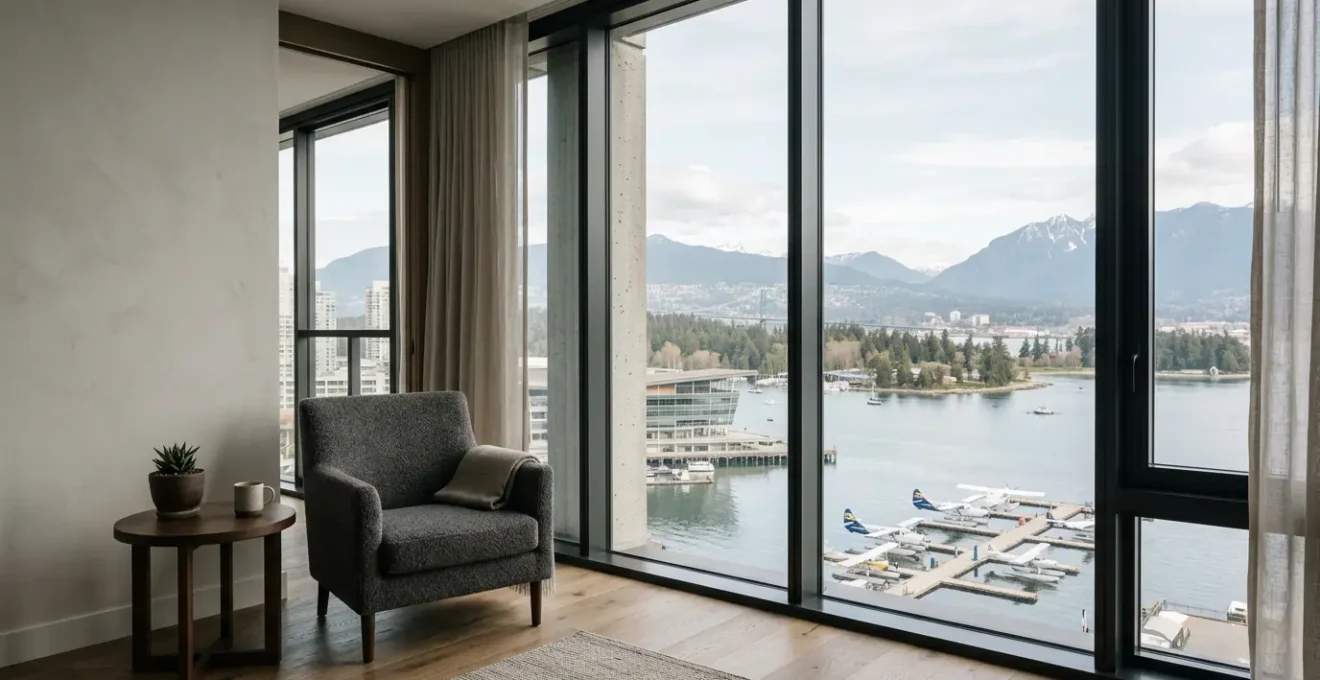
The “best” Vancouver view isn’t a static choice between water and mountains; it’s a dynamic experience you must actively choreograph based on your schedule, the season, and your tolerance for urban energy.
- A harbour view offers a vibrant, ever-changing scene of seaplanes and ships but comes with potential noise and cruise ship obstructions.
- A mountain view provides serene, majestic beauty, but misses the uniquely kinetic energy of the waterfront.
Recommendation: Before clicking “upgrade,” ask yourself: Am I directing a serene nature documentary or a bustling urban film? The answer determines where your $100 is best invested.
You’re there, on the final booking screen for that special occasion trip to Vancouver. The moment of decision arrives: “Upgrade to Harbour View for $100.” It’s a classic hotel dilemma, often simplified to a choice between the tranquil blues of the water and the majestic greens of the mountains. Many guides will tell you it’s a matter of personal preference, a simple choice between boats and trees. But as a hotel general manager, I can tell you that this decision is far more nuanced and strategic. It’s not just about what you see, but *how*, *when*, and *if* you see it.
That $100 isn’t just for a different window pane. It’s an investment in a specific sensory experience. The real question isn’t “Harbour or Mountain?” but “What kind of visual story do I want to be a part of during my stay?” The answer involves a calculus of morning light, seaplane schedules, cruise ship routes, and even the astronomical quirks of a northern city. It’s about visual choreography.
This guide moves beyond the generic advice. We will delve into the practical realities that determine the true value of your view. We’ll analyze the soundscape of the harbour, pinpoint the exact rooms with the most iconic views, discuss the logistics for world-class events, and even reveal how to predict if a giant cruise ship will become your temporary new neighbour. Your room shouldn’t just have a view; it should be the director’s chair for your own Vancouver scenic masterpiece.
To help you make the most informed decision for your special stay, this article breaks down the key factors that define the value of a Vancouver hotel view. Follow along as we explore each element in detail.
Summary: A General Manager’s Guide to Choosing Your Vancouver View
- The Takeoff Noise: Is a Harbour View Room Too Loud in the Morning?
- Canada Place Views: Which Pan Pacific Rooms Look Directly at the Sails?
- Glass vs Railing: Which Balconies Are Best for Time-Lapse Photography?
- The English Bay Premium: How Far in Advance to Book for Celebration of Light?
- The Blocked View: Will a Cruise Ship Obstruct My Water View on Tuesday?
- Why Sunset at English Bay Happens Later Than You Think in June?
- The Altitude Reservation: Does Eating at the Observatory Include the Gondola Ticket?
- Fairmont Pacific Rim or Shangri-La: Which Luxury Hotel Has the Best Spa?
The Takeoff Noise: Is a Harbour View Room Too Loud in the Morning?
The first thing to understand about a prime Vancouver harbour view is that it’s a living, breathing, and sometimes roaring spectacle. The iconic image of seaplanes gracefully taking off from Coal Harbour is a huge part of the city’s charm. However, what’s charming from a distance can be an awakening up close. The Vancouver Harbour Flight Centre is one of the busiest seaplane terminals in the world. During peak summer months, there can be over 160 flights operating daily, starting from the early morning.
So, is it “noise” or “energy”? That truly depends on you. For a light sleeper dreaming of a quiet, lazy morning, the drone of turbines might be a frustrating feature. For an early riser or an aviation enthusiast, it’s the city’s pulse—a front-row seat to the kinetic energy of the West Coast. As one aviation journalist noted, even when close to the action, the experience is unique. The writer from the Runway Girl Network remarked on a flight: “It is not a quiet affair, with two turbines raging only a few feet away, but I don’t mind the noise (also, the ear plugs help).”
As a manager, I advise guests to frame it this way: a mountain view offers silence and stillness, while a harbour view offers a dynamic, industrial-chic performance. If your special occasion involves sleeping in until noon, a mountain-facing room or a very high floor on the harbour side might be a wiser investment. If you’re excited by the thrum of a city in motion, then the harbour view is your stage.
Canada Place Views: Which Pan Pacific Rooms Look Directly at the Sails?
Not all “harbour views” are created equal, especially when a specific landmark is your target. For many visitors, the quintessential Vancouver view includes the iconic white sails of Canada Place. If this is the visual centerpiece you’re paying for, you need to know that room selection is more science than art. At the Pan Pacific Vancouver, which is located right at Canada Place, the hotel’s architecture plays a critical role in the view you receive. This is where insider knowledge becomes invaluable.
The hotel is essentially divided into wings, and your room’s location determines your perspective. Based on the hotel’s own room descriptions, the visual choreography is clear. The West Wing rooms are specifically positioned to offer direct, often dramatic, views of the Canada Place sails, with Stanley Park and the North Shore mountains completing the panorama. Conversely, harbour view rooms in the East Wing face more towards the industrial port and Burrard Inlet, offering stunning sunrise vistas over Mount Baker but largely missing the famous sails.
For the guest seeking the ultimate photographic composition, the hotel’s corner suites, particularly those in the “-01” series, are the coveted prize. These rooms provide multiple angles, allowing you to capture the sails from different perspectives as the light changes throughout the day. When booking, it’s not enough to ask for a “harbour view”; for the best results, you should inquire about a room in the West Wing for that picture-perfect shot of the sails.
Glass vs Railing: Which Balconies Are Best for Time-Lapse Photography?
For the guest whose special occasion will be documented and shared, the composition of the balcony is as important as the view beyond it. The choice between a glass-panelled balcony and one with a traditional metal railing can significantly impact your photographic and videographic pursuits, especially for something as precise as a time-lapse. It’s a technical detail that is often overlooked at the time of booking but becomes immediately apparent when you set up your camera.
A glass balcony offers an unobstructed panorama, which is fantastic for wide, sweeping shots. However, it comes with the significant challenge of glare and reflections. Capturing a sunrise or sunset time-lapse can be ruined by the reflection of your room’s interior lights or even your own silhouette. It requires meticulous camera positioning, often pressed right against the glass, and can be frustrating. A railing balcony, while seemingly more obstructive, can be a photographer’s ally. The gaps between railings offer clean, reflection-free apertures to shoot through, and the top rail can serve as a surprisingly stable platform to brace a camera or mount a small tripod or clamp, minimizing shake.
Ultimately, the “best” balcony depends on your equipment and patience. If you’re shooting casually with a smartphone, a clean glass panel might be preferable. If you’re a serious photographer with a tripod, the stability and reflection-free view offered by a railing balcony is often superior. It’s a small but critical element in choreographing your perfect shot.
Your Time-Lapse Toolkit: A Balcony Photographer’s Checklist
- Assess the Balcony Type: Upon arrival, determine if you have glass or railings. This dictates your entire setup.
- Combat Glass Glare: If you have a glass balcony, pack a polarizing filter for your lens and a dark cloth to drape over yourself and the camera to block reflections.
- Leverage the Railing: If you have railings, bring a small travel tripod or a GorillaPod that can be securely wrapped around or clamped onto the structure for maximum stability.
- Plan for the Light: Check the exact sunrise/sunset times and the sun’s path relative to your room. The “golden hour” offers the best light and the least harsh glare.
- Perform a Test Run: Before your main event (e.g., sunset), do a short test recording to check for unexpected reflections, lens flare, or obstructions that only appear at certain angles.
The English Bay Premium: How Far in Advance to Book for Celebration of Light?
Some experiences are less about a persistent view and more about securing a front-row seat for a world-class, transient event. In Vancouver, no event underscores this more than the Honda Celebration of Light. This massive international fireworks competition attracts an estimated 1.4 million people over its three nights, all converging on the shores of English Bay. For those wanting to experience it from the comfort of a hotel room, the $100 upgrade becomes a non-negotiable entry fee into a very exclusive club.
The demand for rooms with a direct view of the fireworks is astronomical. This is not a “last-minute deal” situation. As a general manager, this is the one time of year I see rooms booked up to a year in advance. The competition is fierce, and hotels know the value of this prime visual real estate. As one seasoned traveller on a TripAdvisor forum bluntly put it when asked about booking for the event: “Having said that, you are way too late to book a room in any hotel facing the Bay. Those are booked early and given to long standing customers.“
This highlights a critical aspect of securing a premium experience: your relationship with a hotel or your booking timeline is paramount. For the Celebration of Light, the “upgrade” is not just a fee; it’s the culmination of foresight. If watching the fireworks from your private balcony is the core of your special occasion, you should be planning your trip 10-12 months out and contacting hotels directly. In this scenario, the value of the view isn’t just $100; it’s priceless, and its availability is fleeting.
The Blocked View: Will a Cruise Ship Obstruct My Water View on Tuesday?
A Vancouver harbour view in the summer is a guarantee of seeing ships. The question is whether they are moving majestically across your panorama or parked directly in front of it. The Canada Place cruise ship terminal is a major hub, and from spring to fall, it’s a constant hub of activity. The Port of Vancouver is a bustling operation, with the Canada Place terminal welcoming a record 327 cruise ship visits between March and October in a recent season. For a hotel guest, this means there is a very real possibility that the stunning water view you paid for will be replaced by a multi-story wall of cabins and lifeboats.
This is where your visual choreography becomes a strategic exercise in timing. Cruise ships have predictable schedules. According to port schedules, they typically arrive in the early morning (5-8 AM) and depart in the late afternoon or evening (3-10 PM). The key variable is not just *if* a ship is in port, but *where* it is docked. The Canada Place terminal has several berths, and a ship’s assignment directly impacts which hotels are affected. For example, a ship at the West Berth primarily obstructs views from the Pan Pacific’s West Wing, while one at the East Berth can block sightlines for the Fairmont Waterfront. This is the “View Obstruction Calculus” in action.
Before your stay, especially if it’s on a weekday between May and September, a savvy traveler should consult the official cruise ship schedule. A quick search will tell you which ships are in port on which days. While berth assignments can change, it gives you a powerful tool to anticipate potential obstructions. If your stay is for a romantic weekend, you might prioritize a guaranteed clear view. If you’re a family thrilled by the spectacle of a massive ship, its presence might be a bonus. The $100 upgrade is for the view; ensuring it’s actually there is your strategic mission.
Why Sunset at English Bay Happens Later Than You Think in June?
One of the most magical experiences in Vancouver is watching the sunset over English Bay, especially near the summer solstice in June. Visitors are often surprised by just how late the sun lingers in the sky. It’s not an illusion; it’s a beautiful quirk of geography and astronomy. Sunset can occur as late as 9:22 PM in late June, with usable twilight extending close to 10 PM. This provides an incredibly long and dramatic “golden hour” for photographers and romantics alike.
The reason for this phenomenon lies in Vancouver’s high northern latitude (around 49.28° N) combined with the Earth’s axial tilt. During the summer solstice, the Northern Hemisphere is tilted most directly towards the sun. The further north you go, the more pronounced this effect is, resulting in longer daylight hours. In Vancouver, this means the sun takes a very long, shallow path across the western sky before dipping below the horizon, painting the sky with colour for an extended period.
This makes an English Bay-facing room with a balcony a particularly valuable asset in early summer. You’re not just getting a sunset; you’re getting a feature-length performance. This extended evening show is a key part of the “sensory ROI” on your room choice. It’s an experience that a south-facing or mountain-facing room simply cannot replicate during this specific time of year. It’s a perfect example of how the ‘best’ view is intricately tied to the season of your visit.
The Altitude Reservation: Does Eating at the Observatory Include the Gondola Ticket?
While downtown views are a primary focus, some of the most breathtaking panoramas of Vancouver are found by gaining altitude. Grouse Mountain is a prime example, and its flagship restaurant, The Observatory, offers a fine dining experience with a stunning city backdrop. A common and very practical question from guests planning a special evening here is about the logistics: if you book a table at the restaurant, do you still need to buy a separate ticket for the Skyride gondola to get up the mountain?
The answer, happily for those planning a special occasion, is generally no. This is a key value proposition that Grouse Mountain offers. When you make a dinner reservation at The Observatory, your admission to the Skyride gondola is typically included. This is an important detail to confirm when booking, as policies can change, but it has long been the standard practice. This policy effectively bundles the transportation and the experience, making a high-altitude fine dining event more seamless and accessible.
This is a perfect example of looking at the total value of an experience. The cost of the meal is higher than a comparable one downtown, but when you factor in the included cost of the mountaintop access (which is a significant fee on its own), the value proposition becomes much clearer. For guests staying in the city, it transforms a simple dinner into a full-evening excursion: a scenic gondola ride, mountaintop exploration, and a meal with an unparalleled view. When advising guests, I always highlight this as an “all-in-one” package for a memorable night out.
Key takeaways
- The “Best View” is a Function of Your Itinerary: The ideal view depends on whether your priority is a specific event (like fireworks), a general ambiance, or a photographic project.
- Harbour Views are Dynamic: They offer energy and a front-row seat to the city’s marine traffic, but come with trade-offs like potential noise and cruise ship obstructions.
- Advance Planning is Crucial for Peak Events: For high-demand moments like the Celebration of Light, securing a view room requires booking up to a year in advance.
Fairmont Pacific Rim or Shangri-La: Which Luxury Hotel Has the Best Spa?
As we’ve seen, the value of a room is an amalgamation of factors: the view, the location, the service. For many guests celebrating a special occasion, another critical component of this “Experience Asset” is the hotel’s spa. In Vancouver’s luxury market, hotels like the Fairmont Pacific Rim and the Shangri-La compete not just on the quality of their suites, but on the caliber of their wellness offerings. The choice between them often comes down to the kind of tranquil escape you’re seeking.
The Fairmont Pacific Rim is celebrated for its Willow Stream Spa, which masterfully integrates the Vancouver experience into its design. It’s described as a “Forbes Five-Star urban retreat” that leverages its location by featuring an outdoor terrace with hot tubs and an infrared sauna that overlook the harbour. This allows guests to enjoy the dynamic water and mountain views while immersed in a state of relaxation—a perfect synthesis of the hotel’s two greatest assets. It’s an experience that is outward-looking, connecting you to the city’s stunning environment.
In contrast, the Shangri-La’s CHI, The Spa, often focuses on an inward journey, creating a sanctuary that transports you away from the city entirely with its lavish, Asian-inspired decor and private treatment suites. The choice between them mirrors the initial dilemma of harbour vs. mountain. Do you want a spa experience that incorporates and elevates the surrounding view (Fairmont Pacific Rim), or one that provides a complete escape from it (Shangri-La)? Ultimately, the “best” spa, like the “best” view, is the one that best choreographs your desired emotional and sensory journey.
Ultimately, the decision to invest that extra $100 in a view is the first step in directing your own stay. By understanding the dynamics of light, sound, and scheduling, you transform from a passive guest into an active choreographer of your own unforgettable Vancouver experience. Your next step is to evaluate what kind of story you want to tell and book the room that provides the perfect stage.