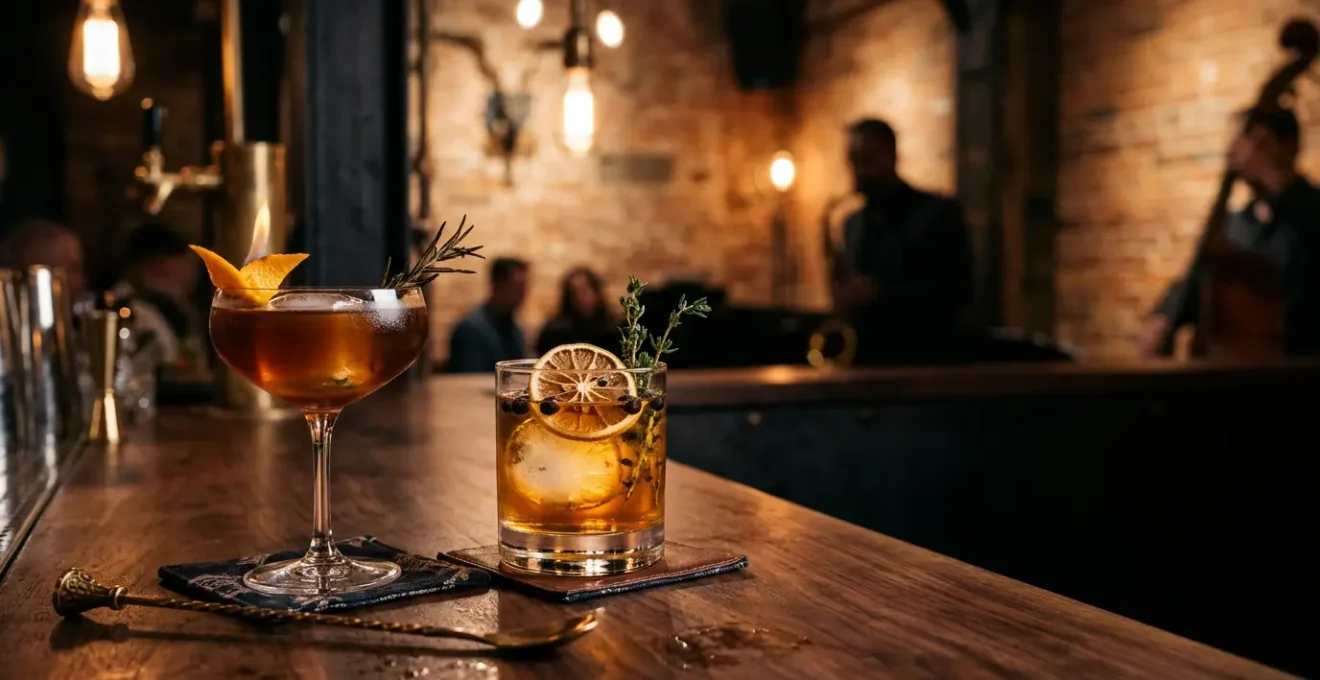
The best cocktail experience depends on the narrative you seek: Guilt & Co offers a raw, improvisational energy, while The 2nd Floor provides a more composed, refined elegance.
- Guilt & Co’s strength is its dynamic, live-music-first atmosphere where cocktails complement the raw energy of the room.
- The 2nd Floor Gastown focuses on a polished, cocktail-forward experience, where the music serves as an elegant soundtrack.
Recommendation: For an unscripted, vibrant night driven by musical discovery, choose Guilt & Co. For a sophisticated, conversation-focused evening with impeccable drinks, The 2nd Floor is your stage.
Choosing a jazz venue in Vancouver for a romantic evening isn’t merely about finding a place with good music and decent drinks. That’s the common advice, and it often leads to a pleasant but forgettable night. The real art lies in understanding the city’s unique nightlife ecosystem. You might be told to just pick a spot in Gastown, but this overlooks the intricate details that separate a standard outing from a truly curated experience. The question isn’t just “Guilt & Co or The 2nd Floor?” but a deeper one: what kind of story do you want your evening to tell?
The truth that seasoned locals and nightlife aficionados understand is that the city’s best venues are masters of experience architecture. Every element, from a hidden entrance and a specific cover charge model to the very lighting in the room, is a deliberate choice designed to shape your evening. This guide moves beyond simple recommendations. Instead, it offers a framework for navigating the sophisticated side of Vancouver’s nightlife. We will dissect the sensory terroir of these establishments, treating the atmosphere, the crowd, and the cocktail menu with the same reverence a sommelier treats a grand cru. By understanding the ‘why’ behind the city’s lounge culture, you’ll learn not just where to go, but how to craft an evening with intention and flair.
In this guide, we’ll explore the subtle yet crucial elements that define a truly exceptional night out in Vancouver. By dissecting everything from hidden entrances to the unspoken rules of dress and timing, you’ll gain the insider knowledge needed to navigate the city’s sophisticated lounge scene like a seasoned local.
Summary: A Connoisseur’s Map to Vancouver’s Nightlife
- How to Find the Hidden Door to Key Party Without Looking Like a Tourist?
- Why Do Some Jazz Clubs Charge a Music Fee on Top of Your Bill?
- Jeans or Suit: What is the Dress Code for Yaletown Lounges?
- The Granville Strip on Weekends: How to Avoid the Rowdy Crowds at 2 AM?
- When Does the Headliner Actually Start at The Painted Ship?
- Guu or Kingyo: Which Izakaya Has the Best Atmosphere for Groups?
- The First Cocktail Bar: Why Is the Sylvia Lounge Historic?
- Omakase or Prix Fixe: Is the $200 Tasting Menu Worth the Splurge?
How to Find the Hidden Door to Key Party Without Looking Like a Tourist?
Finding a speakeasy’s entrance is the first act of the evening’s performance. The key is to embrace the narrative, not fight it. A tourist frantically checks their phone, pacing back and forth. A connoisseur knows the search is part of the experience. For Key Party, the trick is to look for the most mundane business imaginable: an accounting office. Don’t look for a bar; look for a nameplate that reads “Key Party.” The confidence to walk into what appears to be a drab office and give the host a knowing nod is the entire point. This narrative immersion is a growing trend in the city, which is now home to over a dozen such hidden gems.
This concept of a disguised entrance provides a powerful filter, curating a crowd that is in on the secret and invested in the unique atmosphere inside. It’s a stark contrast to more traditional venues, and a key element in the modern speakeasy experience.
Case Study: The Art of the Hidden Entrance
As one of the city’s prime examples, Key Party operates behind a convincing façade of a 1970s accounting office, complete with kitschy decor that transports you before you’ve even ordered a drink. This is deliberate theatre. It contrasts sharply with a venue like Guilt & Co, which, while located in a Gastown cellar, uses a more traditional, unassuming staircase. One is a disguise, the other is discretion. Both create an intimate, below-the-street-level feel, but Key Party’s approach is a full commitment to a playful, immersive story.
Ultimately, acting like you belong is the best way to find the door. Walk with purpose, know what you’re looking for (a nameplate, not a bouncer), and treat the discovery as the first sip of your evening’s cocktail. The door is a test of your commitment to the night’s adventure.
Why Do Some Jazz Clubs Charge a Music Fee on Top of Your Bill?
A music fee or cover charge is not an inconvenience; it’s a statement of values. It signifies that the venue prioritizes the art and the artists on stage. In a city where live music struggles to survive, this fee is often the most direct way to ensure musicians are fairly compensated for their craft. Think of it as purchasing a ticket to a concert, but in a far more intimate setting. This is a core part of the experience architecture; it filters for an audience that is there to listen, not just to talk over the band. Venues like Guilt & Co, with their “by donation” model per set, offer flexibility, while others have a fixed fee that guarantees a certain caliber of performance.
This direct financial support is a critical component of Vancouver’s live music ecosystem. It allows smaller, more intimate venues to host world-class talent without relying solely on high-margin drink sales. For example, some venues take this commitment even further.
The presence of a cover charge is an indicator of the night’s focus. A venue with no cover on a jazz night may treat the music as ambient background noise. A venue that charges is inviting you to be an active, appreciative member of the audience. At Pourhouse, for instance, the model is explicit: a $5 per person cover with 100% of it going directly to the musicians. This transparency builds a relationship between the audience, the venue, and the artist.
The following table, based on data from Vancouver’s nightlife scene, breaks down the different models you’re likely to encounter, demonstrating how each venue approaches the value of live performance.
| Venue | Cover Charge Model | Typical Range | Payment Structure |
|---|---|---|---|
| Frankie’s Jazz Club | Fixed Fee | $10-$30 | Mandatory for all performances |
| Guilt & Co | Per-Set Donation | $7-$12 per 45-min set | By donation, more affordable for multi-set stays |
| The 2nd Floor Gastown | Variable | $6+ (starting) | Depends on artist/night |
| Pourhouse | Reserved Seating | $5 | 100% to musicians |
| Provence Marinaside | No Cover | $0 | Wednesday jazz nights free |
Jeans or Suit: What is the Dress Code for Yaletown Lounges?
Vancouver’s dress code is a paradox, famously casual yet subtly stratified by neighborhood. The blanket advice of “smart casual” is lazy and unhelpful. The real answer lies in matching your aesthetic to the specific sensory terroir of your destination. Yaletown is not Gastown, and dressing for one in the style of the other is a common misstep. Yaletown, with its glass towers and polished patios, calls for a sharper, more contemporary look. Think tailored blazers, quality denim or chinos, and sleek footwear. It’s a professional, polished vibe.
Gastown, by contrast, thrives on a more historic, artsy, and individualistic aesthetic. Here, vintage-inspired pieces, quality leather, and a slightly more rugged or creative layering feel right at home. It’s less about looking expensive and more about looking interesting. As one seasoned observer of the city’s nightlife aptly put it:
Vancouver is very casual bordering on slovenly. You will find all kinds. I usually dress ‘smart casual’ to most restaurants, and when going out, jeans, shoes, dress shirt is common.
– TripAdvisor Forum Contributor, TripAdvisor Vancouver Nightlife Discussion
This casual baseline means you’ll rarely be turned away for being underdressed, but you risk feeling out of place, which can subtly undermine the confidence needed for a perfect romantic evening. The goal is to feel aligned with the room’s energy.
Case Study: Yaletown Polish vs. Gastown Patina
The distinction is clear when you compare neighborhood vibes. Yaletown’s industrial-chic lounges attract a clientele of traveling executives and film industry creatives, where suits and polished looks are common. The atmosphere is one of modern success, complemented by creative craft cocktails. Gastown venues like Guilt & Co or The 2nd Floor cultivate an entirely different feel—a vintage, speakeasy-inspired world of brick, wood, and dim lighting that rewards a more considered, textural, and historically-aware style. Dressing for Yaletown in Gastown can feel overly corporate; dressing for Gastown in Yaletown can feel under-styled.
For a couple, the best strategy is to decide on the evening’s narrative first. Are you a modern power couple? Go for Yaletown’s sharp aesthetic. Are you artistic souls seeking history and character? Embrace Gastown’s layered, vintage-inspired look. Dressing appropriately isn’t about rules; it’s about complementing the story of the space you’re in.
The Granville Strip on Weekends: How to Avoid the Rowdy Crowds at 2 AM?
The Granville Entertainment District is a concentrated vortex of high-energy nightlife. For a couple seeking a sophisticated, intimate evening, it’s a minefield, especially as the night wears on. The key to avoiding the chaos is not to avoid the area entirely, but to master the art of timing and geographic insulation. The district is centered on a dense, seven-block stretch, and its energy peaks between midnight and the 2 AM last call. The strategy is to enjoy the superior culinary and cocktail offerings of adjacent “sophisticated bubbles”—Gastown and Yaletown—and be comfortably settled in your chosen sanctuary before the Granville tide comes in.
Think of your evening in phases. The early phase (7 PM to 10 PM) is for dining and initial cocktails in the calmer, more refined atmospheres of Yaletown or Gastown. The late phase (10:30 PM onwards) is for hunkering down in a curated venue like Guilt & Co or The 2nd Floor, where the door policy and atmosphere provide a natural barrier against the spillover from the main strip. You are creating a pocket of tranquility just blocks away from the pandemonium.
This geographic buffer is your greatest asset. While Granville Street descends into a frenzy of last-call desperation, the historic, cobblestoned alleys of Gastown remain relatively serene, offering a much more romantic and peaceful exit. You can stroll through gaslit streets to find a late-night bite that isn’t pizza-by-the-slice, preserving the sophisticated tone of the evening to the very end. The art is in letting the chaos exist, but on the other side of a wall you’ve deliberately built through smart planning.
Your Action Plan: A Timeline for Avoiding Granville Chaos
- Early Start (Before 9 PM): Begin your evening in Yaletown or Gastown. These neighborhoods offer a wealth of sophisticated dining and cocktail options before the city’s energy level skyrockets.
- Settle In (By 10:30 PM): Be seated in your chosen curated venue, like Guilt & Co or The 2nd Floor. By this time, you are insulated from the peak crowds that begin to flood Granville Street.
- Understand the Peak (Midnight to 2 AM): Acknowledge that Granville’s “second wind” on weekends brings the highest energy and potential for chaos. Your goal is to be observing this from a comfortable distance, not swimming in it.
- Plan Your Exit (2 AM): As last call hits, Gastown provides a superior escape route. Its quieter, historic streets offer a peaceful walk and access to better late-night food options, avoiding the mass exodus from Granville clubs.
- Use Your Bubble: Leverage Gastown and Yaletown as “sophisticated bubbles.” Their distinct atmospheres are just a few blocks away but a world apart from the Granville party zone, acting as your geographic insulation.
When Does the Headliner Actually Start at The Painted Ship?
In the world of live music, there are two clocks: the time on the poster and the time the music actually begins. This is “club time,” an unwritten rule that seasoned patrons understand implicitly. For a venue like The Painted Ship, or indeed most of Vancouver’s dedicated music spots, the listed “doors” or “show” time is rarely when the main act takes the stage. A listed 9 PM showtime almost universally means that’s when the doors open or when the first of one or two opening acts will begin their set.
A good rule of thumb is to expect the headliner to start 90 minutes to two hours after the advertised time. This buffer serves multiple purposes: it allows the room to fill up, encourages patrons to have a drink or two, and gives exposure to up-and-coming opening artists. Arriving at 9 PM on the dot for a 9 PM show is a rookie mistake that guarantees you a long wait. This isn’t a sign of disorganization; it’s a fundamental part of the experience architecture of a music-first venue.
The savvy approach is to treat the advertised time as a loose guideline. Plan to arrive about 45 minutes to an hour after doors open. This timing is the sweet spot: you’ll miss the initial emptiness, catch some of the opening act to get a feel for the night, and secure a good spot before the room gets packed for the headliner. For The Painted Ship, a kitschy and beloved local haunt in Kitsilano, this means if the show is listed at 9 PM, the headliner you came to see will likely grace the stage between 10:30 PM and 11:00 PM. Plan your dinner and pre-drinks accordingly to arrive refreshed and ready for the main event, not exhausted from waiting.
Guu or Kingyo: Which Izakaya Has the Best Atmosphere for Groups?
Choosing between Guu and Kingyo for a group is less a question of food quality—both are excellent—and more a decision about vibrational alignment. You must ask: what is the desired energy for your group? These two iconic izakayas, while sharing a culinary heritage, offer fundamentally different atmospheres. Guu, particularly the original location on Thurlow, is an exercise in joyous, high-energy chaos. The moment you walk in, you’re hit with a booming chorus of “Irasshaimase!” from the entire staff. The room is loud, the seating is tight, and the energy is relentlessly upbeat. It is the perfect choice for a celebratory, boisterous group that wants to feed off the room’s electric vibe.
Kingyo, on the other hand, presents a more refined and composed sensory experience. While still lively and social, its energy is more of a steady buzz than a loud roar. The decor is more intricate, with beautiful details and a slightly more spacious layout. It’s an atmosphere that encourages conversation as much as it does celebration. The sensory terroir is one of sophisticated energy, where the presentation of the food and the craft of the cocktails are given a bit more breathing room. This makes Kingyo the superior choice for a group that wants to connect, converse, and appreciate the finer details, without sacrificing the fun, shared-plates spirit of an izakaya.
The decision, therefore, is a strategic one. If your group’s goal is to be loud, drink, and be swept up in a wave of infectious energy, Guu is your stage. You’re adding your voices to an already vibrant chorus. If the goal is a more stylish gathering, where impressive food and flowing conversation are the main event, Kingyo provides the perfect, artfully crafted backdrop. Both are fantastic, but they are tuned to completely different frequencies.
The First Cocktail Bar: Why Is the Sylvia Lounge Historic?
The Sylvia Lounge isn’t just a bar; it’s a time capsule. Its historical significance lies in a single, transformative fact: in 1954, it became the very first cocktail lounge in Vancouver. Before this, the city’s puritanical liquor laws were far more restrictive. The Sylvia Hotel, an iconic, ivy-covered landmark watching over English Bay, was the institution that broke the mold, ushering in a new era of sophisticated drinking culture for the city. To sit in the Sylvia Lounge is to occupy a piece of Vancouver’s social history.
This history is not just a trivia point; it is the dominant note in the lounge’s sensory terroir. Unlike the modern, self-consciously “vintage” speakeasies of Gastown, the Sylvia’s old-world charm is entirely authentic. It has been earned over seven decades. The room feels less like a designed set and more like a cherished, well-worn living room. The cocktails are not trendy, foam-topped concoctions but timeless classics: a perfect Martini, a sturdy Old Fashioned. The view of the bay, often through a misty rain, adds a layer of quintessential Vancouver melancholy and romance that cannot be replicated.
Visiting the Sylvia Lounge is a deliberate choice to step away from the bleeding edge of mixology and into a narrative of enduring elegance. It’s the perfect venue for a quiet, conversation-driven evening, a pre-dinner drink before a walk on the beach, or a nightcap that feels both classic and deeply rooted in the city’s identity. Its importance lies not in what’s new, but in its steadfast connection to the moment Vancouver’s cocktail scene was born.
Key Takeaways
- The choice between venues like Guilt & Co and The 2nd Floor is about atmosphere and narrative, not just the drinks menu.
- Understanding neighborhood-specific dress codes (Yaletown’s polish vs. Gastown’s artistry) is crucial for feeling comfortable and confident.
- A music fee is not a penalty; it’s an indicator of a venue’s commitment to quality live performance and fair artist compensation.
Omakase or Prix Fixe: Is the $200 Tasting Menu Worth the Splurge?
Whether it’s an Omakase menu at a sushi counter or a multi-course prix fixe dinner with cocktail pairings, the question of “worth” for a $200 tasting experience is often misunderstood. It’s not a simple calculation of food cost versus price. The value of a high-end tasting menu lies in surrendering control and trusting a master to tell you a story. You are not buying food and drink; you are buying a curated, two-hour narrative crafted by a chef or a mixologist. It is the ultimate expression of experience architecture.
From a mixologist’s perspective, a cocktail pairing menu is a symphony. Each drink is designed to harmonize with a specific dish, elevating its flavors while also transitioning the palate to the next course. It’s a journey with a distinct beginning, a rising action, a climax, and a conclusion. The “worth” is found in the moments of surprise and delight—the unexpected flavor combination, the perfect transition, the discovery of a new spirit or technique. It’s a performance, and you have the best seat in the house. For a romantic evening, this shared journey of discovery can be an incredibly powerful and memorable experience.
So, is it worth it? Yes, but only if you are willing to be a passenger, not a driver. It’s worth it if you value artistry, curation, and storytelling over simple volume or choice. If you see dining and drinking as a form of entertainment and art, then the price is not for the ingredients, but for the ticket to the show. It’s the most sophisticated night out you can buy, a complete surrender to the sensory vision of an expert.
To craft your own unforgettable evening, the next step is to choose the narrative that resonates most with you and select the venue that tells that story best.