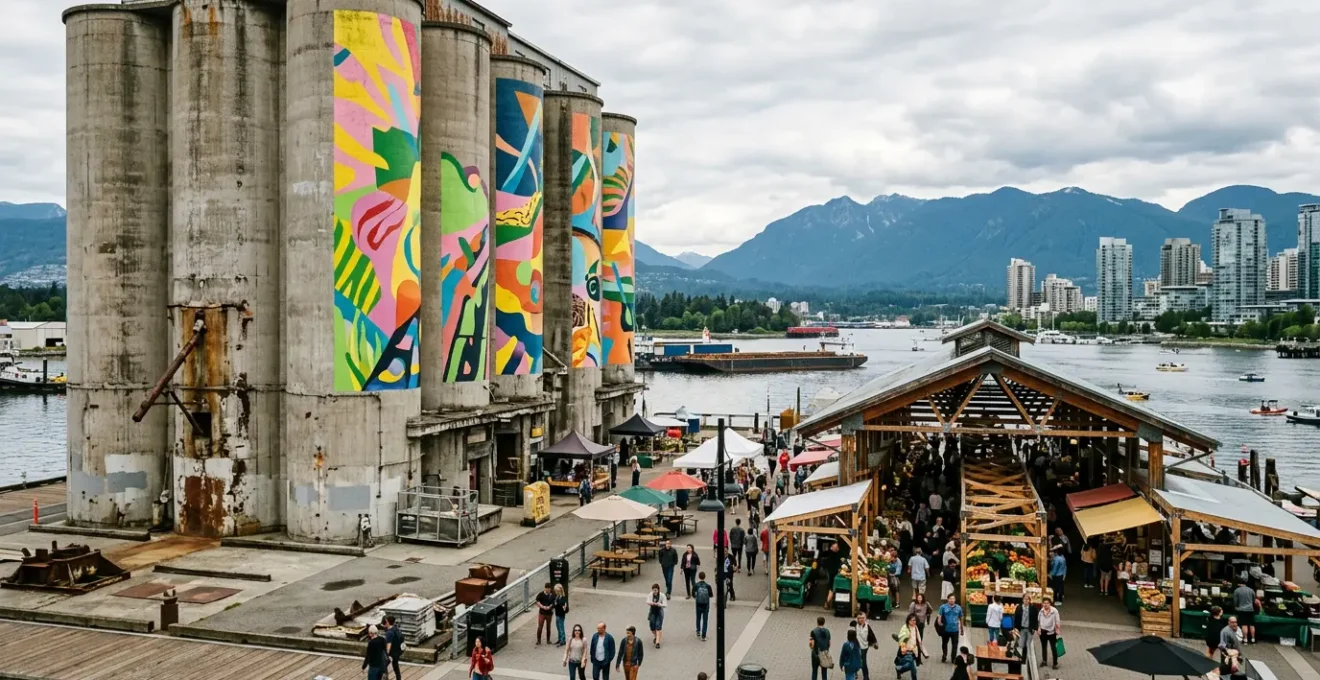
That active concrete plant on Granville Island isn’t an oversight; it’s the key to understanding Vancouver. Contrary to seeing it as a contradiction, the city’s design philosophy is built on “functional heritage,” where industrial bones are not just preserved but remain operational, creating an urban palimpsest. This approach, visible from Yaletown’s patios to Gastown’s lofts, reveals how Vancouver’s history is not a museum piece, but an active, living part of its modern identity and economy.
The scene is a perfect Vancouver postcard: bustling crowds at the Public Market, artisans hawking their wares, and the shimmering waters of False Creek. Then, a cement truck rumbles past, a dusty behemoth navigating through tourists and street performers on its way to the massive silos of the Ocean Concrete plant. For any visitor, the question is immediate: why is a heavy industrial facility still operating in the heart of one of Canada’s biggest tourist hubs? It feels like a mistake, a relic that someone forgot to tear down.
The common assumption is that this is just a quirky holdover from a bygone era, a simple clash of old and new. But what if this juxtaposition isn’t an accident at all? What if it’s the most visible symptom of a deliberate urban design philosophy that defines Vancouver? The key isn’t to see the city as a series of redeveloped zones, but as a living archive where the industrial past is purposefully kept operational. This principle of functional heritage is the hidden logic that explains not just Granville Island—itself a man-made industrial peninsula—but the very fabric of the city’s most iconic neighbourhoods.
This guide deciphers that logic. We will explore how Vancouver preserves its history not behind glass, but by weaving it directly into its daily life. From giant murals on working silos to the evolution of warehouse loading docks into chic patios, you will learn to read the city’s built environment and understand why what appears to be a contradiction is, in fact, the core of its character.
This article explores the stories embedded in Vancouver’s most unique architectural features. The following summary outlines how we will uncover the history behind these iconic urban puzzles.
Summary: Decoding Vancouver’s Urban Palimpsest
- Who Painted the Giants on the Silos and What Do They Mean?
- From Train Repair to Community Hub: What Remains of the Original Engine 374?
- Yaletown’s Loading Docks: Why Are the Patios Raised Above Street Level?
- The Crane in the Sky: Is the Wallace Shipyard Pipe Shop Open to the Public?
- Why Does the Craft Beer Market Building Have No Insulation?
- Brick and Beam: Why Are Gastown Lofts So Expensive despite the Noise?
- The Car Trails: Where Is the Best Overpass for Traffic Light Streaks?
- West End or Yaletown: Which Walkable Neighborhood Fits Your Vibe?
Who Painted the Giants on the Silos and What Do They Mean?
The six colossal, cartoonish figures that wrap around the Ocean Concrete silos are impossible to miss. Titled “Giants,” this monumental mural is the work of Brazilian twin brothers and street artists OSGEMEOS (Gustavo and Otávio Pandolfo). Created for the 2014-2016 Vancouver Biennale, the artwork transformed the industrial facility into one of the city’s most photographed landmarks. This is the ultimate example of adaptive symbiosis: the industrial function of the plant was not hindered, but enhanced, turning its utilitarian structures into a canvas.
The project turned 2,183 square meters of concrete into a public spectacle, a move that perfectly aligns with the artists’ philosophy. As OSGEMEOS stated during the project’s launch, it’s a powerful declaration of intent:
Every city needs art, and art has to be in the middle of the people.
– OSGEMEOS (Gustavo and Otávio Pandolfo), Vancouver Biennale artist statement
The artwork’s meaning is intentionally open, with each of the six giants representing a different connection to the world, inviting personal interpretation. Far from being a temporary installation, this functional artwork has become a permanent fixture, requiring a significant upkeep of an estimated $17,000 per year for maintenance. This ongoing investment proves the mural is not a gimmick but a core part of Granville Island’s identity, a testament to how industry and art can coexist to create a unique sense of place.
From Train Repair to Community Hub: What Remains of the Original Engine 374?
Housed in a stunning glass pavilion at the Roundhouse Community Centre is Canadian Pacific Railway Engine 374. This isn’t just any old locomotive; it’s the engine that pulled the first transcontinental passenger train into Vancouver on May 23, 1887, physically uniting the young nation and cementing the city’s destiny as a Pacific gateway. After decades of service and subsequent decay, the engine was rescued and meticulously restored for Expo 86, becoming a centerpiece of the world’s fair and a permanent symbol of the city’s origins.
Today, Engine 374 is more than a static museum piece. The pavilion that houses it is a community hub, staffed by passionate volunteers. Its restoration tells a story of direct civic engagement, a prime example of how Vancouverites actively participate in preserving their history.
Case Study: The Heritage Brick Fundraising Program
The restoration of Engine 374 for Expo 86 was not just a corporate or government project. According to the Roundhouse Community Centre’s historical records, it was funded through an innovative Heritage Brick Program. For $19.86 each, citizens could purchase a commemorative brick with their name engraved on it. The program raised $400,000 and the resulting 20,000+ name bricks now form the floor of the pavilion. Visitors today literally walk upon the names of the people who helped save this piece of functional heritage, making the ground itself a testament to community spirit.
Yaletown’s Loading Docks: Why Are the Patios Raised Above Street Level?
Strolling through Yaletown, you’ll notice a distinct architectural quirk: nearly every restaurant patio is elevated a few feet above the sidewalk, sheltered by an overhanging canopy. This isn’t a modern design trend for better people-watching. It’s a direct relic of the neighborhood’s past as Vancouver’s premier warehouse district. Before the era of loft apartments and boutique shops, these brick buildings were hubs of industry, and the raised platforms were loading docks built at the perfect height for freight trains to pull alongside.
The covered platforms allowed for the weather-protected transshipment of goods, a critical feature in rainy Vancouver. When Yaletown’s industrial decline gave way to urban renewal in the 1990s, the city made a crucial decision. Instead of demolishing these features, it implemented strict heritage guidelines to preserve the area’s character. This is the “zoning legacy” in action.
Case Study: Yaletown’s Adaptive Reuse Guidelines
The city mandated that the original industrial shells of the warehouses be preserved, including the loading docks and canopies. This forced developers and architects to get creative. The result is a world-class example of adaptive reuse, where the infrastructure of the past finds a new, vibrant purpose. The docks that once supported crates of textiles and paper now support diners and socialites, but their form remains unchanged. This intentional preservation is officially recognized as a cornerstone of the area’s identity.
As the Roundhouse Community Centre’s historical documentation notes, “The heritage significance of the old Yaletown truck loading docks and their characteristic overhanging canopies has been recognized by City Council as a unique architectural feature identifying the area.” The patios are raised because the history beneath them was deemed too valuable to erase.
The Crane in the Sky: Is the Wallace Shipyard Pipe Shop Open to the Public?
Looking across the water to North Vancouver, the massive yellow crane of the former Wallace Shipyards dominates the skyline, a permanent tribute to a century of shipbuilding. This site was an industrial powerhouse. Between 1906 and 1992, the shipyards were a hive of activity, having launched over 450 ships from the site, including many of the crucial Victory Ships built for the war effort in the 1940s. Today, while the shipbuilding is gone, the area has been transformed into The Shipyards District, a lively public space, and at its heart is a beautifully restored heritage building: The Pipe Shop.
And yes, it is very much open to the public. The Pipe Shop is not a museum; it’s a living, breathing community venue. Its restoration is a masterful example of preserving an industrial shell while giving it a completely new, public-facing purpose.
Case Study: The Pipe Shop’s Journey from War Effort to Weddings
Originally constructed in the 1940s, this was the Pipefitters building, where complex mechanical systems for new ships were fabricated. Now, it has been restored as a spectacular 9,300-square-foot event venue. The restoration, financed by the broader Shipyards redevelopment, carefully preserved its most iconic features: the original exposed wooden beams, high vaulted ceilings, and the massive gantry cranes that once lifted heavy pipes. Today, this historic space hosts everything from farmers’ markets and festivals to weddings and corporate events, serving as the true heartbeat of the revitalized waterfront.
The Pipe Shop demonstrates how a city can honor its industrial workforce and history not by cordoning it off, but by inviting the public inside to make new memories within its historic walls. It has transitioned from a place of labour to a place of leisure, without erasing its past.
Why Does the Craft Beer Market Building Have No Insulation?
The CRAFT Beer Market in the Olympic Village is another architectural puzzle. Housed in the historic Salt Building, its vast, open-air feeling is palpable, even in winter. The reason for its drafty character isn’t a design flaw; it’s a deliberate and celebrated feature. The building’s apparent lack of insulation is a direct consequence of a commitment to preserving its authentic industrial form.
Originally built around 1930, the Salt Building was a refinery for salt shipped from San Francisco, used for fishing and farming. Its defining feature was its post-and-beam construction with open sides, designed for ventilation and easy access, not for retaining heat. When the area was redeveloped for the 2010 Winter Olympics, the Salt Building was the only structure saved. The challenge was immense: how to turn an open-air industrial shed into a functional, modern space while honoring its heritage.
The solution was a landmark achievement in adaptive reuse. The restoration team inserted a new, smaller “building-within-a-building” to house the core functions of the restaurant, while leaving the grand, original timber structure largely exposed to the elements. This approach allowed the building to achieve a LEED Gold environmental certification while maintaining its historical integrity. The feeling of being “outside-in” is the point—it allows you to experience the building’s original scale and purpose. You’re meant to feel the history, drafts and all.
Brick and Beam: Why Are Gastown Lofts So Expensive despite the Noise?
Gastown, Vancouver’s oldest neighbourhood, is known for its cobblestone streets, Victorian architecture, and the constant hum of city life. It’s also home to some of the city’s most coveted and expensive real estate: brick and beam lofts. For outsiders, the price tag can be baffling. Why pay a premium to live in an old, often noisy building? The answer lies in the powerful appeal of authenticity and the immense cost of making history safe.
The “brick and beam” aesthetic—exposed 100-year-old brick walls and massive Douglas fir timber beams—offers a tangible connection to the city’s origins. It’s not a manufactured style; it’s the building’s genuine skeleton. This is the urban palimpsest as a lifestyle choice. However, living in history comes with a modern price. These buildings, constructed long before modern earthquake standards, require extensive and costly seismic retrofitting. The raw steel brackets and reinforcement plates often seen intersecting with the old wood and brick are not just an industrial-chic detail; they are multi-million dollar engineering solutions that make the building habitable.
The high cost of these lofts reflects a confluence of factors: the scarcity of authentic heritage stock, the high-end finishes inside, the immense cost of the structural upgrades, and the cultural cachet of living in a place with a story. For residents, the ambient noise of the neighbourhood and the rumble from the nearby port are not seen as detriments, but as part of the immersive, authentic urban experience they are paying for.
The Car Trails: Where Is the Best Overpass for Traffic Light Streaks?
Beyond preserved buildings, Vancouver’s “functional heritage” can also be found in appreciating its living, breathing infrastructure. For urban photographers, the city’s network of bridges and overpasses offers a dynamic canvas, especially at night. Capturing the mesmerizing light streaks from traffic is a classic way to document the city’s pulse. The key is finding a vantage point that offers a clear view, a high volume of traffic, and an interesting background. This is about finding the beauty in the city’s raw, operational machinery.
Several locations in Vancouver are iconic for this type of long-exposure photography. The Cambie Bridge is arguably the most famous, offering a perfect, symmetrical view of the downtown skyline framed by the flowing lines of traffic heading into BC Place and Yaletown. The Granville Street Bridge offers a grittier, more complex view, with multiple layers of traffic and neon signs creating a vibrant, chaotic tapestry of light. For a different perspective, an overpass on the Trans-Canada Highway (Highway 1) in Burnaby or North Vancouver can capture the relentless flow of commuters against a suburban or mountainous backdrop.
Action Plan: Capturing Traffic Light Streaks
- Vantage Point: Choose a safe spot on a pedestrian-accessible overpass or bridge with a clear, unobstructed view of multiple lanes of traffic.
- Essential Gear: Use a sturdy tripod to eliminate camera shake. A remote shutter or a 2-second timer is crucial to avoid jostling the camera when you press the button.
- Camera Settings: Set your camera to Manual (M) or Shutter Priority (S/Tv). Start with an ISO of 100, an aperture of f/8 to f/11 for sharpness, and a shutter speed between 10 and 30 seconds.
- Optimal Timing: The best time is during “blue hour,” the period just after sunset when the sky has a deep blue glow and car headlights are on, providing a beautiful contrast.
- Composition and Focus: Manually focus on a fixed point about one-third of the way into the scene. Compose your shot to include both the traffic flow and a static element, like the city skyline or bridge architecture, for context.
Key Takeaways
- Vancouver’s industrial past isn’t erased but actively integrated into its modern urban fabric, a concept known as “functional heritage.”
- Seemingly odd juxtapositions, like the Granville Island cement plant, are often the result of deliberate heritage conservation and zoning policies.
- This approach creates immense cultural and economic value, turning working silos into public art and historic warehouses into sought-after loft apartments.
West End or Yaletown: Which Walkable Neighborhood Fits Your Vibe?
Understanding Vancouver’s “functional heritage” provides a new lens through which to evaluate its most famous neighbourhoods. The choice between two of its most walkable areas, Yaletown and the West End, becomes more than just a matter of taste—it’s about choosing which layer of the city’s urban palimpsest you want to inhabit.
Yaletown is the polished, final product of the adaptive reuse philosophy. It is the city’s industrial past, repackaged for a modern, affluent lifestyle. Living here means being surrounded by the beautifully preserved brick-and-beam skeletons of old warehouses, where the loading docks of yesterday are the trendy patios of today. The vibe is historic-chic, energetic, and sleek. It’s for those who want their history visible, stylish, and fully integrated with contemporary amenities. You are living *in* the conversion.
The West End, by contrast, represents a different, more layered chapter of Vancouver’s history. It is one of the city’s oldest residential neighbourhoods, a dense tapestry of early 20th-century apartment blocks, mid-century modernist towers from the 1960s and ’70s, and heritage homes. Its history is not one of repurposed industry, but of evolving domestic life. The vibe is more eclectic, community-oriented, and grounded, with closer proximity to the natural grandeur of Stanley Park and English Bay. It’s for those who prefer a quieter, more residential history over an industrial one. You are living *amongst* the layers of time.
Your choice isn’t just about a postal code; it’s about deciding which Vancouver story you want to be a part of. The next time you walk through the city, look beyond the surface. See the loading docks, the seismic brackets, and the rumbling cement trucks not as anomalies, but as the proud, visible seams of a city that builds its future without erasing its past.