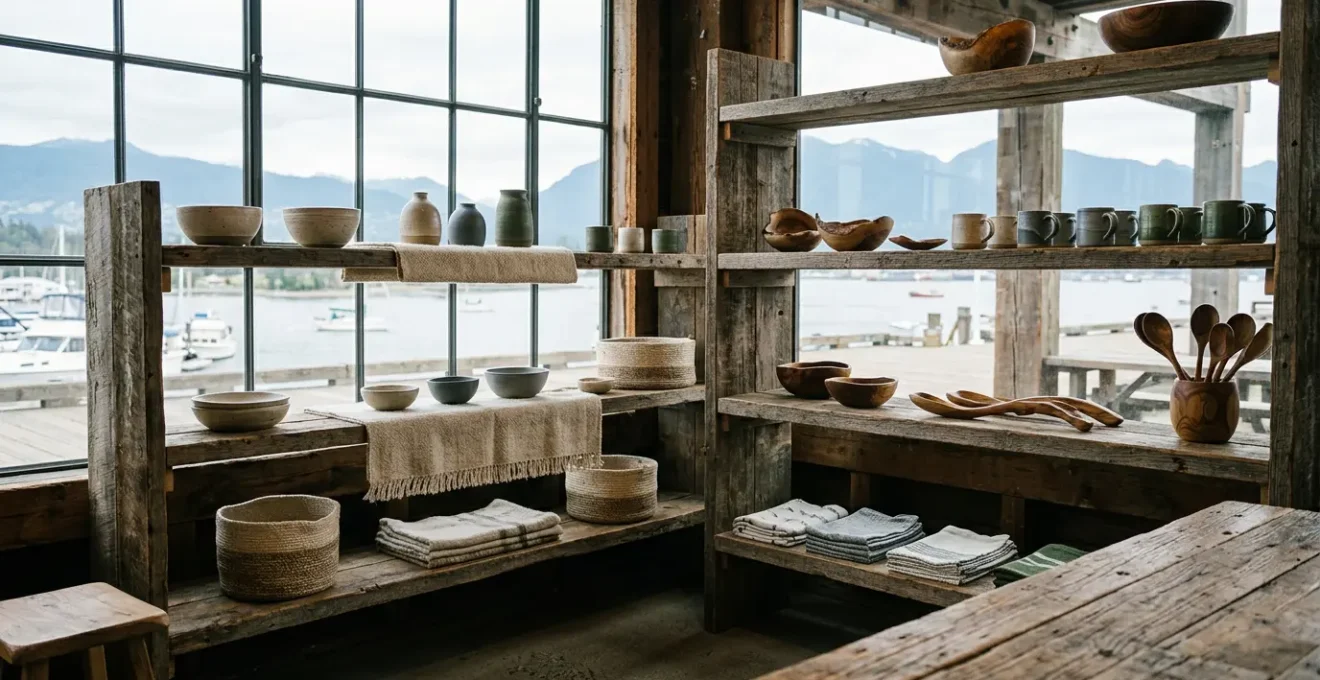
Contrary to popular belief, the best local crafts on Granville Island aren’t always in the main Public Market building.
- Authenticity is revealed through an artisan’s story, materials, and the subtle marks of their handiwork—not just a “Made in Canada” sticker.
- Identifying genuine Indigenous art requires understanding territorial context and specific design languages to avoid mass-produced fakes.
Recommendation: Use the questions and checklists in this guide to look beyond the storefront, engage directly with makers, and invest in pieces with true provenance.
Granville Island buzzes with an energy that is quintessentially Vancouver. For the millions of visitors who cross the cobblestones each year, the Public Market stands as a sensory explosion of food, flowers, and crafts. But for the discerning shopper—the one committed to supporting the local maker economy—a critical question arises amidst the vibrant chaos: Is this beautiful object a true piece of British Columbian craftsmanship, or is it a cleverly disguised import? The usual advice to “look for local labels” or “talk to the artist” often falls short. It’s easy to get lost in the sea of stalls, and not all vendors are the creators of the goods they sell.
The challenge is that resellers and genuine artisans can coexist side-by-side. Differentiating them requires more than a quick glance; it requires a new way of seeing. The secret isn’t just about knowing *where* to look, but *how* to look. It’s about understanding the language of materials, the story behind a studio’s rent, and the subtle signatures left by a creator’s hand. This guide moves beyond the generic advice. It provides the insider framework of a craft guild member, equipping you with the tools to read the signs of true artisanship. We will explore the hidden corners most tourists miss, deconstruct the real cost of a handmade piece, and provide concrete checklists for verifying authenticity, especially for culturally significant First Nations art.
This isn’t just a shopping guide; it’s a field manual for becoming a confident patron of the arts. By the end, you will not only be able to spot a genuine, locally-made treasure but also understand its intrinsic value, ensuring your money directly supports the artists who are the lifeblood of Granville Island’s creative soul.
This article provides a structured approach to navigating the island’s craft scene. Explore the sections below to learn how to identify authentic work, engage with artists, and make purchases you can feel proud of.
Summary: A Discerning Shopper’s Guide to Granville Island Artisans
- Why Do Most Tourists Miss the Net Loft Building Opposite the Market?
- The Thursday Art Walk: How to Catch Artists Working in Their Studios?
- How to Order a Custom Leather Bag from a Granville Island Artisan?
- Why Does a Handmade Mug Cost $60 CAD at the Clay Tek Studio?
- Bubble Wrap and Carry-On: How to Fly Home with BC Pottery?
- The “Made in China” Trap: Identifying Authentic Indigenous Souvenirs
- How to Buy First Nations Silver Jewelry That holds Its Value?
- Riley Park or Kitsilano: Which Farmers Market Has the Best Food Trucks?
Why Do Most Tourists Miss the Net Loft Building Opposite the Market?
The main Public Market on Granville Island is an irresistible force, a whirlwind of sights and smells that understandably captures the attention of the island’s over 10 million annual visits. Its gravitational pull is so strong that many visitors never realize that some of the most dedicated artisan studios are located just a few steps away. The first and most crucial step in separating makers from resellers is to physically separate yourself from the densest crowds. Look directly across from the main market doors and you’ll see the Net Loft, a building steeped in the island’s industrial heritage.
The building’s very name speaks to its history and the island’s authentic, non-commercial past. As the Vancouver Heritage Foundation notes, its name has a practical origin. The Net Loft was originally home to a fishery that used the space for its operations. This history of utility and craft is a stark contrast to the purely retail focus of many market stalls. Inside the Net Loft and in the surrounding alleyways like Railspur Alley, you’ll find a different atmosphere. These are not temporary day tables; they are permanent studios and workshops where artists have invested in long-term leases, built out their spaces, and integrated into the community. This is where you find the potters, the weavers, the jewelers, and the papermakers. They are here day-in and day-out, not just for the weekend rush, making them a cornerstone of the island’s maker provenance.
Missing the Net Loft is an easy mistake, but a significant one. By simply crossing the walkway, you shift your experience from one of passive consumption to active discovery. You enter a world where the process of creation is as important as the final product, and where your chances of speaking directly to the person who made your souvenir increase tenfold. It’s the first filter for any discerning shopper.
The Thursday Art Walk: How to Catch Artists Working in Their Studios?
Once you’ve ventured into the artisan-rich zones like the Net Loft and Railspur Alley, the next step is to engage. While many studios are open daily, Thursdays on Granville Island offer a unique, informal “art walk” atmosphere where many creators are actively working and more open to conversation. This is your opportunity to go beyond the transactional and connect with the creative process. With nearly 30,000 artists and studios across British Columbia, Granville Island serves as a concentrated hub of this talent, and seeing them at work is a powerful experience.
The key is to ask questions that reveal the artist’s story and their connection to their craft. Avoid simple queries about price. Instead, focus on “maker provenance.” Ask about their journey to the island, their choice of materials, and how the Vancouver landscape influences their work. A genuine artisan’s face will light up when asked about their process; a reseller may offer a generic, scripted answer. These conversations are where you discover the material honesty and passion behind a piece. You’re no longer just a customer; you are a witness to their craft. Don’t be afraid to show genuine curiosity.
The image of an artisan’s hands shaping clay is more than just a picture; it embodies the concept of process signatures. Every handmade object carries the subtle, unique marks of its creation. By talking to the artist, you learn to read these signs—the slight variation in a glaze, the feel of a hand-sanded piece of wood, the specific weight and balance of a mug. This dialogue is the most reliable tool you have for confirming authenticity.
Your Checklist for Speaking with Artisans
- Connection to Place: Ask, “How does living in Vancouver or on the coast influence your work?” to gauge their local roots.
- Material Sourcing: Inquire, “Where do you source your materials? Are any of them from BC?” to understand their supply chain.
- Creative Process: Explore with, “Can you walk me through how you made this piece from start to finish?” to see their passion and expertise.
- Community Connection: Ask about their participation in other Vancouver events like the Eastside Culture Crawl to see if they’re part of the broader art ecosystem.
- Studio History: Understand their journey by asking, “How long have you been working on Granville Island, and what drew you to this community?”
How to Order a Custom Leather Bag from a Granville Island Artisan?
Moving from appreciating finished work to commissioning a custom piece is the ultimate act of supporting the maker economy. It’s a collaborative process that results in a one-of-a-kind item that tells a story. Granville Island is home to artisans who have built their entire careers on this model, offering a direct counterpoint to the world of fast fashion and mass production. This process is the epitome of buying local, as you are involved from concept to completion.
Case Study: Hartman Leather’s 36-Year Legacy on Granville Island
Hartman Leather, a fixture on Railspur Alley since 2001, exemplifies this deep-rooted craftsmanship. Founder Dave Hartman’s journey began in the 1970s and led him to Granville Island in 1988. His business wasn’t built on advertising, but on returning clientele who value the quality and uniqueness of his custom bags, belts, and other leather goods. This long history and loyal customer base are powerful indicators of maker provenance. When you order from an artisan like Dave, you aren’t just buying a bag; you’re becoming part of a legacy that has helped define the creative character of the island for decades.
The process of ordering a custom piece is more structured than a simple purchase. It requires consultation, patience, and clear communication. It’s an investment not just of money, but of time. Below are the typical steps you can expect when working with a Vancouver-based leather artisan for a custom project.
- Step 1 – Initial Consultation: Meet with the artisan to discuss your vision. Bring inspirational images and talk about how you intend to use the piece. This is where you establish the design direction.
- Step 2 – Material Selection: The artisan will guide you through premium leather options, often sourced from world-class tanneries. This is where material honesty comes into play; they can explain the origin and qualities of each hide.
- Step 3 – Design Approval: You’ll review sketches and confirm all details, from dimensions and hardware to the style of stitching. This is a critical checkpoint to ensure your vision aligns with the artisan’s plan.
- Step 4 – Timeline & Pricing: A clear timeline (often 3-6 weeks) and payment schedule, usually involving a deposit, will be established. This transparency is a hallmark of a professional maker.
- Step 5 – Craftsmanship Period: The artisan begins the meticulous work of hand-cutting and hand-stitching your piece. This is where their skill and process signatures transform raw materials into a functional work of art.
- Step 6 – Final Delivery & Care Instructions: You’ll receive your finished piece along with instructions on how to care for it, ensuring its longevity. Some Vancouver artisans even offer complimentary conditioning services.
Why Does a Handmade Mug Cost $60 CAD at the Clay Tek Studio?
One of the biggest hurdles for shoppers new to the maker economy is price shock. Why would a mug cost $60 when a similar-looking one at a big-box store is only $15? The answer lies in the vast, often invisible, difference between a handmade object and a mass-produced item. Understanding this difference is key to shifting your mindset from “price” to “value.” A $60 mug isn’t expensive; it’s the fair price for the skill, time, materials, and risk involved in its creation by a Vancouver-based artist.
A factory can produce thousands of identical mugs in a day. An independent potter on Granville Island might spend over a week to bring a small batch of unique pieces through the entire creation cycle. Each step—throwing the clay on the wheel, trimming the base, pulling and attaching a handle, drying it slowly, two to three separate kiln firings, and glazing—requires time and immense skill. Furthermore, the artisan absorbs the cost of failures. A crack in the drying stage or a glaze that runs in the kiln means hours of work are lost. That 20-30% failure rate is a hidden cost baked into the price of every successful piece.
The following table breaks down the tangible and intangible factors, clearly illustrating the value vs. price equation. It accounts for everything from BC-sourced materials and high studio rent on the island to the simple, irreplaceable fact that you are holding a one-of-a-kind object designed for human hands.
This detailed cost breakdown is based on the realities faced by market artisans, as reflected in leasing information from sources like Granville Island’s own administration.
| Factor | Handmade Granville Island Mug ($60 CAD) | Mass-Produced Factory Mug ($8-15 CAD) |
|---|---|---|
| Materials | BC-sourced clay, artisan-mixed glazes, lead-free formulations | Industrial clay blend, standardized glazes |
| Production Time | 8-12 hours total (throwing, trimming, drying, glazing, firing cycles) | Minutes (molded or slip-cast, automated glazing) |
| Kiln Firings | 2-3 firings (bisque, glaze, sometimes third for special effects) using BC Hydro electricity | Single high-volume kiln run |
| Failure Rate | 20-30% (cracks, warping, glaze defects—cost absorbed by successful pieces) | Under 5% (controlled factory conditions) |
| Labor Cost | Vancouver living wage for skilled artisan ($25-35/hour) | Offshore labor or automated process |
| Studio Overhead | Granville Island rent managed by CMHC, equipment, insurance (minimum $2M liability required) | Factory overhead distributed across thousands of units |
| Uniqueness | One-of-a-kind piece, no two exactly alike | Identical replication |
| Ergonomics | Hand-shaped for comfort, weight, and balance | Standardized mold design |
Bubble Wrap and Carry-On: How to Fly Home with BC Pottery?
You’ve found the perfect piece of BC pottery—a tangible memory of your time in Vancouver. Now comes the practical challenge: getting it home in one piece. For the many tourists who visit Granville Island, this is a genuine concern that can deter a purchase. However, with a bit of planning and the right technique, you can transport your fragile treasures safely, whether you’re flying out of Vancouver International Airport (YVR) or shipping them internationally.
The cardinal rule is simple: carry it on. Checked baggage systems are notoriously rough on luggage, and even the most careful packing may not survive the journey. Your carry-on bag is your personal responsibility and the safest place for fragile items. Most artisans on the island are masters of packing and will happily wrap your purchase for travel, but it’s wise to know the best practices yourself. The goal is to create a firm, cushioned cocoon around the piece, preventing it from moving or coming into contact with hard surfaces. Soft clothing makes for excellent, space-efficient padding inside your suitcase.
Navigating airport security at YVR with handmade crafts is also straightforward if you’re prepared. Being polite and proactive with CATSA (Canadian Air Transport Security Authority) officers can make a world of difference. Following these guidelines, sourced from the collective wisdom of island artisans, will ensure your new artwork arrives home safely.
- Pack pottery in your carry-on luggage whenever possible; the risk of breakage in checked baggage is significantly higher.
- Wrap each piece individually in a minimum of three layers of bubble wrap, then secure it with painter’s tape, which leaves no sticky residue.
- Place the wrapped item in the center of your carry-on, surrounded by soft clothing to create a dense cushion barrier on all sides.
- At YVR security, politely inform officers you are carrying fragile, handmade ceramics. They may opt to hand-inspect the item rather than sending it through the X-ray machine.
- Keep your purchase receipts easily accessible. This is useful for declaring the item’s value and proving its artisan origin to customs officials if required.
- For international travel, ask the artisan for a signed certificate of authenticity. Stating the piece was handmade in BC can simplify customs declarations.
- If an item is too large or precious to carry, ask the artisan for their preferred shipping partner or use a nearby Canada Post for insured shipping.
The “Made in China” Trap: Identifying Authentic Indigenous Souvenirs
Nowhere is the distinction between authentic and fake more critical than when purchasing Indigenous art. Granville Island sits on the unceded traditional and ancestral territories of the xʷməθkʷəy̓əm (Musqueam), Sḵwx̱wú7mesh Úxwumixw (Squamish), and səl̓ilw̓ətaʔɬ (Tsleil-Waututh) peoples. Buying authentic work is an act of respect and reconciliation, ensuring that the artists and their communities benefit from the sharing of their culture. Unfortunately, the market is flooded with mass-produced knock-offs, often marked with generic “West Coast style” labels that mislead consumers.
Identifying authentic work requires education. Reputable galleries on Granville Island and across Vancouver are committed to this transparency, providing detailed artist biographies and ensuring a fair and ethical return of proceeds. The first and most important sign of authenticity is clear attribution: the artist’s full name and their Nation (e.g., Haida, Kwakwaka’wakw, Coast Salish) must be clearly identified. If this information is missing, you are almost certainly looking at a piece of “tourist art” with no cultural or economic connection to the people whose designs it imitates. Understanding the visual language is also key. For instance, traditional Coast Salish art is characterized by elements like trigons and crescents, while the Formline design of northern nations like the Haida features distinct ovoids and U-forms.
Examine the piece closely. As this close-up of a carving shows, hand-tooled work has subtle irregularities—the process signatures of the artist. The lines have depth and a fluid, organic quality that a machine cannot replicate. Use the following checklist to guide your purchase and make an informed, ethical choice.
Authentication Checklist for Northwest Coast Art
- Verify Artist and Nation: Ensure the artist’s name AND their specific Nation (e.g., Musqueam, Haida) are clearly labeled. Authentic pieces always credit both.
- Acknowledge Territory: Remember that Granville Island is on the unceded territories of the Musqueam, Squamish, and Tsleil-Waututh peoples.
- Look for Ethical Galleries: Choose galleries that provide artist biographies and guarantee proceeds return to the artists and their communities.
- Learn Visual Elements: Familiarize yourself with key design forms, such as Coast Salish trigons or the ovoids and U-forms of northern Formline art.
- Examine Craftsmanship: Look for the subtle tool marks and organic irregularities of hand-carved or hand-painted work, which differentiate it from machine-perfect replicas.
How to Buy First Nations Silver Jewelry That holds Its Value?
First Nations silver jewelry, particularly hand-engraved bracelets and pendants from Northwest Coast artists, is more than an accessory; it is a wearable form of cultural expression and, often, a significant investment. Unlike mass-produced trinkets, authentic pieces by respected artists can hold or even increase in value over time. Buying a piece that will be cherished for generations requires the same diligence as collecting any other form of fine art: a focus on artist reputation, craftsmanship, and, most importantly, provenance.
As a recognized creative hub in Vancouver, Granville Island is one place where this tradition of artistry is carried forward. Organizations like Arts Umbrella, which has a major facility on the island, help foster the next generation of creators, reinforcing the area’s cultural significance. When purchasing high-value jewelry, your goal is to acquire a piece with a bulletproof history. This starts with the gallery. Reputable dealers who specialize in Indigenous art, like the Lattimer Gallery or the Bill Reid Gallery in downtown Vancouver, are your most trusted sources. They not only guarantee authenticity but also play a key role in documenting the work, which is essential for its long-term value.
Hand-engraving is the primary process signature to look for. Under magnification, you should see the deep, fluid lines and subtle variations of a hand-pushed graver, not the shallow, uniform scratches of a machine. The artist’s reputation is also paramount. Research them: have they won awards? Is their work in museum collections like the UBC Museum of Anthropology? An established artist’s work is far more likely to appreciate. Finally, meticulous documentation is non-negotiable. A simple sales receipt is not enough.
- Document the Purchase: Always request a certificate of authenticity that details the artist’s name and Nation, the title of the piece, creation date, and materials used.
- Photograph the Piece: Take high-resolution photos, including close-ups of the artist’s signature or hallmark.
- Understand the Artist’s Reputation: Research their exhibition history, awards, and presence in major museum collections.
- Verify Hand-Engraving: Examine the lines under magnification to distinguish the organic flow of hand-tooling from machine precision.
- Keep All Original Documentation: Store certificates, receipts, and any gallery materials in a safe place. This is your proof of maker provenance.
- Build Gallery Relationships: Cultivate relationships with trusted Vancouver galleries that can provide authentication and appraisal services.
- Consider an Appraisal: For pieces over $500 CAD, a professional appraisal is recommended to establish fair market value for insurance purposes.
Key Takeaways
- True Granville Island artisans are often found outside the main market hall, in dedicated studios like those in the Net Loft building.
- Authenticity is verified through an artist’s story, their connection to BC, and the unique “process signatures” of their handiwork—not just a label.
- The higher price of handmade goods reflects fair wages for Vancouver artists, material costs, high studio overhead, and the absorption of a 20-30% failure rate in crafts like pottery.
Riley Park or Kitsilano: Which Farmers Market Has the Best Food Trucks?
While Granville Island is a unique, seven-day-a-week destination, the “maker economy” ethos it champions is deeply woven into the fabric of Vancouver itself. To truly understand this culture, one must look at how it connects to the city’s vibrant network of neighbourhood farmers markets, from Riley Park to Kitsilano. These markets operate under a strict “Make It, Bake It, Grow It” policy, meaning every vendor, much like the true artisans of Granville Island, must be the original producer of the goods they sell. This shared principle makes them spiritual cousins in the fight against resale culture.
This connection is felt by locals and is a testament to the island’s dual identity. As documented by Vancouver Foodie Tours, while tourists see a spectacle, “local Vancouverites consider it the ‘bread and butter’ of their routine.” They do their grocery shopping there and plan their lives around its offerings. This daily-use reality aligns perfectly with the community-focused atmosphere of the farmers markets. Just as you might discuss the origin of heirloom tomatoes with a farmer at the Kitsilano market, you can discuss the source of clay with a potter on Granville Island. The context is different, but the core value—a direct connection between producer and consumer—is identical.
These markets, like Granville Island’s craft community, also serve as incubators. A food truck that builds a following at the Riley Park Summer Market might one day open a permanent stall on the island. An artist who sells at the massive Circle Craft Christmas Market, which attracts over 40,000 visitors, might find their permanent home in a Railspur Alley studio. They are all part of the same ecosystem. So, while the question of which market has the best food trucks is a matter of delicious debate, the more profound truth is that they all share the authentic spirit that makes Granville Island’s maker culture so special. Visiting them provides a broader context for the artisanship you see on the island.
Apply these principles on your next visit to become a true patron of Vancouver’s vibrant maker community, ensuring your support goes directly to the creators who make this city’s art scene so unique.