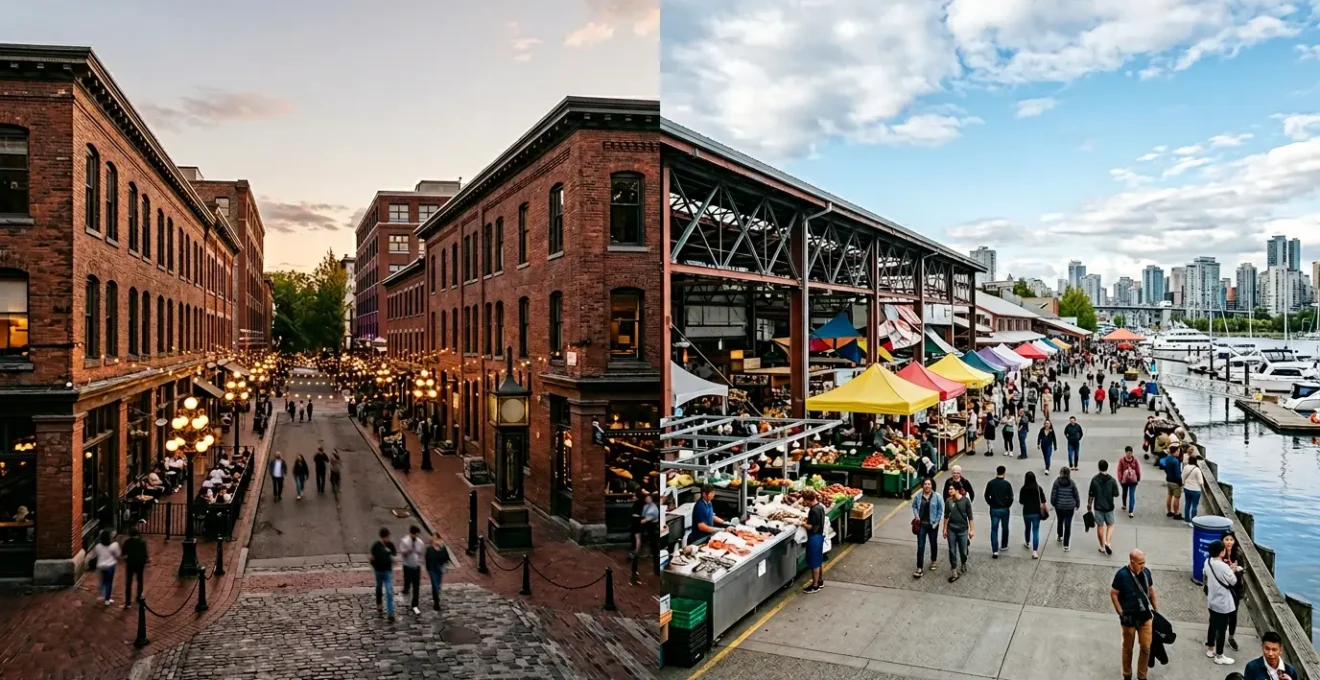
For a 4-hour visit, Gastown’s evening tour offers a better culinary return on your time than Granville Island’s market tour.
- Gastown provides a relaxed, seated, multi-course experience with low logistical friction, ideal for a special occasion.
- Granville Island offers more individual samples but involves navigating significant crowds and a faster, stand-up tasting format.
Recommendation: Choose Gastown for a high-quality, paced “moment,” and Granville Island if your priority is purely the quantity and variety of quick bites.
You have four precious hours in Vancouver, and a world of flavour awaits. You’re a foodie couple, eager to dive into the city’s culinary scene, but you’re facing the classic dilemma: a Gastown food tour or a Granville Island food tour? Most guides will tell you it “depends on your preference,” listing the potential foods you might try. They’ll mention that one is a historic district filled with chic restaurants while the other is a bustling public market. This is all true, but it doesn’t help you make a decisive choice when your time is the most valuable currency you have.
The common advice misses the crucial factor for a short visit: efficiency and experience quality. What if the best way to decide isn’t about the food itself, but about the very structure of the tour? The secret lies in a concept I call “Tasting Density”—the optimal balance of flavour variety, minimal logistical friction (walking, waiting, crowds), and memorable moments packed into your limited timeframe. It’s not just about how much you eat, but how well you experience each bite.
This guide reframes the debate. We’ll move beyond simple lists of food and instead analyze each tour’s “Culinary ROI” (Return on Investment). We will break down everything from tipping etiquette and dietary concerns to the very real differences between a midday market rush and a relaxed evening progression. By the end, you won’t just have a preference; you’ll have a clear, strategic reason for choosing the tour that will make your four hours in Vancouver absolutely unforgettable.
To help you make the most informed decision, this article breaks down all the crucial factors, from practical logistics to the very definition of the local cuisine you’ll be tasting. Explore the topics below to find the perfect fit for your culinary adventure.
Summary: A Foodie’s Guide to Vancouver Tours
- The “Hidden” Cost: How Much to Tip Your Food Guide in Vancouver?
- Gluten-Free Tours: Which Neighborhood Is Safest for Celiacs?
- Corporate Team Building: How to Organize a Tasting Tour for 20 People?
- Lunch or Dinner Tour: Which Time Slot Has Less Walking and More Eating?
- The “Free Tour” Trap: Why You Should Avoid Unlicensed Food Guides?
- What Exactly Is “West Coast Cuisine” and Where Can You Taste It?
- The Cart vs The Menu: How to Order Dim Sum Like a Local?
- Japadog to Dim Sum: How to Plan a Self-Guided Food Tour in Downtown?
The “Hidden” Cost: How Much to Tip Your Food Guide in Vancouver?
Once you’ve enjoyed an amazing tour, the question of gratuity inevitably comes up. In Vancouver, tipping is a customary way to show appreciation for excellent service, and food tour guides are no exception. While it’s not mandatory, a tip is a powerful signal that your guide did a fantastic job sharing their knowledge and passion for the city’s food scene. It acknowledges their effort in coordinating with vendors, managing the group, and providing an entertaining and seamless experience.
So, what’s the standard? For tour guides in Vancouver, the general guideline is to tip between $5 to $10 CAD per person for a standard tour of a few hours. If your guide went above and beyond, creating a truly exceptional and personalized experience, you might consider a tip in the 15-20% range of the tour price, similar to what you would in a restaurant. This is especially true if they expertly handled special requests or dietary needs.
When it comes to the method, practicality is key. As one Canadian travel guide points out, while digital payment options are becoming more common, cash is often preferred for tips in most tour situations. Having some Canadian currency on hand makes it simple and direct to thank your guide at the end of the tour. It’s a small gesture that makes a big difference and ensures your appreciation is directly received.
Gluten-Free Tours: Which Neighborhood Is Safest for Celiacs?
For travelers with Celiac Disease, a food tour can feel like a culinary minefield. The fear of cross-contamination is real, and navigating a series of unknown kitchens requires trust and clear communication. The good news is that Vancouver has a robust and aware food scene, making it one of the more manageable cities for gluten-free dining. Both Gastown and Granville Island have operators and vendors who can often accommodate dietary needs, but the environment in which they operate makes a significant difference in safety.
Vancouver is home to a growing number of celiac-safe spots, with a database showing at least 11 dedicated gluten-free places in the city, including bakeries and restaurants. The key is communicating your needs effectively. A professional tour company will do this on your behalf, but it’s always wise to be your own best advocate. This is where the choice of tour becomes critical. Gastown tours, which are often based in established restaurants with professional kitchens, may have more controlled environments and established protocols for handling allergies. They are better equipped to prevent cross-contamination.
Conversely, Granville Island’s public market setting, while offering immense variety, presents higher logistical friction for celiacs. The open-air stalls, shared spaces, and rapid-fire service can increase the risk of cross-contamination. To ensure a safe experience, you must be proactive. Ask your tour operator if they inform vendors of allergies in advance and confirm with each server that your sample is indeed gluten-free. Inquire about dedicated fryers and separate prep spaces. A well-prepared restaurant in Gastown is often a safer bet than a busy market stall.
Corporate Team Building: How to Organize a Tasting Tour for 20 People?
Taking a food tour is an excellent team-building activity, offering a relaxed environment for colleagues to connect outside the office. However, organizing one for a large group of 20 people requires a different approach than booking a tour for two. You can’t simply join a public tour, as most operators have a firm capacity limit. For instance, it’s common to see a stated maximum of up to 16 persons for public tours to ensure a quality experience and avoid overwhelming the vendors.
For a group of 20, the solution is a private, customized tour. This is the standard offering for corporate events and large parties. Contacting a reputable tour company and requesting a private booking is the first step. This allows the operator to create an itinerary that suits your team’s schedule, dietary needs, and specific interests. They can arrange for appropriate staffing and, most importantly, give their partner restaurants and vendors a heads-up to prepare for a large influx of guests at once.
The benefits go beyond logistics. A private tour can be tailored to foster interaction, with curated stops that might include a sit-down component or a tasting that encourages conversation. The success of this model is well-documented by Vancouver’s top operators.
Case Study: Corporate Event Success with Private Food Tours
An event organizer for major corporations like RBC, Shell, and UBC highlighted the effectiveness of private tours, stating: “Taste food tours has been an ace up my sleeve for planning corporate events in Vancouver. I’ve sent three different large groups through these tours and I’ve yet to receive a single complaint.” The key to this success was the tour company’s ability to create customized private experiences that successfully accommodated large groups, fostering team connections through shared culinary discovery.
When planning, provide the tour operator with as much information as possible: your group size, any specific dietary restrictions, your preferred date and time, and your budget. This will enable them to craft a seamless and memorable event for your team.
Lunch or Dinner Tour: Which Time Slot Has Less Walking and More Eating?
For a couple with only four hours, maximizing your “Culinary ROI” is everything. The choice between a Granville Island lunch tour and a Gastown dinner tour is the central pivot of your decision. While both tours typically have a duration of 2.5 to 3 hours covering 7-8 stops, the *experience* within that time frame is vastly different. It’s a classic case of quantity versus quality, of a tasting sprint versus a paced culinary journey.
Let’s break it down with a direct comparison. The table below, based on offerings from top Vancouver operators, reveals the fundamental differences in structure and atmosphere that define the “Tasting Density” of each tour.
This data comes from a detailed analysis of local tour offerings, such as the comparative details provided by Vancouver Foodie Tours. The numbers tell a story about two distinct experiences.
| Feature | Granville Island Lunch Tour | Gastown Evening Tour |
|---|---|---|
| Time Slot | 10:30am – 12:30pm | 3:00pm – 6:00pm |
| Duration | 2 hours | 3 hours |
| Number of Stops | 10 tasting locations | 3 tasting locations |
| Atmosphere | Peak market rush, crowded | Relaxed evening vibe |
| Sample Style | 20+ tastings, standup format | Seated progressive tastings |
| Beverage Pairing | Non-alcoholic included | Optional alcohol pairings ($50 CAD upgrade) |
| Crowd Level | High (public market) | Lower (restaurant-based) |
The Granville Island tour offers a staggering number of samples—over 20 tastings in just two hours. This is an incredible volume, but it comes with high logistical friction. You’ll be navigating the market at its absolute peak, standing for most tastings, and moving quickly from one vendor to the next. It’s a fantastic whirlwind of flavour but can feel chaotic. For a couple looking for a special experience, it may lack a sense of occasion. In contrast, the Gastown tour is a progressive, seated meal spread across three hours and three distinct locations. While the number of stops is lower, the moment-to-sample ratio is much higher. Each tasting is a mini-course in a relaxed setting, allowing you to savour the food, enjoy an optional drink pairing, and connect with your partner. For your 4-hour window, the Gastown tour delivers a more refined and memorable experience, with significantly less stress and more quality eating time.
The “Free Tour” Trap: Why You Should Avoid Unlicensed Food Guides?
In your search for the perfect tour, you might come across offers for “free” or unusually cheap walking tours that promise to show you the culinary delights of Vancouver. While tempting, these often fall into the category of “you get what you pay for.” Opting for a licensed, professional food tour operator isn’t just about paying for food samples; it’s an investment in safety, quality, and a genuinely good experience. Unlicensed guides operate in a grey area, and there are significant risks involved.
The most critical concern is food safety. Licensed tour companies operate under strict regulations. As one Vancouver tour operator emphasizes, professionalism includes ensuring guides are properly certified:
Reputable tour operators require their guides to have a BC ‘FOODSAFE’ certificate, ensuring they understand safe food handling practices—a standard an unlicensed guide will likely not have.
– Article Author, Gastown or Granville Island Food Tour Planning Guide
This certification is non-negotiable for anyone handling and serving food to the public. Beyond safety, licensed tours guarantee a consistent, high-quality experience. They have pre-existing financial agreements with their vendors, meaning your samples are paid for and planned. An unlicensed guide may rely on vendor goodwill, freebies, or simply point at food you have to buy yourself. This leads to an inconsistent and often disappointing experience, turning your tour into an awkward and disjointed trek rather than a seamless culinary journey.
Your Checklist: Spotting an Unlicensed Guide
- Business Legitimacy: Verify the tour operator has a City of Vancouver business license and proper liability insurance. Professional companies will display this information proudly.
- Guide Vetting: Confirm that guides have passed the background checks required for all licensed operators working with the public.
- Food Safety Certification: Ask if guides hold a valid BC FOODSAFE Level 1 certificate. This is the minimum standard for food handling.
- Vendor Relationships: Inquire if the tour has pre-arranged, paid agreements with its tasting partners, ensuring you’re not just getting leftover scraps.
- Guaranteed Quality: Ensure that consistent, quality samples are a guaranteed part of the tour price, not something dependent on the mood of the vendor that day.
What Exactly Is “West Coast Cuisine” and Where Can You Taste It?
You’ll hear the term “West Coast Cuisine” used frequently in Vancouver, but what does it actually mean? It’s more of a philosophy than a rigid set of recipes. At its heart, West Coast cuisine is about three things: seasonality, sustainability, and a multicultural influence. It’s a style of cooking that celebrates the incredible bounty of the Pacific Northwest, from the ocean to the mountains and the fertile valleys in between. Think of it as a hyper-local approach that lets pristine ingredients shine.
The core ingredients are what you’d expect from our stunning geography: wild Pacific salmon (especially sockeye and chinook), halibut, spot prawns, and oysters are staples. From the land, you’ll find ingredients from the Fraser Valley and the Okanagan, including seasonal berries, foraged mushrooms, and a vast array of fresh vegetables. This commitment to local sourcing is so ingrained that many top chefs were practicing the “100-Mile Diet” long before it became a global trend. This is beautifully captured by restaurants like ARC at the Fairmont Waterfront, which describes its food as being expertly crafted to highlight the best of West Coast cuisine, served alongside stunning harbour views.
To truly understand it, you need to taste it. A prime example is the approach of a restaurant like Burdock & Co. An analysis in Vancouver Magazine highlights how Chef Andrea Carlson creates an inventive menu with hyper-local sourcing, featuring dishes like Naramata-themed tastings with burrata and black-pepper-pickled apricots. The cuisine is then layered with influences from Vancouver’s diverse population, especially from Asia, creating a unique “Pacific Rim” fusion. On a food tour, you might experience this in a piece of candied salmon, a bowl of seafood chowder, or a craft beer brewed with local hops. It’s the taste of the region, pure and simple.
The Cart vs The Menu: How to Order Dim Sum Like a Local?
While a food tour in Gastown or Granville Island will focus on West Coast flavours, many visitors are also eager to explore Vancouver’s world-renowned Asian cuisine, particularly dim sum. If you decide to venture out on your own, knowing how to navigate the experience like a local can make all the difference. The biggest distinction to understand is the service style: the traditional rolling carts versus ordering from a menu.
Historically, dim sum involved servers pushing carts laden with bamboo steamers through the dining room, allowing you to point at what you wanted. Today, this iconic cart service has become rarer in Vancouver proper, though it can still be found in the suburb of Richmond, which is a hub for authentic Chinese cuisine. In many of Vancouver’s popular Chinatown restaurants, the trend has shifted to menu-based ordering. This ensures each dish is made fresh to order, guaranteeing better quality and heat, though it may lack some of the classic chaotic charm.
Whether you’re ordering from a cart or a menu, a few points of etiquette will help you feel right at home. Master these simple rules to enhance your experience:
- The Stamp Card: Your table will have a card. As you select dishes (from a cart or menu), the server will stamp it. Prices are often tiered by size (S, M, L, XL), and this card is your running bill.
- The Tea Thank You: When someone refills your teacup, it’s customary to tap your index and middle fingers on the table twice. This silent gesture is a traditional Cantonese way of saying “thank you.”
- Share Everything: Dim sum is a communal meal. Don’t order individual portions. The goal is to order a variety of dishes for the entire table to share, allowing everyone to sample a wide range of flavours and textures.
- Pacing is Key: Don’t order everything at once. Start with a few dishes, see how you feel, and then order more. It’s a marathon, not a sprint.
Key Takeaways
- The best tour for a tight schedule depends on your priority: quantity of samples (Granville Island) or quality of experience (Gastown).
- Professional, licensed tours are an investment in safety (FOODSAFE certification) and quality, avoiding the risks of “free” tours.
- West Coast Cuisine is a philosophy based on seasonal, sustainable, and multicultural influences, best tasted through curated experiences.
Japadog to Dim Sum: How to Plan a Self-Guided Food Tour in Downtown?
What if you decide to brave it on your own? A self-guided food tour offers ultimate flexibility and can be lighter on the wallet. You can linger where you like and focus only on the foods that intrigue you most. However, this freedom comes at the cost of time and effort—two things you have in short supply. For a 4-hour window, the “logistical friction” of a DIY tour can quickly eat into your tasting time. You’ll spend time researching stops, navigating, and, most critically, waiting in lines, something a professional tour guide helps you bypass.
The cost difference is also a factor, but it’s important to weigh it against the value you receive. A professional tour’s price includes not just the food but also the storytelling, the curated flow, and the line-skipping privileges. Here’s a look at how the costs and benefits stack up.
The following comparison is based on an analysis of typical costs for DIY versus paid tours in Vancouver.
| Option | Approximate Cost (CAD) | Pros | Cons |
|---|---|---|---|
| Self-Guided DIY Tour | $40-60 per person | Complete flexibility, lower cost, explore at own pace | No storytelling/context, waiting in lines, research time required |
| Paid Professional Tour | $95-$195 per person | Expert storytelling, skip lines, curated samples, social experience | Higher cost, fixed schedule, group pacing |
If you’re still set on the DIY route, strategy is everything. A well-planned timeline can help you maximize your four hours. A great strategy is to start in the late afternoon to avoid the peak lunch rush and capitalize on happy hour deals. For example: begin around 2:30 PM in the downtown core for street food icons like Japadog, move to Gastown between 3:00-5:00 PM for happy hour cocktails and bites, and then finish in Chinatown for bakeries or dim sum before it gets quiet in the evening. Remember to research your stops in advance, carry some cash for food trucks, and be mentally prepared for queues.
Now that you’re armed with the concept of Tasting Density and a clear view of the pros and cons, you can make a choice that truly aligns with your goal for the day. Whether you opt for the curated journey of a professional tour or the adventure of a self-guided exploration, the next step is to commit to your plan and prepare for an unforgettable taste of Vancouver.