The superior spa hotel is determined not by its treatment menu, but by its ability to minimize hidden costs and environmental stressors, delivering a higher “return on tranquility.”
- The Fairmont Pacific Rim often presents better value by waiving common fees (like pet charges) and offering a more vibrant, albeit potentially louder, environment.
- Ancillary costs, such as poolside access and late-night dining, and environmental factors, like room views and noise, are critical to the overall wellness experience.
Recommendation: Choose Fairmont Pacific Rim for its integrated wellness ecosystem and transparent value. Choose Shangri-La if your priority is absolute seclusion, and you are prepared to manage the associated costs.
When a discerning wellness traveler seeks refuge in Vancouver, the choice often narrows to two titans of luxury: the Fairmont Pacific Rim and the Shangri-La. On the surface, both offer world-class spas—the Willow Stream Spa and the Chi, The Spa, respectively. The typical approach is to compare treatment menus and hydrotherapy features. This, however, is a superficial analysis. As a spa director, I have observed that true relaxation is a fragile state, easily disrupted by small frictions and unexpected costs that lie beyond the spa’s serene walls.
The real question is not simply “which spa is better?” but “which hotel provides the most seamless, stress-free, and holistic wellness environment?” A truly restorative stay is measured by the total cost of tranquility. This includes not just the price of a massage, but the value of a quiet room, the convenience of high-quality 24/7 service, and the peace of mind that comes from transparent pricing without a cascade of ancillary fees. These seemingly minor details—what I term “amenity friction”—are what separate a good hotel from a genuinely restorative sanctuary.
This analysis moves beyond the treatment list to audit the complete guest experience. We will deconstruct the hidden costs and experiential trade-offs that define a luxury stay in Vancouver. By examining everything from the price of a poolside lounger to the noise level of a coveted harbour view, you will gain the clarity to invest not just in a hotel room, but in your own profound well-being.
To help you make the most informed decision for your restorative getaway, this guide breaks down the critical, often-overlooked aspects of a luxury hotel stay. Explore the detailed comparisons to understand where the true value of tranquility lies.
Summary: A Spa Director’s Guide to Vancouver’s Luxury Hotels
- The Cabana Cost: Do You Need to Pay Extra for Poolside Loungers?
- The 24-Hour Menu: Is the $30 Burger Worth It at 3 AM?
- Club Level Access: Is the Extra $150/Night for the Lounge Worth It?
- The “Pet Fee” Shock: How Much Does It Cost to Bring a Dog to the Fairmont?
- Valet, Bellman, Housekeeping: How Much Cash Should You Carry for Tips?
- The Takeoff Noise: Is a Harbour View Room Too Loud in the Morning?
- The Fairmont In-Terminal: Is It Worth Booking a Day Room for a 6-Hour Layover?
- Harbour View vs Mountain View: Which Room Upgrade Is Worth $100 More?
The Cabana Cost: Do You Need to Pay Extra for Poolside Loungers?
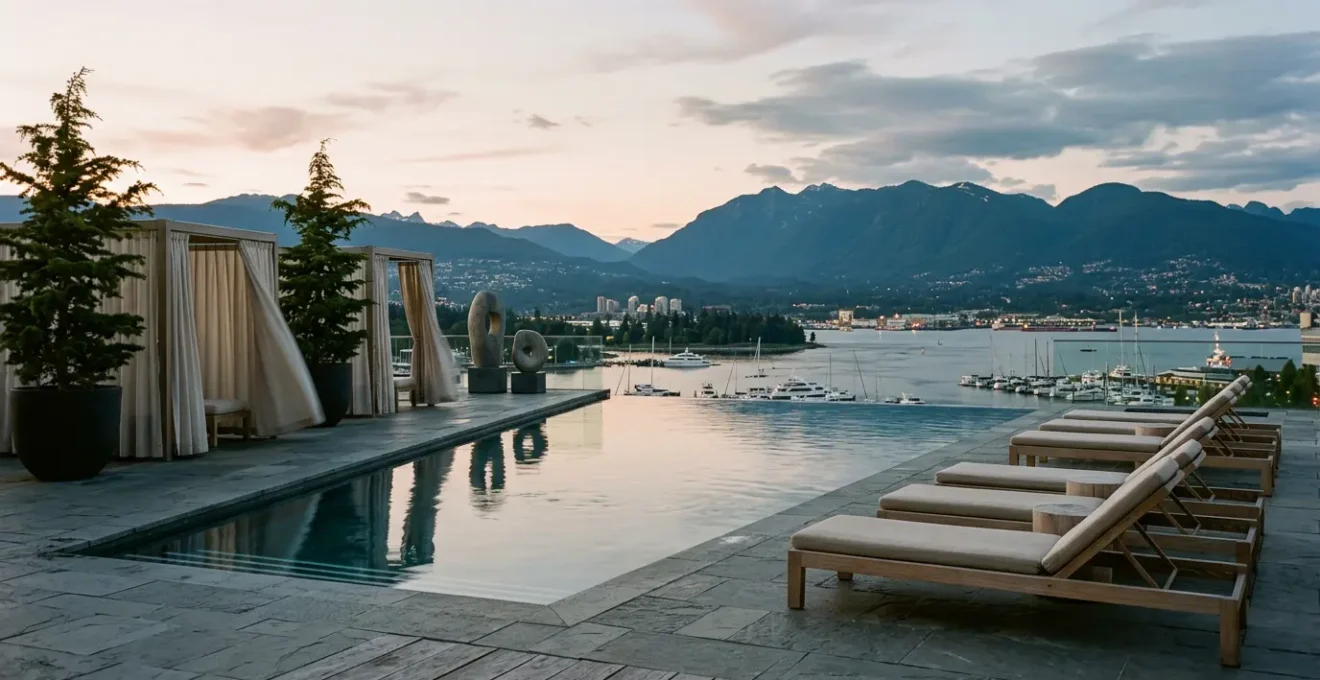
The rooftop pool deck is the heart of a hotel’s social wellness space, a place for peaceful repose. However, the experience can be quickly compromised by the stress of securing a comfortable spot. Many luxury properties have begun monetizing their prime poolside real estate, creating an unwelcome layer of friction. At the Fairmont Pacific Rim, the stunning rooftop pool with its palm trees and city views is a major draw, but access to the best seating is not always guaranteed. While general loungers are complimentary for guests, the coveted, private cabanas come at an additional cost.
This practice is becoming a standard in the industry. For context, it’s not uncommon for day-pass users at other properties to pay significant fees. While hotel guests receive priority, the principle of paying extra for comfort can detract from a seamless luxury experience. For instance, some pricing models show access can cost $40 per person for just 60 minutes for guests, though this can sometimes be offset if you’re booking a spa service. This transforms relaxation into a transaction.
From a wellness perspective, the ideal environment is one of effortless access. Before booking, it is crucial to clarify the hotel’s policy on poolside seating. Ask if cabanas can be reserved in advance and what the associated fees are. The value of serenity is highest when it is not accompanied by a surprise bill. A hotel that offers ample, high-quality complimentary seating demonstrates a deeper commitment to the guest’s holistic peace of mind.
The 24-Hour Menu: Is the $30 Burger Worth It at 3 AM?
A wellness journey is not always aligned with standard restaurant hours. A late arrival from a long-haul flight or a simple middle-of-the-night craving requires a hotel to provide nourishment that is both high-quality and readily available. This is where the 24-hour room service menu becomes a critical, yet often overlooked, amenity. The value of a $30 burger at 3 AM is not in its price, but in its existence and quality, especially within the context of “Vancouver’s notoriously sparse late-night food scene,” as noted in a local analysis of the city’s dining options.
For the wellness traveler, this service is a non-negotiable part of a holistic wellness environment. Being able to order a well-prepared, satisfying meal at any hour eliminates a significant source of stress and allows your body’s rhythm to take precedence over the hotel’s schedule. Both the Fairmont Pacific Rim and the Shangri-La offer 24-hour in-room dining, but the quality and breadth of the menu can differ. A truly superior service offers more than just basic fare; it provides nourishing, comforting, and even indulgent options around the clock.
Vancouver’s notoriously sparse late-night food scene
– Local food culture observation, Vancouver late-night dining analysis
When considering this, think beyond the price tag. Is the menu inspiring? Does it offer healthy, restorative choices alongside classic comfort food? The ability to satisfy a late-night hunger pang with a delicious, high-quality meal without leaving the sanctuary of your room is a profound luxury. It’s an investment in uninterrupted comfort and a key indicator of a hotel’s dedication to the complete guest experience.
Club Level Access: Is the Extra $150/Night for the Lounge Worth It?
The allure of the Club or Gold Level is often presented in tangible terms: complimentary breakfast, evening canapés, and an honour bar. For a typical traveler, the calculation is simple arithmetic—will I consume more than the supplementary cost? For the wellness traveler, however, the equation is entirely different. The true value of paying an extra $150 or more per night is not measured in food and beverage, but in the acquisition of a priceless commodity: guaranteed tranquility.
Think of the Club Lounge as a private sanctuary within the larger hotel. It offers a refuge from the morning rush at the main breakfast restaurant and a quiet, sophisticated space to unwind in the evening, away from a bustling lobby bar. This exclusivity is a powerful tool for managing your energy and cognitive load. The ability to have a coffee and read in peace, or to have a light dinner in a calm environment, significantly reduces “amenity friction.” This answers the common question of whether Fairmont Gold is worth it: if your goal is peace, the answer is often yes.
The $150 is an investment in peace. Before committing, consider your personal needs. Do you value quiet mornings above all else? Does the thought of navigating a crowded restaurant for breakfast add stress to your day? If so, the Club Level is not an expense; it is a strategic component of your wellness retreat. It ensures that your moments of rest between spa treatments or city explorations are spent in a serene, controlled, and exclusive environment.
The “Pet Fee” Shock: How Much Does It Cost to Bring a Dog to the Fairmont?
For many wellness-minded individuals, the presence of a beloved pet is non-negotiable for true relaxation. The stress of leaving a furry companion behind can negate the benefits of a getaway. However, navigating the labyrinth of hotel pet policies and fees can introduce its own form of anxiety. Here, the Fairmont Pacific Rim provides a masterclass in removing amenity friction. In a move that demonstrates a deep understanding of the modern luxury traveler, verified directories confirm that the Fairmont Pacific Rim allows pets of any size for no additional fee.
This is not the industry standard and stands in stark contrast to the policies of many other five-star properties in Vancouver. A fee of $25 to $50 per night is common, which can add up significantly over a multi-day stay. By eliminating this charge, the Fairmont signals that pets are not just “tolerated” but are genuinely welcome, contributing to a more complete sense of home and comfort for the guest.
The following table, based on a recent analysis of dog-friendly luxury hotels in Vancouver, illustrates this key differentiator. The provision of amenities like beds, dishes, and treats further elevates the experience from a simple stay to a thoughtful, inclusive welcome.
| Hotel | Pet Fee | Amenities Included |
|---|---|---|
| Fairmont Pacific Rim | No fee (currently waived) | Pet bed, walking map, dishes, treats |
| Fairmont Vancouver Airport | $25 CAD/night | Dog bed, dishes |
| Rosewood Hotel Georgia | $50/night | Plush pet bed, bowls, feeding mat |
| Four Seasons Vancouver | No fee | No weight restrictions |
This policy is a powerful indicator of a hotel’s philosophy. It prioritizes the guest’s emotional well-being over an easy revenue stream, a hallmark of a truly guest-centric and holistic wellness environment. For the pet owner, this single factor can often be the deciding one in choosing a sanctuary.
Valet, Bellman, Housekeeping: How Much Cash Should You Carry for Tips?
In a seamless luxury experience, the final moment of a transaction should not be a moment of anxiety. Yet, the ambiguity surrounding tipping can create precisely that. Fumbling for cash, wondering about the appropriate amount, or realizing you only have large bills can introduce a jarring note into an otherwise serene stay. From a spa director’s perspective, preparing for these small interactions is as important as scheduling a treatment. It’s about maintaining a state of effortless flow.
In Vancouver, as in the rest of Canada, tipping service staff is customary and appreciated. The key is to be prepared with the right currency—small Canadian bills ($5 and $10 CAD), as coins are impractical and the smallest bill is the $5 note. Having a small cache of these on hand removes all friction from these interactions. You can graciously acknowledge excellent service from the valet who retrieves your car in the rain or the housekeeper who impeccably maintains your private sanctuary without a moment’s hesitation.
To eliminate any guesswork, consider this your practical guide to gratuities at a luxury Vancouver hotel. Following these local norms ensures that you are showing appreciation appropriately, allowing you to focus on your relaxation.
Your Vancouver Luxury Hotel Tipping Plan (CAD)
- Valet: Prepare $2-5 CAD for when your car is retrieved. Consider a higher amount for exceptional service or during inclement weather.
- Bellman/Porter: Have $1-2 CAD per bag ready, adjusting for particularly heavy or cumbersome luggage.
- Housekeeping: Leave $2-5 CAD per day on a pillow or desk. It’s best to tip daily, as the staff attending your room may change during your stay.
- Concierge: For simple directions, no tip is necessary. For complex tasks like securing a last-minute reservation at a top restaurant, $5-10 CAD is a thoughtful gesture.
- Cash on Hand: Ensure you carry a mix of Canadian $5 and $10 bills, as these are the most practical for tipping.
By planning for these small transactions, you are protecting your own peace of mind. It’s a simple, proactive step that ensures your entire experience remains smooth, gracious, and free of unnecessary stress.
The Takeoff Noise: Is a Harbour View Room Too Loud in the Morning?
A room with a view of Coal Harbour is one of Vancouver’s most iconic hotel experiences. Watching the seaplanes glide across the water against the backdrop of the North Shore mountains is undeniably spectacular. However, for the wellness traveler whose priority is deep, uninterrupted rest, this iconic view comes with a critical question: what is the cost to your tranquility? The harbour is not just a scenic vista; it is a busy, operational airport.
With over 160 seaplane flights in and out daily during peak season, the activity begins early in the morning. While luxury hotels like the Fairmont Pacific Rim are constructed with high-quality soundproofing, no building is entirely impervious to the low-frequency rumble of a plane at takeoff. For a light sleeper, or anyone sensitive to noise, this can be a significant disruption to the sleep cycle, particularly the crucial REM and deep sleep stages that are essential for restoration.
This presents a direct trade-off. You must weigh the aesthetic pleasure of the view against the potential for auditory disturbance. If your primary goal is to sleep in and enjoy quiet mornings in your room, a harbour-facing room may introduce an element of “amenity friction” you wish to avoid. It’s a crucial consideration when calculating the “total cost of tranquility.” The most beautiful view in the city is worth little if it compromises the very rest you came to find.
The Fairmont In-Terminal: Is It Worth Booking a Day Room for a 6-Hour Layover?
A layover is often seen as a period of travel purgatory. However, with strategic planning, it can be transformed into a micro-retreat. For a traveler with a six-hour layover at Vancouver International Airport (YVR), the question arises: is it better to seek refuge at the in-terminal Fairmont or venture downtown to the Fairmont Pacific Rim’s Willow Stream Spa? From a pure wellness and time-management perspective, the answer is clear when we analyze the transit logistics.
The journey from YVR to downtown Vancouver is efficient, but it is not instantaneous. This is the crucial factor to consider when time is your most precious asset. The downtown hotel might seem more glamorous, but the time commitment is substantial, leaving you with a compressed window for actual relaxation.
The Case for an Airport Day Room: A Layover Time Analysis
The Fairmont Pacific Rim is located approximately 30-40 minutes from Vancouver International Airport via the Canada Line rapid transit. For a 6-hour layover, travelers must factor in a minimum of one hour for round-trip transit time. More importantly, upon returning to YVR, you must go through security again, which can easily consume another hour. This leaves you with only about four hours of usable time at the downtown spa, a period shadowed by the stress of a ticking clock. In contrast, booking a day room at the Fairmont Vancouver Airport provides immediate access to its own quiet rooms and spa facilities, maximizing every minute of your layover for genuine rest and rejuvenation without any transit-related anxiety.
In this scenario, the “total cost of tranquility” is measured in time and stress. The convenience of the in-terminal hotel far outweighs the allure of its downtown counterpart. Opting for the airport hotel is a strategic decision to eliminate transit friction and maximize restorative time, making it the unequivocally superior choice for a short layover.
Key Takeaways
- True luxury is measured by the “total cost of tranquility,” which includes hidden fees, noise levels, and convenience, not just the spa menu.
- The Fairmont Pacific Rim often demonstrates superior value by waiving common charges like pet fees, enhancing the guest’s sense of welcome.
- Room selection is a critical wellness decision; a Harbour View offers iconic scenery but potential noise, while a Mountain View promises serenity and a unique “string of pearls” light show at dusk.
Harbour View vs Mountain View: Which Room Upgrade Is Worth $100 More?
The decision between a Harbour View and a Mountain View room, often separated by a $100 price difference, is the ultimate test of your wellness priorities. It’s a choice between two different forms of tranquility: the dynamic, vibrant energy of the harbour versus the serene, steadfast calm of the mountains. There is no universally “better” option; the superior choice is the one that aligns with your personal definition of peace.
The Harbour View offers a captivating, ever-changing tableau of city life. You have a front-row seat to the ballet of seaplanes, cruise ships, and city lights reflecting on the water. For some, this energy is invigorating and inspiring—a visual connection to the heart of Vancouver. However, as we’ve established, this comes with a potential cost: morning noise. It’s a view best suited for the traveler who feels energized by the city’s pulse.
Conversely, the Mountain View offers a different, more profound sense of calm. The North Shore mountains provide a majestic, unchanging backdrop that instills a feeling of stability and peace. The experience is quieter, more contemplative. At dusk, this view offers its own unique magic as the lights of Grouse Mountain create a “string of pearls” effect against the twilight sky. This is the view for the traveler seeking a true escape—a visual anchor that pulls the mind away from the hustle and bustle below. That $100 investment buys you a quieter, more meditative experience, which for many, is the very essence of a wellness retreat.
To determine the right hotel and room for you, begin by defining your personal “tranquility priorities.” Consider what truly restores you—is it vibrant city energy or quiet natural grandeur? By aligning your choice with your deepest wellness needs, you ensure your investment yields the greatest possible return in peace and rejuvenation.