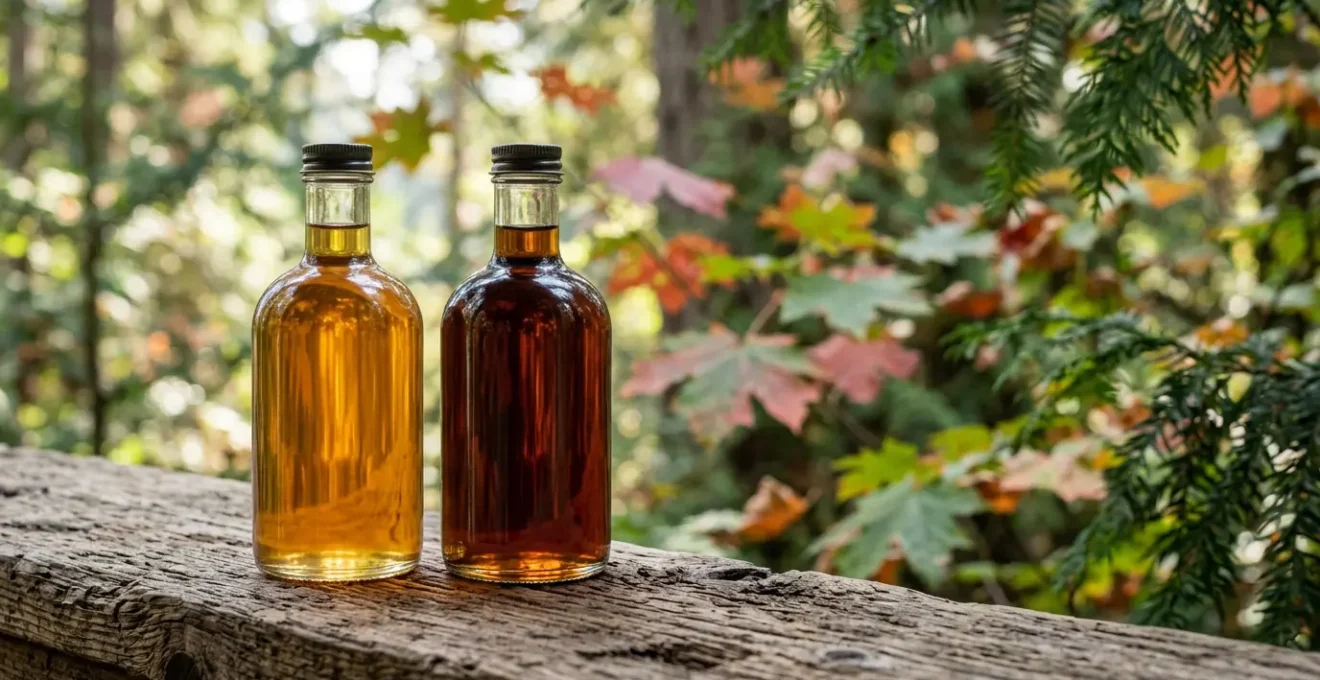
The best maple syrup souvenir from Vancouver isn’t Amber for pancakes; it’s a robust Dark grade that captures the unique taste of BC’s wilderness.
- Standard grades (Golden, Amber) are based on Eastern Canadian sugar maples, but British Columbia has its own distinct variety: the Bigleaf Maple.
- Dark and Very Dark grades of Bigleaf maple syrup offer a richer, more complex flavour profile with notes of caramel, vanilla, and a hint of smokiness that’s perfect for a memorable gift.
Recommendation: Seek out “Dark” or “Very Dark” grade syrup specifically labeled “Product of British Columbia” or “Bigleaf Maple” from a vendor at Granville Island Market for the most authentic taste of the West Coast.
There you are, standing in a Granville Island shop, surrounded by the sweet scent of possibility. You came to Vancouver for the mountains and the ocean, but you’re determined to leave with a piece of its flavour. In your hands are two bottles of maple syrup. One is a beautiful, sunny Amber. The other is a mysterious, deep Dark. The labels all say “100% Pure,” but they look and feel worlds apart. You’ve heard the common advice: Amber is for pancakes, Dark is for cooking. It seems simple enough, but a nagging feeling tells you there’s more to the story, especially here on the West Coast.
That feeling is right. The standard advice is based entirely on the sugar maples of Eastern Canada. But here in British Columbia, we have our own liquid gold, tapped from the mighty Bigleaf maple trees of our coastal rainforests. Choosing a syrup here isn’t just about colour; it’s about choosing an experience. It’s about deciding whether you want a simple sweet topping or a complex, robust flavour that tells a story of the local terroir. If you’re looking for a souvenir that truly captures the essence of your trip, one that will make you close your eyes and remember the scent of the damp BC forest, the choice becomes clear.
This guide is your inside scoop, from my sugar bush to your suitcase. We’ll move past the generic rules and dive into the heart of what makes BC maple syrup special. We’ll cover the practicalities of getting it home safely, how to use it in your own kitchen, and how to spot the real deal. But most importantly, we’ll help you choose the grade that delivers not just sweetness, but the most memorable flavour.
To help you navigate this flavourful journey, this guide breaks down everything a visitor to Vancouver needs to know. From practical baking tips and travel-safe packaging to understanding the unique taste of our local ingredients, you’ll be choosing your souvenir syrup like a local in no time.
Summary: Your Complete Guide to Choosing a Vancouver Maple Syrup Souvenir
- Substitution Ratio: How to Replace Sugar with Maple Syrup in Baking?
- The Crystal Mistake: Why You Must Refrigerate Maple Syrup After Opening?
- The Ingredient Label Trick: How to Spot “Table Syrup” Disguised as Maple?
- Glass vs Plastic Jug: Which Container Survives a 10-Hour Flight?
- Butter, Taffy, or Sugar: Which Maple Product Is Best for Hiking Snacks?
- The 3 Layers: What Makes a Nanaimo Bar “Authentic” BC Style?
- The Nanaimo Bar Quest: Where to Buy a Box That Won’t Melt on the Plane?
- Okanagan Fruit to Fraser Valley Duck: Why BC Ingredients Taste Better?
Substitution Ratio: How to Replace Sugar with Maple Syrup in Baking?
So, you’ve brought home a bottle of that beautiful, dark BC maple syrup. Now what? Before you just pour it into your favorite cookie recipe, let’s talk specifics. Maple syrup is sweeter than white sugar and it’s also a liquid, so a simple one-to-one swap can lead to soggy, overly sweet results. As a sugar maker, I want you to love what you bake, so here’s the method we all use. The key is to reduce the other liquids in your recipe to compensate for the syrup’s moisture content. It’s a simple adjustment that makes all the difference.
Remember that the flavour of your bake will change, too—and for the better! Using a robust, Dark maple syrup will impart a wonderful caramel-like depth that white sugar simply can’t match. It’s also worth noting the incredible effort that goes into each drop. Here in BC, it can take 50 litres of Bigleaf maple sap to make just 1 litre of syrup, so every spoonful is precious. This concentrated nature is what gives it such a powerful flavour, making it a star ingredient rather than just a sweetener.
Your Action Plan: The 4-Step Maple Syrup Baking Substitution Method
- Replace: For every 1 cup of white sugar, use ¾ cup of maple syrup. Maple is naturally sweeter than refined sugar, so you need less.
- Reduce: Decrease other liquids in your recipe (like milk or water) by 2 to 4 tablespoons to compensate for the maple syrup’s liquid content.
- Add: Include ¼ to ½ teaspoon of baking soda. This helps balance the syrup’s slight acidity and ensures a proper rise, unless your recipe already has acidic ingredients like buttermilk.
- Lower: Reduce your oven temperature by 25°F (about 15°C). According to baking experts, this prevents over-caramelization, as maple syrup browns faster than white sugar.
Mastering this simple conversion unlocks a whole new world of flavour in your home baking. It’s the perfect way to share the taste of your travels with friends and family, infusing your favorite recipes with the rich character of the Pacific Northwest.
The Crystal Mistake: Why You Must Refrigerate Maple Syrup After Opening?
This is the one piece of advice I give to every single person who buys my syrup: once you break that seal, the bottle belongs in the refrigerator. I can’t tell you how many sad stories I’ve heard about a beautiful souvenir bottle of maple syrup, left in the pantry like honey, only to be discovered with a fuzzy layer of mould on top. It’s a heartbreaking sight, and it’s completely avoidable. Maple syrup, unlike its processed counterfeit cousins, is a natural, pure product with no preservatives.
Before it’s opened, a properly sealed bottle of maple syrup is shelf-stable indefinitely. The heat-packing process creates a sterile environment. But the moment you twist that cap, you introduce airborne spores from the environment. As the Government of Ontario’s guidelines on maple production explain, “Maple syrup is particularly susceptible to types of moulds that can grow in high-sugar environments.” Chilling the syrup doesn’t just keep it fresh; it slows the growth of these naturally occurring moulds to a near standstill, preserving its flavour and safety. Proper storage means your delicious souvenir can last for a very long time; some maple experts suggest that refrigeration can extend its life for up to two years.
Think of it this way: you are protecting a pristine piece of the forest. The cool, dark environment of the fridge mimics the conditions that keep nature’s products fresh. Storing it properly ensures that the last drop tastes just as pure and flavourful as the first. It’s a simple step to protect your delicious investment and the hard work that went into making it.
The Ingredient Label Trick: How to Spot “Table Syrup” Disguised as Maple?
Nothing gets a sugar maker’s blood boiling quite like seeing a bottle of “table syrup” masquerading as the real thing. These impostors are often just corn syrup, water, artificial flavours, and caramel colouring, sold in a bottle that tries its best to look like authentic maple syrup. They are an insult to the forest, the farmers, and your pancakes. As the Canadian Food Inspection Agency (CFIA) states, authentic maple syrup is a “pure, single ingredient food” obtained exclusively from maple sap. There’s no grey area here.
Luckily, in Canada, we have strict regulations to protect both you and our national treasure. Learning to read the label is your superpower against fraud. It’s a simple trick that takes only a few seconds but guarantees you’re getting the authentic, flavourful product you’re paying for. The front of the bottle might be designed to look rustic and charming, but the ingredient list and the grade stamp on the back never lie. They are your window into the bottle’s true identity. When you’re in a busy market, this quick check is the most important thing you can do.
This skill is especially important when you’re looking for that unique BC Bigleaf Maple syrup. Because it’s a more niche, artisanal product, you’ll want to be extra sure you’re getting the genuine article. A true local producer will be proud to clearly label their syrup as a “Product of British Columbia” and specify that it’s from Bigleaf maples. It’s a mark of quality and a promise of the unique West Coast flavour you’re seeking. Use the checklist below to become a maple syrup detective and ensure your souvenir is 100% authentic.
Glass vs Plastic Jug: Which Container Survives a 10-Hour Flight?
You’ve found the perfect bottle of dark, flavourful BC maple syrup. Now comes the logistical challenge: getting it home without it becoming a sticky tragedy in your checked luggage. As a producer who ships syrup to folks all over the world, I can tell you that the container you choose is just as important as the syrup inside it. The classic maple leaf-shaped glass bottle is a beautiful souvenir, but it’s also the most fragile. The humble plastic jug is light and shatterproof, but there’s a small risk of the cap loosening under pressure changes in the cargo hold.
The unsung hero of air travel for maple syrup is the tin can. It’s the best of both worlds: lightweight, incredibly durable, and completely leak-proof. It won’t shatter, and the sealed top is impervious to pressure changes. Many vendors at places like Granville Island Market, who cater to tourists, will specifically offer syrup in tins for this very reason. It’s what I recommend to all my long-distance travelers. Remember the key rule from the Canadian Air Transport Security Authority (CATSA): any liquid container over 100ml must go in your checked bag. Don’t try to sneak a 500ml bottle through security at YVR—it will be a sad and swift confiscation.
A pro tip from seasoned Vancouver travelers is to use that sturdy tin of maple syrup as a protective case for other, more fragile souvenirs. If you’ve also purchased a box of delicate Nanaimo bars, you can wrap them, place them next to the tin in the center of your suitcase, and surround the whole bundle with soft clothing. The rigid tin acts like a fortress, protecting its precious neighbours.
| Container Type | Durability (Flight Survival) | Weight Impact | Leak-Proof Rating | Flavor Preservation | Best Use Case |
|---|---|---|---|---|---|
| Glass Maple Leaf Bottle | Medium (requires bubble wrap) | Heavy (adds 300-500g) | High (if properly sealed) | Excellent (no oxygen transfer) | Premium gift souvenir |
| Tin Can | High (dent-resistant) | Medium (adds 150-250g) | Very High (welded seams) | Excellent (no light penetration) | Best for checked luggage |
| Plastic Jug | High (flexible, won’t shatter) | Light (adds 50-100g) | Medium (cap may loosen under pressure) | Good (some oxygen permeability over time) | Budget-conscious travelers |
| Small Glass Bottles (250ml) | Medium-High (easier to protect) | High | Excellent | Carry-on if under 100ml; multiple small gifts |
Butter, Taffy, or Sugar: Which Maple Product Is Best for Hiking Snacks?
One of the best ways to experience Vancouver is to get out on the trails, whether it’s a strenuous hike up the Grouse Grind or a peaceful walk through Pacific Spirit Park. And the best way to fuel that adventure? With the natural, unprocessed energy of maple. But not all maple products are created equal when it comes to portability and performance. Maple taffy is a delicious winter treat, but it turns into a sticky mess in a backpack on a warm day. Maple butter is a creamy delight, but it requires a container and a utensil.
For the trail, you need something that is energy-dense, lightweight, and mess-free. This is where hard maple sugar candies or granulated maple sugar shine. They are pure, crystallized maple syrup—essentially a solid energy puck. They won’t melt in your pocket, they weigh very little, and they provide an immediate, powerful boost of energy when you need it most. Many long-distance hikers on trails like the West Coast Trail carry granulated maple sugar to sweeten their morning oatmeal or coffee, as it provides the most calories for the least weight.
For a day hike, a few hard maple sugar candies are perfect. They dissolve slowly in your mouth, providing a sustained release of energy rather than a jarring sugar rush. They are the forest’s answer to synthetic energy gels. Packing these alongside some local Fraser Valley hazelnuts and dried Okanagan cherries creates a GORP (Good Ol’ Raisins and Peanuts) mix that is 100% pure British Columbia fuel, connecting you to the landscape in more ways than one.
| Maple Product | Energy Density | Weight (per 100 calories) | Melt Resistance (°C) | Packability | Best Trail Application |
|---|---|---|---|---|---|
| Hard Maple Sugar Candies | Very High | 28g | Excellent (melts above 35°C) | Excellent (small, hard) | Grouse Grind, day hikes in hot weather |
| Maple Butter | High | 32g | Poor (softens at 20°C) | Medium (requires container) | Cool-weather hikes, spread on trail crackers |
| Maple Taffy | High | 30g | Very Poor (sticky at 15°C) | Poor (requires wax paper) | Winter snowshoeing only |
| Maple Syrup (small squeeze bottle) | Medium | 38g | N/A (liquid) | Medium (leak risk) | Quick energy boost, mix with water for electrolyte drink |
| Granulated Maple Sugar | Very High | 25g | Excellent (hygroscopic but stable) | Good (resealable bag needed) | West Coast Trail, multi-day backpacking for cooking |
The 3 Layers: What Makes a Nanaimo Bar “Authentic” BC Style?
You can’t visit British Columbia without trying its most famous dessert: the Nanaimo Bar. Named after the city on Vancouver Island, this no-bake treat is a holy trinity of texture and flavour. An authentic Nanaimo Bar must have three distinct layers. First, a dense, crumbly base of chocolate, graham cracker crumbs, coconut, and nuts. Second, a sweet, creamy middle layer of buttercream custard, which gives it its signature yellow stripe. And finally, a crisp, snappy top layer of pure dark chocolate that cracks when you bite into it. Anything else is just a square.
While the classic recipe is sacred to many, the spirit of the West Coast is one of innovation. Here in Vancouver, creative pastry chefs are finding ways to honour the tradition while incorporating other iconic BC flavours. And this is where our maple syrup story comes full circle. Instead of using corn syrup in the base layer, some of the most forward-thinking bakeries are using robust, Dark grade Bigleaf maple syrup.
Case Study: Maple-Infused Nanaimo Bar Innovation at Vancouver Bakeries
BC pastry chefs have begun experimenting with incorporating Dark grade Bigleaf maple syrup into Nanaimo Bar recipes. This is a significant innovation, as it bridges two of Canada’s most iconic flavours. According to West Coast Wild Foods, a Vancouver-based specialty producer, Bigleaf maple syrup has a unique flavour profile with “hints of vanilla, caramel and a light smokiness” that is “richer and darker compared to eastern maple syrup.” By substituting the traditional corn syrup in the chocolate-nut base with this robust maple syrup, chefs are creating a “West Coast Woods” variation. This terroir-driven approach elevates the classic dessert, adding a layer of complexity that complements the traditional coconut, custard, and chocolate profile without overpowering it, creating a truly unique and authentic taste of British Columbia.
This innovation is the perfect example of my advice in action. It’s the Dark, complex flavour of the local syrup that chefs are reaching for, not the milder Amber. They know it’s the grade that has the character to stand up to the chocolate and nuts, adding a delicious new dimension. When you taste a maple-infused Nanaimo bar, you are tasting the evolution of BC’s culinary identity.
The Nanaimo Bar Quest: Where to Buy a Box That Won’t Melt on the Plane?
Now that you’re craving a maple-infused Nanaimo bar, the quest begins. Finding a good one in Vancouver isn’t hard, but finding one that’s packaged to survive a long flight home is a different challenge. The creamy custard layer is sensitive to temperature, and the chocolate top can easily melt. You need a vendor who understands the needs of a traveler. Your best bet, without a doubt, is the Granville Island Public Market.
This bustling market is a one-stop shop for all your edible souvenirs. Not only will you find some of the best Nanaimo bars in the city, but you’ll also find the vendors who know how to pack them. Many of the artisan bakeries offer their bars in rigid tin containers. This is exactly what you’re looking for. The tin protects the bars from being crushed in your luggage and provides a degree of insulation. Be sure to ask specifically for “flight-safe packaging” to ensure you get the right thing. While you’re there, you can also pick up that travel-friendly tin of Bigleaf maple syrup we talked about.
For the ultimate souvenir-packing strategy, here is the route I recommend to all my visiting friends:
- Arrive Early: Start at the main entrance of the Granville Island Public Market (1689 Johnston Street) in the morning for the freshest selection and smaller crowds.
- Find the Bakery: Head to one of the main artisan bakery stalls. Look for those offering travel-packaged Nanaimo bars and ask for them in a rigid tin.
- Locate the Syrup: Visit a specialty food vendor carrying BC Bigleaf Maple Syrup. Prioritize the ones sold in tin cans for maximum durability in your checked luggage. You’ll often find producers from Vancouver Island at the market on weekends.
- Combine and Protect: If traveling in summer, consider buying a small insulated cooler bag (often sold on-site) and an ice pack. As a final pro tip, pack the tin of Nanaimo bars right next to the tin of maple syrup in the center of your suitcase, then surround them with your clothes for cushioning. The two tins will protect each other.
Following this simple plan ensures your delicious BC treats make it home in perfect condition, ready to be enjoyed as you share the stories of your trip.
Key takeaways
- The best maple syrup souvenir from Vancouver is a Dark or Very Dark grade from local Bigleaf maples, not the milder Amber grade.
- Authentic Canadian maple syrup has only one ingredient; use the CFIA label checklist to avoid “table syrup” fakes.
- For air travel, choose maple syrup in a tin can, as it’s the most durable and leak-proof option for checked luggage.
Okanagan Fruit to Fraser Valley Duck: Why BC Ingredients Taste Better?
By now, you’ve realized that choosing a souvenir from British Columbia is about more than just picking an item off a shelf. It’s about tasting the place itself. From the sun-ripened cherries of the Okanagan Valley to the rich bounty of the Fraser Valley, our province is blessed with a unique and diverse terroir. This is the magic ingredient you can’t find anywhere else—the specific combination of soil, climate, and environment that gives our food its incredible flavour. And our Bigleaf maple syrup is perhaps the purest expression of this coastal terroir.
Unlike the vast, open sugar bushes of the East, our Bigleaf maples grow wild in the complex ecosystem of the Pacific coastal rainforest. They share the soil with Douglas firs, cedars, and ferns, drawing minerals and character from this rich, damp earth. This is why our syrup tastes different. It’s less about pure, straightforward sweetness and more about a complex, layered flavour profile. It has a story to tell.
Our western maple syrup has more flavour than its eastern cousin. While good on pancakes, it excels for use in cooking baked beans, many deserts and as a glaze for vegetables, ham, ribs and fish.
– Bigleaf Maple Syrup Producers Guide, Vancouver Island Bigleaf Maple Syrup Production Guide
This is the secret that local chefs have known for years. The robust, almost smoky notes of Dark Bigleaf syrup are what they reach for when they want to glaze a Fraser Valley duck or add depth to a dessert. They understand that this syrup isn’t just a sweetener; it’s a defining regional ingredient. So when you choose a bottle of Dark BC maple syrup, you are not just choosing a colour. You are choosing the most authentic, flavourful, and memorable taste of the West Coast—a true liquid souvenir that carries the essence of the British Columbia wilderness.
So, the next time you drizzle that dark, wonderful syrup over your morning pancakes, I hope you’ll be transported back to the lush, green forests of Vancouver. The best way to honour that memory is to seek out and share the authentic taste of British Columbia with those you love.