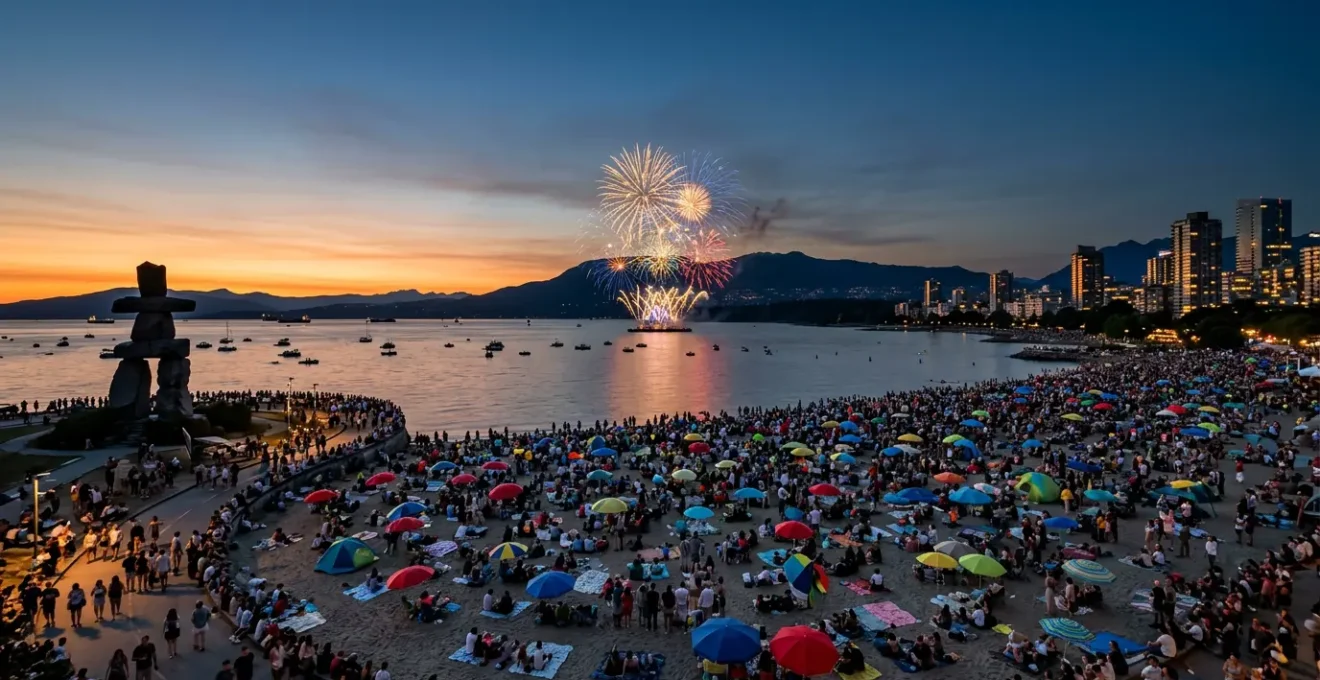
The key to enjoying the Celebration of Light isn’t arriving earlier; it’s using logistical strategies to outsmart the crowd and maximize your experience.
- Paid options like grandstands or shoulder venues offer guaranteed views with a clear return on investment.
- Free viewing requires tactical planning, such as the “Park and Stroll” or “Tag-Team” methods, to claim space efficiently.
Recommendation: Identify your priority—cost, comfort, or convenience—and select a corresponding strategy from this guide instead of defaulting to the 8-hour wait on the sand.
The annual Celebration of Light paints the Vancouver sky with spectacular pyrotechnics, but for many, the thought of the event is synonymous with a single, daunting image: a massive crowd and an all-day commitment to guarding a small patch of sand. The conventional wisdom is clear: to get a good view, you must sacrifice your entire day. This grueling test of endurance, waiting from noon for a 10 PM show, has become a rite of passage that many locals and tourists alike would rather skip. The fear of navigating the West End’s packed streets and the sheer exhaustion of the wait often outweighs the allure of the fireworks themselves.
Most guides will offer the same familiar tips: take transit, arrive at dawn, or watch from a distant beach. While not incorrect, this advice fails to address the core problem for those who want a premium experience without the day-long ordeal. It treats the event as a brute-force problem, where the earliest arrival wins. But what if the challenge wasn’t about endurance, but about strategy? What if you could approach the Celebration of Light not as a camper, but as a logistician, leveraging an insider’s understanding of crowd flow, geography, and value?
This guide reframes the problem entirely. Forget the sleeping bags and the 10-hour wait. We will break down the event with the precision of an event manager, revealing the strategic hacks and logistical trade-offs that allow you to secure a fantastic spot without the traditional sacrifice. From analyzing the return on investment of a patio seat to employing tactical parking maneuvers, you’ll learn how to bend the event’s logistics to your advantage. It’s time to stop fighting the crowd and start outsmarting it.
This article delves into the critical logistical questions every event-goer faces, from water safety and parking to evaluating the true value of premium experiences. Explore the sections below to build your master plan for the next Celebration of Light.
Summary: Celebration of Light Logistics: A Strategic Viewing Guide
- The E. Coli Count: Is It Safe to Swim in English Bay After a Rainstorm?
- The Chair Guy: How Much Does It Cost to Rent a Lounger for the Day?
- The West End Maze: Where to Park for the Beach on a Sunday?
- The Patio Line: Is the View Worth the 90-Minute Wait at Cactus Club?
- The Inukshuk Statue: Why Is This the Most Popular Sunset Photo Spot?
- Wreck Beach or Jericho: Which Offers the Best Sunset Views in August?
- The English Bay Premium: How Far in Advance to Book for Celebration of Light?
- Why Is the Pacific Ocean Around Vancouver So Cold Even in July?
The E. Coli Count: Is It Safe to Swim in English Bay After a Rainstorm?
A warm summer day at English Bay often invites a pre-fireworks dip in the ocean, but a savvy local knows to check one critical factor first: the weather from the past 48 hours. After a heavy rainstorm, the risk of water contamination rises significantly. This isn’t just a vague warning; it’s a measurable phenomenon. Vancouver’s urban runoff, including waste from streets and overflows from its older combined sewer systems, gets washed into False Creek and English Bay, causing bacterial counts to spike. As a logistician, you treat this not as a deterrent, but as a predictable variable to be managed.
The official body monitoring this is Vancouver Coastal Health. Their guidelines are precise: while an investigation begins when levels reach 235 E. coli units per 100 mL, swimming advisories are issued when a single sample hits 400 or when the geometric mean of five samples exceeds 200 E. coli per 100 mL. These aren’t just numbers; they are your go/no-go signal for swimming. Ignoring them can lead to gastrointestinal illness or skin infections, a surefire way to ruin your fireworks night.
Therefore, the first rule of your beach day logistics is to check the data before you pack your towel. Vancouver Coastal Health maintains a real-time beach water quality map online—a crucial tool for any summer plan. If you see an advisory posted or if there has been significant rainfall in the last two days, it’s strategically wiser to enjoy the beach from the sand. The risk of getting sick is simply not worth the reward of a quick swim. Enjoy the sun, play some frisbee, but save the ocean dip for a day with a clear water quality report. This is a simple step that separates a well-planned day from a potential disaster.
The Chair Guy: How Much Does It Cost to Rent a Lounger for the Day?
For those looking to elevate their beach experience beyond a simple towel on the sand, the iconic blue loungers and umbrellas available for rent at English Bay present an appealing option. These concessions offer a touch of comfort and a designated personal space amidst the growing crowds. From a logistical standpoint, renting a chair is a classic “Experience ROI” calculation: you’re trading a monetary cost for a significant upgrade in comfort and convenience. However, the key is understanding the cost structure and, more importantly, the supply-and-demand dynamics on a peak event day.
Typically, beach concession operators like the “chair guy” offer rentals on an hourly or daily rate. An hourly rate might seem economical for a short visit, but for a long-haul event like the Celebration of Light, the full-day rate is almost always the more strategic choice. Prices can vary, but you can generally expect a day rental for a chair and umbrella set to be a notable line item in your day’s budget. Think of it as purchasing a piece of temporary real estate on the beach.
The real challenge isn’t the cost, but the availability. On a sunny Sunday, and especially on a fireworks night, these coveted loungers are a finite resource. They are often claimed early in the day, long before the main crowds arrive. Arriving at 3 PM and expecting to find an available chair is a logistical miscalculation. If your plan hinges on securing one of these rentals, you must treat it like any other premium ticketed event: arrive early. While this article is about avoiding the all-day wait, renting a chair is one of the few instances where an earlier arrival (think late morning) directly translates to a better, more comfortable experience for the rest of the day.
The West End Maze: Where to Park for the Beach on a Sunday?
For any event at English Bay, parking is the ultimate logistical puzzle. The West End, with its dense residential streets and limited commercial lots, becomes a veritable maze for drivers, especially on a weekend. The default assumption is that parking is impossible, leading many to give up before they even start. However, an event manager sees this not as an impossibility, but as a system with variables that can be optimized. The secret is to abandon the idea of finding a “perfect” spot right by the beach and instead embrace a strategy of logistical arbitrage.
The most effective strategy is the “Park and Stroll” approach. Instead of circling the blocks around Denman Street in a futile search, you intentionally park further away in a more accessible area—like Yaletown or even parts of downtown—and incorporate a 15-20 minute scenic walk into your plan. This trades a bit of walking time for a massive reduction in stress, time spent searching, and often, parking cost. You’re leveraging Vancouver’s walkability as a strategic asset. Another creative option is parking at Granville Island and taking the charming Aquabus across False Creek, turning a logistical necessity into a memorable part of the experience.
For those committed to parking closer, understanding the landscape is key. All street parking near the beach is metered and highly limited. The few parkades in the West End fill up exceptionally fast. A systematic approach, as this detailed parking comparison shows, is essential to making an informed decision rather than relying on luck.
| Parking Option | Distance to English Bay | Cost Estimate | Availability on Events | Notes |
|---|---|---|---|---|
| Beach Avenue street parking | 0-2 blocks | Metered (paid) | Very limited | All parking near English Bay is paid; no free options exist |
| West End parkades (1125 Denman St) | 2-4 blocks | Hourly rate | Limited | Within walking distance, fills quickly on sunny days |
| Yaletown/Downtown parkades | 15-20 min walk | Lower hourly rate | Better availability | Park and Stroll strategy; scenic urban walk becomes part of the experience |
| Granville Island + Aquabus | Ferry ride + walk | Parking + ferry fare | Good availability | Alternative experience; park across False Creek and take scenic boat to beach |
The Patio Line: Is the View Worth the 90-Minute Wait at Cactus Club?
The Cactus Club Cafe on English Bay holds a legendary status during the Celebration of Light. Its sprawling patio offers what appears to be the ultimate viewing experience: a comfortable seat, food and drink service, and an unobstructed, elevated view of the fireworks. The catch? The infamous, hours-long lineup. This scenario presents the quintessential “Experience ROI” dilemma: is the guaranteed comfort and view worth the significant investment of time spent waiting in line? For a logistician, the answer isn’t a simple yes or no; it’s about a calculated trade-off.
The value proposition is undeniable. You are protected from the elements, have access to washrooms, and can enjoy a meal instead of huddling on a crowded beach. The ambiance is vibrant, and the view is, without question, spectacular. This is the peak of comfort for viewing the fireworks. The cost, however, is not just the price of your meal but the one to three hours you might spend in line to secure a table, with no guarantee of a prime patio spot. You are essentially trading waiting-on-the-beach time for waiting-on-the-sidewalk time.
The strategic play here depends on your group size and timing. A small group of two might get seated faster than a group of six. Arriving well before the dinner rush (e.g., mid-afternoon) to put your name down can sometimes work, but on fireworks nights, demand is relentless. The view is absolutely worth it if your group values comfort above all else and is willing to dedicate a significant portion of the evening to the process. It is not worth it if your goal is to have a more spontaneous or cost-effective evening. For many, the stress of the lineup simply replaces the stress of finding a spot on the sand.
Ultimately, choosing the patio is a conscious decision to invest heavily in comfort. It’s a luxury viewing option, and like all luxuries, it comes at a premium—in this case, a premium of time. It’s a valid strategy, but only for those who have weighed the cost and decided the return is sufficient for their desired experience.
The Inukshuk Statue: Why Is This the Most Popular Sunset Photo Spot?
Long before the fireworks begin, another light show captivates the crowds at English Bay: the sunset. And at the heart of it all stands the Inukshuk, arguably the most photographed silhouette in Vancouver. From a crowd-management perspective, understanding why this specific spot draws so many people is key to navigating the area. Its popularity isn’t accidental; it’s a perfect storm of cultural significance, artistic composition, and geographical alignment.
Firstly, the Inukshuk is not just a pile of rocks; it’s a powerful cultural symbol. As the official plaque text notes, it has a rich history. This context elevates it from a mere sculpture to a meaningful landmark.
Constructed of grey granite by Alvin Kanak of Rankin Inlet, this monument was commissioned by the Government of the Northwest Territories for its Pavilion at EXPO ’86 and later given to the city of Vancouver.
– Official plaque text, Vancouver Public Art Registry – Inukshuk by Alvin Kanak
This origin story, rooted in both Inuit culture and a pivotal moment in Vancouver’s history (EXPO ’86), gives the statue a gravitational pull. People aren’t just taking a picture of a statue; they’re capturing a piece of shared heritage. Secondly, its form is a photographer’s dream. The humanoid shape provides a powerful, relatable focal point against the vastness of the ocean and sky. It creates a sense of scale and a human connection to the landscape, making for an instantly compelling image. The gaps between the stones act as natural windows, framing the vibrant colours of the sunset in unique ways.
Finally, its placement is geographically perfect. Positioned at the edge of the bay, it allows photographers to frame it with the setting sun, the water, and the distant mountains all in one shot. This convergence of culture, art, and location makes it a natural magnet for anyone with a camera. Knowing this, a strategic event-goer can either join the crowd to get the classic shot or deliberately find a vantage point away from the statue for a less congested but equally beautiful sunset view.
Wreck Beach or Jericho: Which Offers the Best Sunset Views in August?
For those looking to escape the core English Bay crowds for the sunset prelude, two popular “shoulder” beaches come into play: Wreck Beach and Jericho Beach. While both offer stunning views, they provide vastly different logistical experiences. Choosing between them isn’t about which is “better,” but about which aligns with your group’s desired atmosphere, accessibility needs, and tolerance for adventure. An event manager would analyze this choice based on a clear set of operational parameters.
Wreck Beach, located at the western tip of Point Grey, offers a direct, head-on view of the sun setting over the water in late summer. Its vibe is famously bohemian, naturalist (it is a clothing-optional beach), and often features spontaneous drum circles at dusk. The experience is raw and immersive. However, this comes with a significant logistical challenge: the infamous 500-plus stairs that lead down a steep trail to the beach. The descent is manageable, but the climb back up in the dark after sunset requires a flashlight and a good level of fitness. Amenities are minimal; you must pack in everything you need.
Jericho Beach, by contrast, is the epitome of accessibility and family-friendly organization. The beach is flat, easily accessible, and offers ample amenities like washrooms, concessions, and parking. The sunset view here is different; it’s a side-lit panoramic that captures not just the sun but also the glowing downtown skyline and North Shore mountains. It’s a broader, more cityscape-oriented perspective. The atmosphere is active and social, with volleyball games and sailors from the nearby club dotting the scene. This comparison, sourced from an analysis by Vancouver’s Best Places, breaks down the decision.
| Factor | Wreck Beach | Jericho Beach |
|---|---|---|
| Vibe & Atmosphere | Bohemian, naturalist (clothing-optional), drum circles at sunset, secluded | Family-friendly, organized, active (volleyball, sailing), accessible |
| Sunset View Quality | Direct-on view (sun sets further north in August), dramatic cliff backdrop | Side-lit view of downtown skyline and mountains, broader panoramic perspective |
| Accessibility | Requires navigating 500+ stairs down steep trail; bring flashlight for climb back up in dark | Flat, wheelchair accessible, adjacent to Jericho Pier for alternate vantage point |
| Amenities | Minimal; no formal washrooms nearby, bring all supplies | Public washrooms, concessions, picnic areas, ample parking |
| Crowd Level | Moderate, more dispersed along beach length | Higher, popular with families and organized sports groups |
| Cultural Experience | Spontaneous drum circles and bohemian gatherings at dusk | Organized family atmosphere, potential overlap with events like Folk Festival |
Key Takeaways
- Strategic planning, not early arrival, is the key to enjoying the Celebration of Light without the all-day wait.
- Leverage “logistical arbitrage” by choosing options like “Park and Stroll” or shoulder venues to trade minor inconveniences for major gains in comfort and time.
- Every choice, from a paid seat to a beach spot, has an “Experience ROI” (Return on Investment); calculate whether the cost in money or time is worth the benefit.
The English Bay Premium: How Far in Advance to Book for Celebration of Light?
For those who find the idea of battling for a free spot on the sand completely unappealing, the Celebration of Light offers several ticketed, premium viewing experiences. These are the ultimate logistical hack: you are paying a premium to bypass the crowds and the wait entirely. This includes reserved seating in the Concord Pacific Grandstand, the all-inclusive experience at Inukshuk Point, and even patio events at nearby venues. The question is not *if* you should book, but *how far in advance* to secure these highly coveted spots.
The answer is unequivocally: as soon as they go on sale. These tickets are not a last-minute decision. They often sell out weeks, if not a month or more, before the event dates. The demand is driven by a clear value proposition: a guaranteed, comfortable seat with a perfect, unobstructed view. For many, the cost is a worthwhile investment to eliminate all stress. The pricing reflects this premium; for example, 2025 pricing showed that premium options like the grandstand, where tickets can be around $68, offer a stark contrast to the all-inclusive Inukshuk Point experience at over $240. These venues often include perks like access to private washrooms and the ability to purchase alcohol, which is prohibited on the public beach.
Another high-end strategy is booking a hotel room with a view of English Bay, such as at the historic Sylvia Hotel. This is the most luxurious option, combining your accommodation with a private, guaranteed viewing platform. Naturally, these rooms must be booked months in advance and come at a significant premium. For anyone serious about a stress-free fireworks night, monitoring the official Celebration of Light website and the social media of venues like the H.R. MacMillan Space Centre for their ticket release dates is a critical first step.
Action Plan: Securing Your Prime Fireworks Spot
- Early Booking: Identify your preferred premium venue (e.g., Grandstand, Inukshuk Point) and set a calendar reminder to book tickets the moment they are released, typically several weeks pre-event.
- Hotel Strategy: For the ultimate private viewing, research hotels with English Bay views (like the Sylvia Hotel) and book a room months in advance, confirming the view direction at the time of reservation.
- The ‘Tag-Team’ Tactic: For free viewing, coordinate with your group. One person arrives mid-day with a large blanket to claim a prime territory, with others joining after work. This is a common and effective local strategy.
- Shoulder Venue Scouting: Explore ticketed events at alternative locations like the Museum of Vancouver or H.R. MacMillan Space Centre in Vanier Park, which offer excellent views with a different atmosphere and often less competition for tickets.
- Patio Reconnaissance: If targeting a restaurant patio, call ahead to understand their fireworks night policy. Some may take limited reservations, while others are first-come, first-served, requiring you to plan your arrival accordingly.
Why Is the Pacific Ocean Around Vancouver So Cold Even in July?
A common surprise for visitors enjoying a hot July day in Vancouver is the shocking cold of the Pacific Ocean. While air temperatures can be a pleasant 25°C (77°F), the water remains stubbornly frigid. This isn’t just a feeling; it’s a geophysical reality. Despite the summer sun, coastal seawater temperatures in Vancouver rarely breach the mid-teens. Data consistently shows that the Pacific maintains a brisk average of 12–16°C (54–61°F) even in July and August, with only brief, shallow-water heatwaves pushing it slightly higher. This is a fundamental characteristic of the local environment that every beachgoer must factor into their plans.
The primary reason for this chill is the source of the water itself. The ocean currents in this region, particularly the California Current, bring cold, nutrient-rich water down from the subarctic regions of the North Pacific and Alaska. Unlike the warm Gulf Stream that heats the Atlantic coast, our currents act as a constant source of natural air conditioning. Additionally, the deep waters of the Strait of Georgia do not warm up easily, and tidal mixing constantly brings that deeper, colder water to the surface, preventing the sun-warmed surface layer from becoming too thick.
Instead of seeing this as a flaw, Vancouver’s culture has embraced it. The cold water is seen as invigorating and is central to the city’s wellness identity. This is most famously demonstrated by the city’s long-standing New Year’s tradition.
Case Study: The Vancouver Polar Bear Swim Tradition
The annual Vancouver Polar Bear Swim, held every January 1st at English Bay since the early 20th century, epitomizes the city’s embrace of cold water as a feature rather than a bug. Hundreds of participants enthusiastically plunge into frigid ocean waters (typically 6–8°C in winter) in a celebrated civic tradition. This event demonstrates how Vancouver’s cold Pacific waters have become integral to local identity and urban wellness culture, a spirit that also fuels the growing trend of year-round cold plunging at beaches across the city.
So, when you dip your toes into the water at English Bay, know that its briskness is a signature of the Pacific Northwest. It’s a reminder of the vast, deep ocean that lies just beyond the city, and a feature that has shaped the hardy, vibrant character of Vancouver itself.