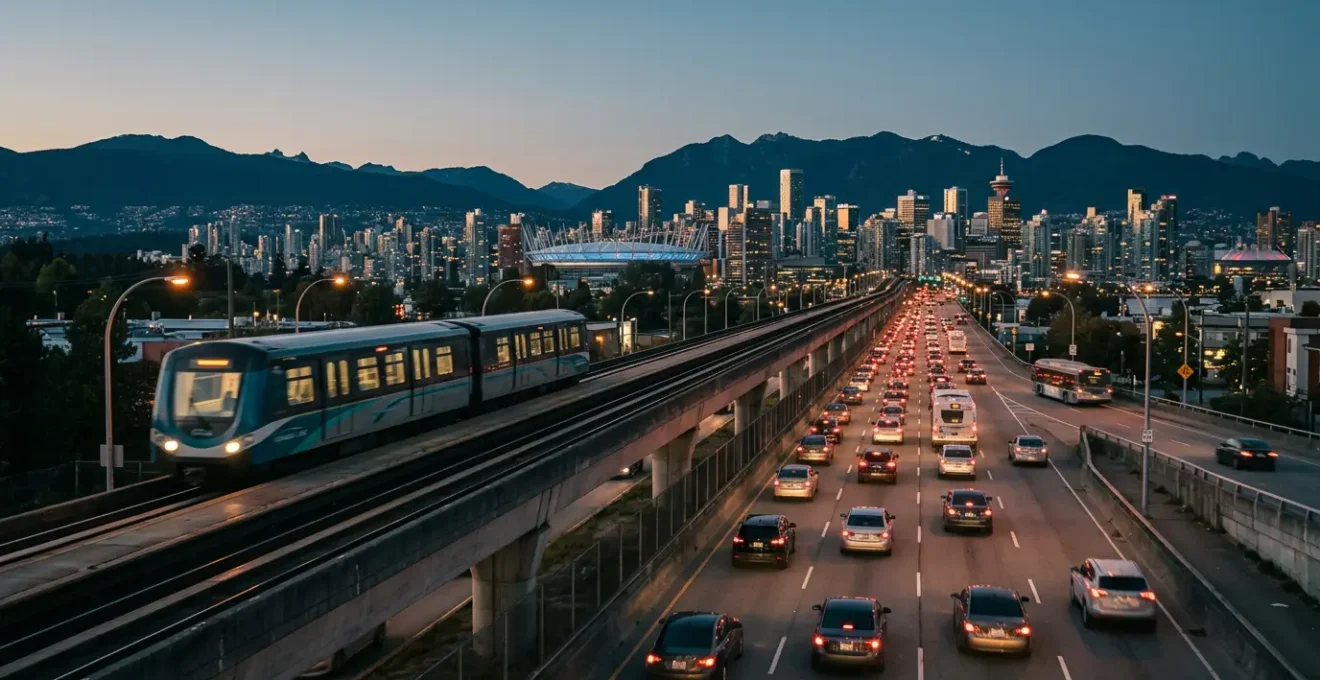
For a business traveler arriving at Vancouver International Airport (YVR) at 5 PM, the data is unequivocal: the Canada Line is not just faster, it is the only predictable and strategically sound option for reaching downtown.
- Uber and other rideshare services are a high-risk gamble against rush hour congestion on the Arthur Laing Bridge and volatile surge pricing.
- The Canada Line operates on a dedicated, grade-separated track, guaranteeing a sub-30-minute trip time, regardless of road conditions.
Recommendation: Choose the Canada Line for absolute certainty in your schedule and budget. Use the predictable travel time to decompress or prepare for your evening, arriving downtown on time and stress-free.
The aircraft’s wheels touch down at Vancouver International Airport. It’s 5:00 PM on a weekday. Your downtown meeting is in two hours, and the familiar traveler’s dilemma begins: the renowned efficiency of the Canada Line SkyTrain or the door-to-door comfort of an Uber? Most travelers weigh the train’s lower cost against the perceived luxury of a private car. They might check traffic on a map, glance at Uber’s estimated price, and make a gut decision. This analysis is not about gut decisions.
As traffic analysts, we view this choice not as a matter of preference but as an exercise in risk management. The critical question isn’t simply “which is faster today?” but “which system offers the highest probability of an on-time arrival with zero cost volatility?” The answer lies in a data-driven comparison of the transportation systems themselves—their design, their limitations, and their integrity under pressure. While a car offers a private seat, the train offers something far more valuable to a time-sensitive traveler: certainty. The entire system is engineered to bypass the very chaos that defines rush hour traffic.
In this analysis, we will break down the crucial data points, from luggage capacity and fare structures to the fundamental difference between a closed-loop transit system and the unpredictability of surface streets. We will demonstrate why, for a business traveler arriving at 5 PM, the choice is not a choice at all, but a clear, strategic imperative.
This article provides a comprehensive, data-driven breakdown of every factor to consider. From fare structures to connection logistics, the following sections will guide you through a complete analysis to make the optimal decision for your journey from YVR to downtown Vancouver.
Summary: The Definitive Guide to YVR to Downtown Transport During Peak Hours
- The “Airport Car”: Why Are Only Some Trains Designed for Suitcases?
- The $5 Surcharge: Why Is the Ticket More Expensive Leaving the Airport?
- Waterfront Station: How to Connect from Canada Line to SeaBus?
- Oakridge vs McArthurGlen: Which Mall Is Easier to Access by Train?
- Bridgeport Station: Do You Need to Tap Out When Switching Zones?
- The Observation Deck: Where to Watch Planes Take Off Inside the Terminal?
- The “Richmond Driver” Stereotype: Is It Dangerous to Drive in the Golden Village?
- How to Avoid Overpaying for SkyTrain Zones When Traveling from YVR?
The “Airport Car”: Why Are Only Some Trains Designed for Suitcases?
A primary concern for any arriving traveler is luggage. The choice between Canada Line and Uber often begins here, but the comparison reveals a fundamental difference in design philosophy. The Canada Line was engineered with the airport connection as a core function. The “airport cars” feature open floor plans specifically designed to accommodate multiple large suitcases, with extra legroom that conveniently fits a carry-on. Furthermore, the design includes designated space for skis, snowboards, and golf clubs, acknowledging the specific needs of travelers visiting British Columbia.
In contrast, an UberX offers the standard trunk of a sedan, which can be a gamble for more than two medium suitcases. Securing an UberXL is necessary for more significant luggage, which comes at a higher price and potentially longer wait time. The Canada Line’s design removes this variable entirely. The train’s capacity is a fixed, reliable feature, not a matter of chance based on which driver accepts your ride. This highlights the first point in our risk analysis: the train is purpose-built for travelers, while a standard rideshare vehicle is not.
This table illustrates the practical differences in luggage handling between the two primary options.
| Transportation Option | Luggage Capacity | Oversized Items (Ski Bags/Golf Clubs) | Accessibility |
|---|---|---|---|
| Canada Line Airport Car | Open floor space for multiple suitcases; leg room designed to fit suitcase between seats | Designated space available (skis, snowboards, golf clubs) | No additional charge; elevator access from all terminals |
| UberX | Standard sedan trunk (2-3 medium suitcases) | Not accommodated; requires UberXL upgrade | Variable; depends on vehicle availability |
| UberXL | SUV/minivan (4-6 large suitcases) | Can accommodate with advance notice | Must request specifically; limited availability at YVR |
This foresight in design ensures that your journey from the baggage carousel to the train is seamless, removing the stress of wondering if your luggage will fit.
The $5 Surcharge: Why Is the Ticket More Expensive Leaving the Airport?
One of the most frequently questioned aspects of taking the Canada Line from the airport is the $5.00 “AddFare” levied on top of the standard zone-based fare. From a purely surface-level view, this seems like a disadvantage compared to a single, all-in Uber price. However, understanding the “why” behind this fee transforms it from a simple cost into a symbol of the system’s financial predictability. The AddFare is a direct result of the public-private partnership (P3) that built the Canada Line. It is a fixed, transparent fee used to repay the private consortium for its massive capital investment, a figure detailed in TransLink’s financing agreement, which notes a $720 million contribution from the private sector.
As a TransLink spokesperson explained in an interview with Daily Hive, “The YVR Funding Agreement allows TransLink to charge AddFare at the three SkyTrain stations on Sea Island to repay the concessionaire for a portion of the Canada Line’s capital expenses.” This fixed surcharge stands in stark contrast to Uber’s surge pricing model, where the price can multiply unpredictably during peak demand like a 5 PM rush hour. The AddFare is a known quantity; a surge price is a volatile variable. For a business traveler, this cost volatility is a significant risk that the train system eliminates.
This visual metaphor captures the core difference: the predictable, fixed cost of the train versus the chaotic, fluctuating price of a rideshare during peak hours.
The choice is between a transparent, one-time fee that supports infrastructure and an opaque, algorithm-driven price that penalizes you for traveling at the same time as everyone else. The former is a predictable business expense; the latter is a gamble.
Therefore, paying the AddFare is not just paying a fee; it’s buying cost certainty in a market defined by price volatility.
Waterfront Station: How to Connect from Canada Line to SeaBus?
The Canada Line’s primary advantage is not just its speed to a single point, but its integration into a wider transit network. The journey from YVR culminates at Waterfront Station, a major multimodal hub in the heart of downtown. This is the train’s terminus, and according to official YVR airport transportation data, the trip takes under 30 minutes. Upon arrival, the system’s design continues to prioritize efficiency. For a traveler needing to connect to North Vancouver via the SeaBus, the process is seamless and well-signed.
Waterfront Station is a historic and beautiful building, but navigating it is straightforward, even with luggage. Elevators and clear signage guide passengers from the underground Canada Line platform to the SeaBus terminal. The entire transfer is indoors, protected from the elements, and requires no new fare payment if done within the 90-minute transfer window provided by the Compass Card or a contactless payment method. This deep integration demonstrates a key principle of system integrity: the journey doesn’t just end, it connects.
Your Action Plan: Transferring from Canada Line to SeaBus at Waterfront
- Exit the Canada Line train at Waterfront Station, the final stop on the line from YVR.
- Tap out at the fare gates using your Compass Card or contactless payment; no additional fare is needed for a transfer within 90 minutes.
- Follow the prominent overhead signs marked ‘SeaBus’ and ‘North Vancouver’, which will guide you towards the Cordova Street side of the station.
- Proceed through the main hall of the historic railway station or use the designated connection corridors.
- Locate the SeaBus terminal entrance, which is fully accessible with elevators and ramps for luggage and mobility assistance.
- Tap in at the SeaBus fare gates using the same payment method to complete your seamless transfer.
In contrast, an Uber would drop you on a busy downtown street, leaving you to navigate the final leg of your journey on your own, potentially in the rain.
Oakridge vs McArthurGlen: Which Mall Is Easier to Access by Train?
The strategic design of the Canada Line fare system extends to unique local opportunities, particularly for those with a layover or an interest in shopping. The choice between two major shopping centres, Oakridge (currently under redevelopment) and the McArthurGlen Designer Outlet, perfectly illustrates the system’s logic. McArthurGlen, located at Templeton Station, is on Sea Island, the same fare-free island as the airport. This creates a remarkable advantage: you can travel between YVR, Sea Island Centre, and Templeton Station for free. As confirmed by TransLink’s AddFare exemption policy, any fare charged is refunded when you tap out at one of these three stations.
This allows a traveler to leave the airport, shop at the designer outlet, and return to the airport without ever paying a transit fare. In contrast, accessing Oakridge Centre requires a full paid journey into Vancouver’s Zone 1, incurring both a standard fare and the $5 AddFare upon departure from YVR. This distinction isn’t arbitrary; it’s a deliberate feature of the zone-based system.
Case Study: The Layover Shopper at McArthurGlen
McArthurGlen Designer Outlet’s location at Templeton Station makes it directly accessible from YVR Airport without crossing into a paid fare zone. Travelers can ride the Canada Line for free between all three Sea Island stations (YVR–Airport, Sea Island Centre, and Templeton), creating an unparalleled layover shopping opportunity. Many travelers use this feature to spend a few hours at the outlet mall between flights. The trade-off is clear: McArthurGlen offers duty-free pricing and ultimate convenience but has limited options for storing large travel luggage. Oakridge Centre, on the other hand, offers a more extensive and traditional retail experience but requires navigating Vancouver’s full zone-based fare system and paying the YVR AddFare.
For the savvy traveler, the Canada Line offers not just transportation but also unique, cost-effective recreational opportunities that are impossible with a point-to-point rideshare service.
Bridgeport Station: Do You Need to Tap Out When Switching Zones?
For first-time users, transit systems can seem complex, with rules about zones and transfers causing unnecessary anxiety. The Vancouver SkyTrain system, powered by the Compass Card and contactless payment, is designed to eliminate this stress. The cardinal rule is simple: tap in when you enter a station, and tap out when you exit. The system automatically calculates the correct fare. This applies universally across the SkyTrain network, including at key transfer points like Bridgeport Station.
At Bridgeport, the Canada Line splits, with one branch heading to YVR Airport and the other to Richmond–Brighouse. A common question is whether one needs to tap out and in again when passing through or changing trains. The answer is no. As long as you are staying within the fare-paid zone of the station, no extra tapping is required. The system is designed to handle the journey seamlessly. If you are traveling from YVR to downtown, you will simply stay on the train as it passes through Bridgeport. Your journey is one continuous trip, and you only tap out at your final destination. Forgetting to tap out is the only real mistake, as the system will then default to charging the maximum three-zone fare.
The system is built on a foundation of simplicity for the user. You don’t need to be a transit expert or memorize zone boundaries. You just need to remember to tap in and tap out, and the technology handles the rest, ensuring you are charged the correct, predictable fare for your journey. This automation is another pillar of the system’s reliability, removing the potential for human error in fare payment.
This contrasts with the potential for miscommunication or route confusion with a rideshare driver, where the passenger is responsible for ensuring the destination is correctly understood.
The Observation Deck: Where to Watch Planes Take Off Inside the Terminal?
The most significant, yet often overlooked, benefit of the Canada Line’s predictability is the currency it provides: time. A business traveler’s schedule is often tight, and the stress of a potentially delayed arrival can be immense. By guaranteeing a sub-30-minute trip, the train doesn’t just get you to the airport; it gives you a predictable buffer of time. This isn’t dead time; it’s a valuable asset that can be used productively or to decompress before a flight. This experience is a recurring theme among seasoned travelers.
Instead of arriving frazzled and last-minute after being stuck in traffic, you arrive with time to spare. This allows for a relaxed meal, a final check of emails, or a visit to YVR’s public observation deck. Located on Level 4 of the Domestic Terminal, this public area offers expansive, floor-to-ceiling windows with panoramic views of the airfield and runways—a perfect spot to watch planes take off and land. This amenity transforms the airport from a place of transit into a place of interest, but it’s an experience only accessible to those who are not racing against the clock.
The Canada Line gets you to YVR reliably on schedule, unlike being stuck in traffic on the Arthur Laing Bridge. [This] allowed us to enjoy the observation areas, grab a relaxed meal, or simply decompress before our flight rather than arriving frazzled from a congested Uber ride.
– Vancouver Traveler, TripAdvisor Review Analysis
Ultimately, the Canada Line delivers not just a passenger to their destination, but a calm, prepared traveler with time on their side—a luxury that no rideshare service stuck in traffic can offer.
The “Richmond Driver” Stereotype: Is It Dangerous to Drive in the Golden Village?
The “Richmond driver” is a long-standing and contentious local stereotype referring to perceived erratic or unpredictable driving habits in the city of Richmond, where YVR is located. While the stereotype itself is a broad generalization, it serves as a proxy for a very real and data-driven problem for any road-based transport: the inherent unpredictability of surface street traffic. This includes accidents, sudden congestion, and the actions of other drivers—all variables that are completely outside of a passenger’s or an Uber driver’s control. A trip that should take 25 minutes can easily stretch to 50 minutes or more due to a single incident on a key artery like the Arthur Laing Bridge.
This is where the Canada Line’s most profound structural advantage comes into play: it is a grade-separated system. Its tracks are elevated on guideways or tunneled underground, completely isolated from the chaos of the road network below. It is immune to traffic jams, fender benders, and “Richmond driver” moments. As one analysis of transit reviews aptly puts it, the train offers a complete bypass of all these risks.
This wide-angle view shows the Canada Line’s elevated guideway, a physical representation of its separation from the traffic and unpredictability of the street grid below.
The Canada Line completely bypasses Richmond’s surface street traffic, road accidents, and unpredictable driving patterns.
– Transit user review analysis, TripAdvisor Canada Line reviews compilation
Choosing the Canada Line is an active step in risk mitigation, insulating your journey from the countless potential disruptions of road travel.
Key Takeaways
- Predictability is Paramount: During rush hour, the Canada Line’s fixed 26-minute travel time is a guarantee that road-based transport like Uber cannot match.
- Cost is Fixed vs. Volatile: The train’s fare, including the $5 AddFare, is transparent and static, whereas Uber’s surge pricing introduces significant and unpredictable financial risk.
- System Integrity Wins: The Canada Line is a grade-separated system, making it immune to the traffic, accidents, and congestion that plague surface streets and define the rideshare experience during peak hours.
How to Avoid Overpaying for SkyTrain Zones When Traveling from YVR?
For the time-sensitive business traveler, “overpaying” is not merely a matter of dollars and cents. It’s a calculation that must include the cost of time, stress, and uncertainty. The ultimate comparison between the Canada Line and Uber during a 5 PM rush hour comes down to a final, data-driven table. While an Uber might seem simpler, its final cost and travel time are a black box of variables: base fare, distance, time, airport fees, and, most critically, a surge multiplier that can dramatically inflate the price precisely when you need a ride most.
The Canada Line, in contrast, presents a simple, fixed-cost equation. The fare is based on the number of zones traveled plus the fixed $5.00 AddFare. There is no surge pricing. There is no traffic variable. The cost is known before you tap your card, and the travel time is known before you step on the train. To “avoid overpaying” in the truest sense is to choose the system with the lowest financial and temporal risk. During rush hour, that system is unequivocally the train.
The following table, using data from transit authorities and rideshare fare aggregators, provides the final, stark comparison.
| Factor | Canada Line | Uber (UberX) |
|---|---|---|
| Base Fare (Off-Peak) | $7.75 CAD fixed ($2.75 + $5 AddFare) | $30-45 CAD (variable) |
| Base Fare (Peak Hours) | $9.00 CAD fixed ($4.00 + $5 AddFare) | $35-50 CAD (variable) |
| Surge Pricing | None (fixed at all times) | Can increase 1.5x-3x during rush hour, events, bad weather |
| Travel Time (Normal Conditions) | 25-30 minutes (consistent) | 25-30 minutes (variable with traffic) |
| Travel Time (Rush Hour) | 25-30 minutes (unaffected by road traffic) | 35-50+ minutes (heavily affected by Arthur Laing Bridge congestion) |
| Predictability | 100% predictable cost and timing | Unpredictable due to surge pricing and traffic |
| Hidden Costs | None beyond stated fare | Airport pickup fee, potential toll charges, surge multipliers |
For the business traveler, where time is money and predictability is a non-negotiable asset, the data-driven choice is clear. Optimize your arrival by stepping onto the Canada Line and trading the risks of the road for the certainty of the rails.