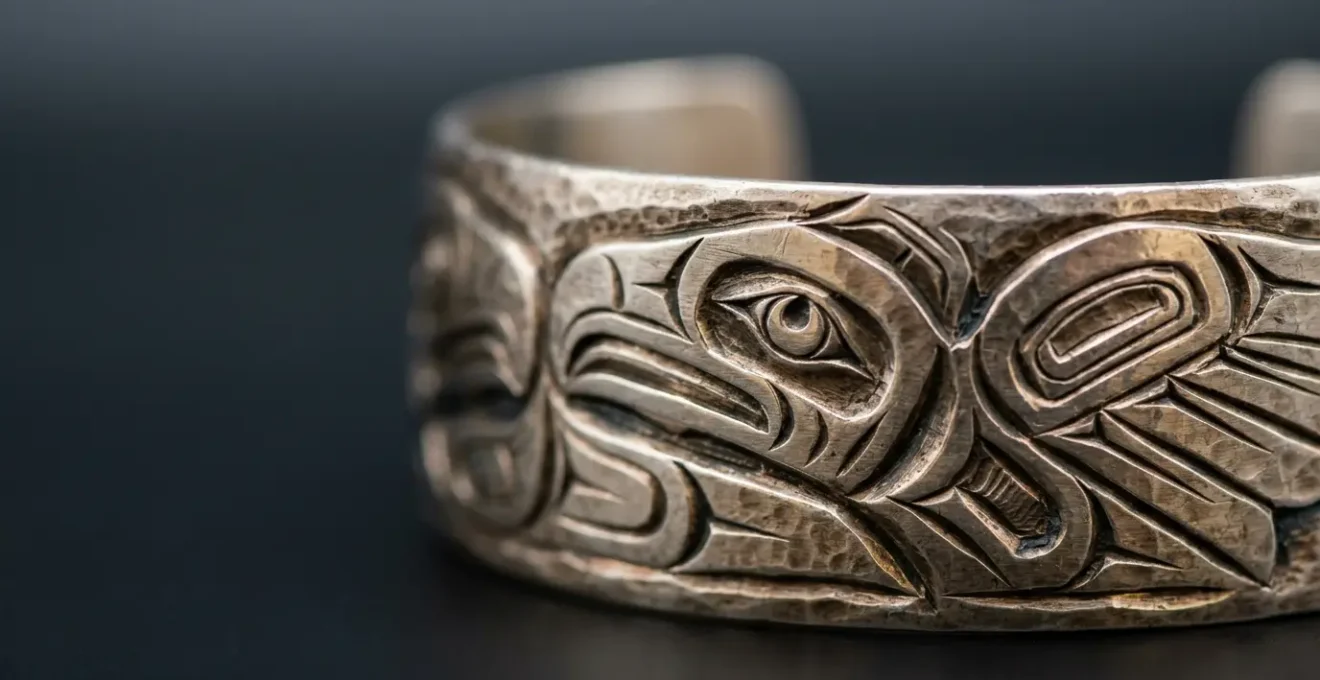
Buying authentic First Nations silver jewelry is about more than a signature; it’s about verifying its material, technique, and cultural story.
- True value resides in hand-carved work, meticulously crafted by an artist, not in mass-produced cast replicas.
- Authenticity is proven through artist lineage, verifiable marks, and official designations, not just a generic “authentic” sticker.
Recommendation: Use the specific material tests and Vancouver gallery insights in this guide to invest in a piece with confidence.
As a visitor to Vancouver, the desire to purchase a piece of First Nations silver jewelry is often born from a place of deep respect. You want to bring home more than a souvenir; you want a tangible connection to the rich artistic traditions of the Northwest Coast. Yet, this desire is frequently met with a nagging uncertainty. Standing before a display case, you wonder: “Is this piece genuinely hand-carved? Will it hold its value? How do I ensure my purchase supports the artist and their community, rather than a factory overseas?” Many guides offer simple advice, like looking for a signature, but this barely scratches the surface.
The common approach often overlooks the critical factors that an appraiser uses to determine true worth. The market is saturated with pieces that mimic traditional formline designs but lack the essential qualities of authentic art. This guide moves beyond the platitudes. We will not just tell you what to look for, but explain *why* it matters. The key to purchasing a piece that holds its value is not a secret; it is a formula based on three pillars: material integrity, carving technique, and cultural lineage. Understanding this formula is the difference between acquiring a mere trinket and investing in a piece of cultural heritage.
This article will provide you with an appraiser’s framework to confidently navigate Vancouver’s art scene. We will deconstruct common myths, provide practical tests for materials, and map out the city’s reputable art hubs. By the end, you will be equipped to identify and purchase a piece of silver jewelry that is not only beautiful but also an authentic, valuable work of art.
To help you navigate this complex topic, this guide is structured to build your expertise step by step. Below is a summary of the key areas we will cover, from understanding cultural symbolism to identifying the best places in Vancouver to make your investment.
Summary: An Appraiser’s Framework for Buying First Nations Art in Vancouver
- Raven or Eagle: Which Spirit Animal Carving Best Suits Your Personality?
- The “Authenticity Tag” Scam: What to Look for on the Back of a Mask?
- Cedar vs Argillite: Which Material is Safe to Carry in Checked Luggage?
- Limited Edition Print or Original Painting: Which Fits a $1000 Budget?
- Gastown or Granville Island: Where Are the Most Reputable Indigenous Galleries?
- Beyond Souvenirs: Where to Buy High-Fashion Indigenous Clothing?
- BC Jade: How to Tell Real Nephrite from Dyed Glass?
- Is Art in South Granville Galleries Reserved Only for Millionaires?
Raven or Eagle: Which Spirit Animal Carving Best Suits Your Personality?
One of the first things a new collector is drawn to is the powerful animal imagery in Northwest Coast art. A common misconception, often encouraged in tourist shops, is to choose a “spirit animal” based on personal affinity. While you may feel a connection to a Wolf or a Bear, understanding the true meaning of these figures is the first step toward appreciating the art’s value. In many Northwest Coast cultures, such as Haida, Tsimshian, and Tlingit, these are not spirit animals but crests that denote lineage and social identity. The two most prominent of these are the Raven and the Eagle, which represent the two primary social structures, or moieties.
An individual belongs to either the Raven or the Eagle moiety, and this is inherited from their mother. These crests are owned by specific families and clans, and an artist has the right to depict only the crests belonging to their lineage. Therefore, asking “Which animal suits my personality?” is the wrong question. The correct, and more respectful, question is, “What is the story of this crest, and to which family and Nation does it belong?” An artist depicting a crest that is not their own is a serious breach of cultural protocol and a red flag regarding the piece’s authenticity.
Case Study: Bill Reid’s ‘The Raven and the First Men’
The late Haida artist Bill Reid, whose work is a cornerstone of Vancouver’s cultural landscape, masterfully used his crests to tell stories. His monumental sculpture ‘The Raven and the First Men’, housed at the UBC Museum of Anthropology, depicts the Haida creation story, where Raven, the Trickster, coaxes the first humans out of a clamshell. Reid, a member of the Raven moiety, had the cultural right to tell this story. His work serves as a powerful local example of how crests are not generic symbols but integral parts of an artist’s identity and inherited narrative rights. Before buying, visiting the museum provides invaluable context on the significance of these designs.
When you see a piece of jewelry, its value is tied to the artist’s legitimate right to carve that specific crest. A reputable gallery will always provide this information, linking the art not just to an individual, but to a deep and specific cultural history.
The “Authenticity Tag” Scam: What to Look for on the Back of a Mask?
In a market where appearances can be deceiving, many buyers look for a simple sign of legitimacy, like a sticker or a tag. However, a generic “Authentic Native Art” sticker is often meaningless. The threat of counterfeit art is significant in Vancouver; a 2019 investigation revealed that an unsettling 75% of tourist shops sell counterfeit Indigenous art. To protect your investment, you must look for specific, verifiable proof of provenance that goes far beyond a simple tag. This is particularly true for high-value items like masks, but the principles apply directly to the back of a silver pendant or bracelet.
Authenticity is proven through a combination of elements. First is the artist’s signature or “chop” mark. A genuine piece will be hand-signed or feature a unique, registered symbol carved by the artist. Printed labels without a direct artist attribution are a major warning sign. Second, and most important for silver jewelry, is the distinction between hand-carved and cast. A hand-carved piece will show subtle, unique tool marks under magnification. A cast piece is a molded replica, often mass-produced, and holds significantly less value. Your budget of $200-$500 should secure you a genuine, hand-engraved piece by a talented artist, not a cast copy.
Furthermore, Vancouver’s art scene has developed robust systems to combat fraud. Reputable galleries and organizations provide clear verification methods that empower buyers. Instead of relying on vague assurances, use a methodical checklist to confirm the artwork’s origin and protect your investment.
Your Action Plan: Verifying Artwork Authenticity
- Seek Official Designation: Look for the “Authentic Indigenous” gold decal displayed by businesses verified by Indigenous Tourism BC. This is a provincially supported system confirming the art comes from BC Indigenous artists.
- Examine the Signature: Inspect the piece for a hand-carved signature, a pencil signature, or a unique artist’s mark known as a “chop.” Be wary of printed labels with no artist name.
- Inquire about Digital Provenance: Ask if the gallery provides a digital certificate or QR code. Some modern Vancouver galleries use these systems to link a piece to an online database, offering indisputable proof of origin.
- Verify Artist Lineage: A legitimate gallery will proudly display the artist’s full name, Nation (e.g., Haida, Squamish, Kwakwaka’wakw), and personal story alongside every piece, demonstrating respect for cultural protocols.
- Ask about the Technique: Explicitly ask, “Is this piece hand-carved or cast?” A trustworthy dealer will answer directly and be able to explain the difference in the context of the piece you are considering.
Cedar vs Argillite: Which Material is Safe to Carry in Checked Luggage?
Beyond design, the material itself is a fundamental component of an artwork’s value and story. Cedar is central to Northwest Coast cultures, used for everything from longhouses to masks. Argillite, a black carbonaceous shale, holds a unique and protected status. Understanding the properties of these materials is key, both for appreciation and for practical considerations like travel. In terms of luggage safety, both materials are generally safe, but with important caveats. A delicate cedar carving with fine details is fragile and should always be in carry-on. Argillite is a stone; it is dense and more robust but can chip or crack under sharp impact. It is best transported as carry-on, carefully wrapped.
The real distinction lies in their cultural and economic value. While cedar is widespread, argillite is found in only one location in the world: a quarry on Haida Gwaii. Since the mid-19th century, the Haida people have carved this unique material. A critical fact for any collector is that since 1941, the Haida Nation has held exclusive rights to quarry and carve argillite. This means that any authentic argillite carving you find in a Vancouver gallery is, by definition, made by a Haida artist. This legal and cultural exclusivity gives it a profound and protected value.
When examining a piece purported to be argillite, its physical properties are your first clue to authenticity. True argillite is soft enough to be carved with woodworking tools, yet it is a dense, cool stone. It has a characteristic deep, matte black finish that can be polished to a soft sheen, but it is not glassy or plasticky like many fakes.
As seen in the texture of genuine Haida work, the material possesses a subtle grain and depth. Fakes, often made from resin or other polymers, lack this organic quality. An appraiser learns to identify a material by touch and sight, and as a collector, you should too. Holding a piece of true argillite, you can feel its cool, dense weight, a quality that cheap replicas cannot imitate.
Limited Edition Print or Original Painting: Which Fits a $1000 Budget?
As you move beyond small jewelry, you may consider acquiring a piece for your wall. A common question for those with a budget around $1000 is whether to buy an original work by an emerging artist or a limited-edition print by a master. From an investment perspective, there is no single right answer, but understanding the market tiers is crucial. An original work is a one-of-a-kind piece, offering a direct connection to the artist. A limited-edition print is a reproduction, but one whose value is protected by a finite number of copies, each signed and numbered by the artist.
For a budget of $1000, you are at an interesting crossroads. You could acquire a small, compelling original painting from a talented emerging artist, perhaps discovered at an event like Vancouver’s Eastside Culture Crawl. This path carries higher risk but also higher potential for significant appreciation if the artist’s career takes off. Alternatively, the same budget allows you to acquire a high-quality, limited-edition serigraph (a silk-screen print) by a “blue-chip” artist like Robert Davidson or Roy Henry Vickers. This is a safer investment, as the artist’s market is already established, ensuring the print will hold its value and likely appreciate steadily over time.
It’s also important to understand the hierarchy within prints. A serigraph, created with hand-pulled layers of ink, is generally considered more valuable than a giclée, which is a high-quality inkjet print. Furthermore, special editions within a print run, such as the “Artist’s Proof” (AP) or “Printer’s Proof” (PP), often command a premium.
This table compares the two primary options for a collector with a $1,000 budget, based on data from established Vancouver galleries. As this overview of market offerings shows, this price point opens up several strategic collecting pathways.
| Factor | Limited Edition Print by Master Artist | Original Work by Emerging Artist |
|---|---|---|
| Price Point | $800-$1,200 (serigraph/giclée) | $600-$1,500 (small original) |
| Artist Examples | Robert Davidson, Roy Henry Vickers (established) | Artists from Eastside Culture Crawl, smaller galleries |
| Value Stability | High – established market demand | Variable – higher risk, higher potential appreciation |
| Investment Potential | Safer bet for holding value long-term | Potential for significant appreciation if artist gains prominence |
| Print Type Hierarchy | Serigraph (screen print) > Giclée; AP/PP command premium | N/A – original one-of-a-kind work |
| Where to Find | Gastown galleries (Coastal Peoples), South Granville Gallery Row | Eastside Culture Crawl, Grunt Gallery, Bill Reid Gallery gift shop |
| Authenticity | Numbered, signed, certificate of authenticity | Direct from artist, signed original |
Gastown or Granville Island: Where Are the Most Reputable Indigenous Galleries?
Knowing what to look for is half the battle; knowing where to look is the other. Vancouver’s landscape of Indigenous art galleries can seem overwhelming, but it is highly specialized. The two best-known areas, Gastown and Granville Island, serve different types of buyers. Neither is inherently “better,” but they offer different experiences and inventory. Your choice should depend on your goals as a collector. Are you seeking a museum-quality investment piece or hoping to discover a new, affordable artist?
Gastown is historically the heart of Vancouver’s high-end Indigenous art market. Galleries here, such as Coastal Peoples Fine Arts Gallery and Artina’s Jewellery, specialize in established, “blue-chip” artists. This is where you will find significant sculptures, masks, and high-carat gold and silver jewelry. While prices can be high, the quality and authenticity are generally impeccable. This is the place for investment-grade purchases where provenance is paramount. In contrast, Granville Island offers a more diverse, craft-oriented experience. Galleries like the Wickaninnish Gallery feature a broader range of artists, including many talented emerging and mid-career creators. It’s an excellent place to find unique, high-quality jewelry and smaller works in your $200-$500 price range, offering a greater sense of discovery.
Beyond these two hubs, a savvy buyer should also consider the UBC Museum of Anthropology’s gift shop, which offers a highly curated selection of authentic pieces, and the contemporary galleries of South Granville’s Gallery Row. A truly reputable gallery, regardless of location, shares common traits: transparent artist attribution, knowledgeable staff, and a clear respect for Indigenous cultural protocols. An essential question to ask gallery staff is, “Who did this artist learn from?” In Northwest Coast art, apprenticeship lineage is a critical factor in a work’s value and authenticity.
When you enter a gallery, assess the environment. Does it feel like a museum, with each piece given space and context, or a souvenir shop, with items crowded together? The presentation itself is often an indicator of the gallery’s commitment to representing the art and artists with respect.
Beyond Souvenirs: Where to Buy High-Fashion Indigenous Clothing?
The principles of authenticity and ethical purchasing extend far beyond traditional carvings and jewelry into the vibrant world of contemporary Indigenous fashion. For collectors interested in wearable art, Vancouver is a hub for high-fashion Indigenous clothing that powerfully blends ancestral designs with modern aesthetics. This is a market segment where the distinction between authentic Indigenous creation and cultural appropriation becomes critically important.
The key phrase to look for is “Designed by” an Indigenous creator, not “Inspired by” Indigenous art. When you purchase from an Indigenous designer, the proceeds directly support the artist, their community, and the continuity of their cultural traditions. In contrast, mass-market brands that use tribal-style patterns without permission or compensation are engaging in cultural appropriation. This ethical distinction also has a direct impact on value; a piece by a recognized Indigenous designer is a piece of art, while a generic “tribal print” fast-fashion item is not.
Case Study: Vancouver Indigenous Fashion Week (VIFW)
The premier event for discovering this talent is Vancouver Indigenous Fashion Week (VIFW). This showcase brings together leading and emerging Indigenous designers from across British Columbia and Canada, placing their work on a global stage. VIFW is more than a series of runway shows; it’s a vital platform for cultural expression and entrepreneurship. Following the designers featured at VIFW is the best way to connect with the authentic heart of the Indigenous fashion movement. This ecosystem also extends to lifestyle brands, such as skincare companies that incorporate traditional botanical knowledge from Nations like the Skwxwú7mesh (Squamish), offering holistic ways to support Indigenous-owned businesses in Vancouver.
For a buyer, this means seeking out designers and boutiques that are part of this community. Look for artist bios, collaborations with other Indigenous creators, and participation in events like VIFW. Supporting Indigenous fashion is an investment in living culture and a powerful statement against appropriation.
BC Jade: How to Tell Real Nephrite from Dyed Glass?
Alongside silver and argillite, jade is another material deeply associated with British Columbia. In fact, British Columbia is renowned as the world’s largest producer of Nephrite Jade, and it is the province’s official mineral. However, its popularity has also led to a market flooded with imitations. For a buyer, being able to distinguish real BC nephrite from dyed glass, serpentine, or plastic is a crucial skill for making a sound investment.
First, it’s important to understand a key mineralogical distinction. The jade you see in Vancouver is almost exclusively Nephrite. The vibrant, highly translucent emerald-green jade often associated with Asian jewelry is typically Jadeite, a different and often more expensive mineral. BC nephrite has its own unique beauty, ranging in colour from deep, forest greens to milky whites and even black. Its value comes from its toughness, its cultural significance in the region, and the artistry of its carving. Authentic BC nephrite will have natural, subtle variations in colour and may contain small mineral inclusions. A piece that is perfectly uniform in colour and transparency, especially at a low price, is highly suspect.
Fortunately, you don’t need a gemology lab to perform basic authentication. There are several practical, hands-on tests you can conduct right in the gallery:
- The Cold Test: Real nephrite jade is a dense stone that feels cool to the touch. Hold the piece in your hand. It should feel cold initially and warm up slowly. Glass or plastic will feel closer to room temperature and will warm up almost instantly from your body heat.
- The Sound Test: Gently tap the piece with another piece of jade or a metal object. Real nephrite has a crystalline structure that produces a high-pitched, musical chime. Glass or plastic will produce a dull, low-pitched thud.
- Visual Inspection: Look closely at the surface. Are there natural, flowing patterns within the stone? Or does it look perfectly uniform and glassy? Real nephrite has character; imitations often lack this organic complexity.
If you plan on a major purchase, your best course of action is to seek expert validation. Visit the jade displays at the UBC Museum of Anthropology to train your eye, or consult with established Vancouver lapidaries who specialize in the material.
Key Takeaways
- True value in First Nations art is determined by cultural lineage and artist rights, not just aesthetic appeal.
- Verifiable authenticity involves specific checks for signatures, carving techniques, and official designations, not generic tags.
- The material itself—whether exclusive argillite, tough nephrite jade, or symbolic cedar—is a crucial component of a piece’s story and worth.
Is Art in South Granville Galleries Reserved Only for Millionaires?
The stretch of South Granville known as “Gallery Row” has a well-deserved reputation as Vancouver’s premier destination for high-end, investment-grade art. The polished windows and hushed interiors can be intimidating, leading many potential buyers to assume it’s a playground reserved only for millionaires. While these galleries do handle major works with price tags in the tens or hundreds of thousands, it is a mistake to dismiss the area entirely if you have a more modest budget.
Most prestigious galleries operate on a tiered system. The main exhibition space showcases the large, primary works of their top artists. However, nearly every gallery maintains a “back room” inventory. This is where you can find smaller studies, sketches, drawings, and limited-edition prints by the very same “blue-chip” artists. These pieces are often available at much more accessible price points, providing a crucial entry point for new collectors to acquire a work by an established name. For example, an original painting by a master like Robert Davidson might be unattainable, but an authenticated, limited-edition serigraph could fall within a $1,000 to $2,500 budget.
Case Study: Accessing ‘Gallery Row’ on a Budget
South Granville galleries actively cultivate new collectors. By building a relationship with a gallery director, you can gain access to these back-room inventories. Expressing a serious interest and a clear budget can open doors to works not on public display. These galleries also champion emerging and mid-career artists whose original works may be priced under $5,000. This creates a complete art ecosystem in Vancouver: South Granville offers the ‘blue-chip’ investment focus; Gastown provides a mix of high-end and accessible fine art; and areas like Main Street feature edgier, emerging artist scenes. There is an entry point for every budget tier.
Don’t let the high-end reputation deter you. Approaching these galleries with respectful curiosity and a clear idea of your budget is the first step to discovering that a piece of the city’s top artistic talent may well be within your reach.
By applying this appraiser’s framework—evaluating material integrity, carving technique, and cultural lineage—you transform from a passive consumer into a confident collector. You are now equipped not just to buy a beautiful object, but to invest in a piece of living history, ensuring your purchase is one of lasting cultural and monetary value. Your next step is to put this knowledge into practice at the galleries themselves.