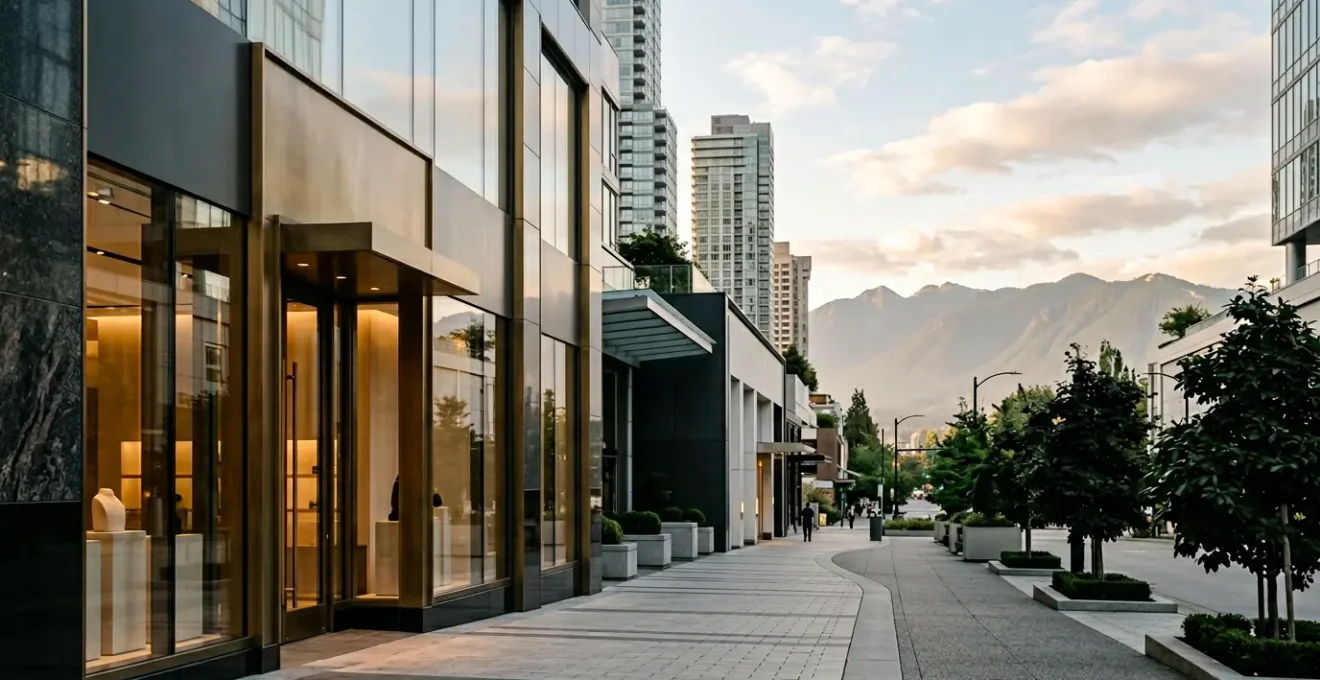
To conquer Vancouver’s luxury scene, one must look beyond the price tag and master the operational intelligence of the city’s elite retail landscape.
- The strong USD offers an advantage, but it’s nuanced by Canadian MSRPs, sales taxes (GST/PST), and US duty limits.
- Access to limited editions is less about who you know and more about mastering digital raffle systems and local boutique protocols.
Recommendation: Treat your shopping not as a transaction, but as a bespoke excursion, planned with an understanding of parking strategy, tipping etiquette, and the unique character of each luxury district.
For the discerning global visitor, Vancouver’s Alberni Street presents an immediate and compelling allure. Lined with the gleaming façades of Tiffany & Co., Prada, and Rolex, it has rightfully earned its reputation as the city’s nexus of high fashion. Most travel guides will dutifully list these flagships, offering a perfunctory map of what they call the “Luxury Zone.” They might mention the favorable exchange rate for American visitors or suggest a stroll through historic Gastown for a different flavour of retail.
However, this surface-level advice misses the essential truth of the Vancouver luxury experience. It fails to address the critical operational intelligence required for a truly seamless and successful excursion. The real advantage lies not just in a strong dollar, but in understanding the intricate dance of provincial and federal taxes, US customs declarations, and brand-specific price adjustments. True access isn’t about walking into a store; it’s about navigating the digital waitlists for a rare pair of sneakers or knowing which concierge can secure a last-minute reservation.
This guide moves beyond the obvious. We will not merely point you to the storefronts. Instead, we offer the insider’s perspective—the strategic knowledge of a seasoned luxury concierge. We will deconstruct the financial nuances, reveal the unwritten rules of etiquette from the valet stand to the art gallery, and compare the city’s distinct shopping personas. This is your blueprint for transforming a simple shopping trip into a masterfully executed, bespoke Vancouver experience.
To provide a comprehensive overview, this article delves into the key questions that define a sophisticated shopping strategy in the city. From financial considerations to navigating the social customs of high-end service, the following sections are designed to equip you with true insider knowledge.
Summary: Mastering Vancouver’s Luxury Retail Landscape
- Strong US Dollar: Is Buying Luxury Goods Cheaper in Vancouver for Americans?
- How to Get on the Waitlist for Limited Edition Sneakers on Robson?
- The “Tax Refund” Myth: Can Tourists Claim Back GST/PST at the Airport?
- Holt Renfrew vs Nordstrom (RIP): Where to Find Multi-Brand Luxury Now?
- Valet or Self-Park: Where to Leave Your Car When Shopping on Alberni?
- The “Don’t Touch” Rule: How to Behave in High-End Galleries with Kids?
- Valet, Bellman, Housekeeping: How Much Cash Should You Carry for Tips?
- Gastown vs South Granville: Which District Has Better Independent Boutiques?
Strong US Dollar: Is Buying Luxury Goods Cheaper in Vancouver for Americans?
The allure of a strong US dollar against the Canadian dollar creates a compelling narrative for cross-border luxury shopping. On the surface, the math seems simple: an item priced at $10,000 CAD could appear to cost only around $7,300 USD, suggesting immediate savings. However, the reality is a far more sophisticated financial equation that every discerning buyer must master. Global luxury brands are not naive to currency fluctuations; they often implement regional MSRP adjustments in Canada to partially offset this advantage and maintain global price parity. An item is rarely a direct conversion of its US price.
Furthermore, one must factor in British Columbia’s tax structure. All purchases are subject to a 5% Goods and Services Tax (GST) at the federal level and a 7% Provincial Sales Tax (PST), for a combined total of 12%. This is a significant addition that must be compared against your home state’s sales tax. Finally, returning to the United States requires a truthful declaration. While individuals are granted an $800 duty-free exemption after a 48-hour stay, any amount exceeding this is subject to US duties. For a high-value purchase like a Chanel bag or a Rolex watch, this duty can erode a substantial portion of the initial currency savings.
The following table provides a high-level comparison, but remember that these figures are illustrative. The true cost requires meticulous pre-trip research on the Canadian MSRP and current exchange rates.
This comparative analysis, which uses figures based on market research and central bank data, illustrates the nuanced reality. As the data from a Bank of Canada currency converter shows, while some savings are possible, they are not as dramatic as a simple currency conversion might suggest.
| Luxury Item | Vancouver Price (CAD + 12% Tax) | Seattle Price (USD + 10.25% Tax) | Los Angeles Price (USD + 9.5% Tax) |
|---|---|---|---|
| Cartier Love Bracelet | ~$9,500 CAD ($10,640 with tax) | ~$7,400 USD ($8,159 with tax) | ~$7,400 USD ($8,103 with tax) |
| Chanel Classic Flap Bag | ~$12,000 CAD ($13,440 with tax) | ~$10,200 USD ($11,245 with tax) | ~$10,200 USD ($11,169 with tax) |
| Rolex Submariner | ~$14,000 CAD ($15,680 with tax) | ~$10,500 USD ($11,576 with tax) | ~$10,500 USD ($11,498 with tax) |
| Note: Prices include applicable sales taxes. Exchange rate fluctuations and MSRP adjustments by brands can significantly impact final savings. Data compiled from Bank of Canada exchange rates and retail market research. | |||
How to Get on the Waitlist for Limited Edition Sneakers on Robson?
In the world of high-end streetwear, securing a pair of limited-edition sneakers is less about fortuitous timing and more about mastering a set of precise, often digital, access protocols. Vancouver’s sneaker culture, centered around Robson Street and the adjacent Gastown district, has evolved beyond physical line-ups into a sophisticated ecosystem of online raffles. For the uninitiated, attempting to simply walk in on release day is a strategy destined for failure. The key is to engage with the city’s premier boutiques on their own terms, long before the drop date.
Boutiques like Livestock, Haven, and Roden Gray are the gatekeepers. Success requires becoming part of their digital community. This means actively following their social media accounts, particularly Instagram, where raffle announcements are made. These are not passive notifications; they are calls to action, often requiring immediate engagement—liking a post, tagging friends, and, most importantly, following a link to an external entry form. These forms are time-sensitive and typically require a local British Columbia address, a measure designed to prioritize the local collector community over international bots.
Case Study: Vancouver’s Sneaker Raffle Ecosystem: Livestock’s Instagram-Based System
Livestock, one of Vancouver’s premier sneaker boutiques with locations in Gastown and Chinatown, operates a sophisticated raffle system for limited edition drops. Their methodology typically involves announcing raffles via their Instagram account @livestockcanada, where followers must like the announcement post and complete an entry form at deadstock.ca/releases. The system requires entrants to have a local British Columbia address and demonstrates engagement with their social media presence. This dual-platform approach (Instagram + website form) has become the standard for Vancouver’s sneaker scene, distinguishing serious local collectors from casual participants.
The texture and material of these items are a significant part of their appeal, and as the close-up detail shows, the craftsmanship is a key differentiator. Being prepared to act swiftly when a raffle is announced is the only viable strategy for acquiring these coveted pieces. For visitors, partnering with a local concierge who can provide a valid entry address can be a crucial advantage.
The “Tax Refund” Myth: Can Tourists Claim Back GST/PST at the Airport?
One of the most persistent and misleading pieces of advice given to international visitors in Canada revolves around the idea of a tax refund at the airport. It is imperative to state this clearly and without ambiguity: the Canadian government’s Visitor Rebate Program was eliminated on April 1, 2007. Consequently, international tourists can no longer claim a refund on the 5% Goods and Services Tax (GST) or the 7% British Columbia Provincial Sales Tax (PST) for most goods purchased during their stay.
Any blog, travel guide, or anecdotal advice suggesting that you can simply present your receipts at a kiosk at Vancouver International Airport (YVR) for a refund is operating on severely outdated information. There is no such general facility available. This policy was discontinued to streamline the tax system, and it has not been reinstated. Believing this myth can lead to significant disappointment and an inaccurate calculation of your total expenditure. The 12% combined GST/PST is a non-recoverable cost for tourists on nearly all luxury goods, dining, and other services.
The only narrow exception to this rule applies to goods that are purchased in Canada but shipped directly by the vendor to an address outside of the country. In this specific scenario, the 7% PST may not be charged, but the 5% GST is still applicable. Furthermore, this option is at the discretion of the retailer and may involve shipping and insurance costs that can negate the savings. For any high-value item, it is essential to confirm this policy directly with the boutique before making a purchase. Do not assume it is a standard service. In summary, budget for the full 12% tax as part of your final cost.
Holt Renfrew vs Nordstrom (RIP): Where to Find Multi-Brand Luxury Now?
The abrupt exit of Nordstrom from the Canadian market in March 2023 left a significant void in Vancouver’s luxury retail landscape. The sprawling downtown location was more than just a department store; it was a social and commercial hub that, despite the Vancouver location generating an estimated $300 million per year, became a casualty of the company’s nationwide retreat. For the discerning shopper accustomed to Nordstrom’s curated brand mix and legendary service, the question became: what now?
The answer, unequivocally, has been Holt Renfrew. The long-standing Canadian luxury institution did not merely wait to absorb displaced customers; it launched a swift and aggressive strategy to capture them. This involved not only expanding its brand matrix but also targeted marketing campaigns to intercept former Nordstrom clientele.
How Holt Renfrew Captured Nordstrom’s Market Share in 2023
When Nordstrom announced its Canadian exit, Holt Renfrew launched a strategic 10-week programmatic digital out-of-home advertising campaign. The campaign targeted over 200 screens near the shuttered Nordstrom, along commuting routes and near affluent residential buildings. Simultaneously, Holt Renfrew’s Vancouver location added new brand concessions, including the Belgian luxury bag brand Delvaux (previously exclusive to Nordstrom in Canada). This demonstrated a clear and aggressive strategy to fill the multi-brand luxury void, as confirmed by a report on their successful post-Nordstrom marketing efforts.
Today, Holt Renfrew stands as the primary destination for multi-brand luxury shopping in Vancouver. It complements the monobrand boutiques on Alberni Street and the menswear specialists at Harry Rosen. The sentiment among local retail experts was captured succinctly in the wake of the closure.
I guess it’s Holt Renfrew, Harry Rosen and monobrand boutiques from here on out.
– Vancouver retail observer, Retail Insider Canada
Valet or Self-Park: Where to Leave Your Car When Shopping on Alberni?
For those arriving on Alberni Street by car, the question of parking is the first piece of logistical chess. While street parking is technically an option, its near-zero availability and aggressive ticketing make it a non-starter for a relaxed luxury experience. The real choice lies between the seamless convenience of hotel valet services and the practicality of a premium self-park garage. The decision is not merely about cost, but about the kind of experience you wish to begin your day with. Opting for valet at a prestigious hotel like the Shangri-La or the Fairmont Pacific Rim is about more than just parking; it’s a statement of intent. It signifies a preference for white-glove service and a frictionless transition from your vehicle to the boutique.
This option provides the highest level of service and prestige, placing you within a one-to-two-block radius of the main shopping corridor. In contrast, self-parking at a location like the Pacific Centre parkade offers direct, covered access to Holt Renfrew and is more cost-effective. It’s a pragmatic choice that prioritizes efficiency, especially if your visit includes the wider mall. Several parkades also now offer Level 2 EV charging stations, a crucial amenity for those with electric luxury vehicles like a Porsche Taycan or Lucid Air.
The optimal choice depends on your itinerary and personal style. For a focused, high-end boutique crawl on a rainy Vancouver day, the valet is an unparalleled convenience. For a longer, multi-stop shopping day that includes the mall, a premium self-park is the more strategic option. The following table breaks down the key considerations.
This detailed breakdown, based on information from local guides like GoVanCity’s analysis of the district, should inform your arrival strategy.
| Parking Option | Typical Cost (CAD) | Walking Distance to Dior/Tiffany | Prestige Level | Special Features |
|---|---|---|---|---|
| Valet at Shangri-La Hotel | $15-25/hour | 1 block (2 min walk) | Highest | Direct access to hotel lobby, luxury experience, attendant service |
| Valet at Fairmont Pacific Rim | $15-25/hour | 2 blocks (4 min walk) | Highest | Prestigious hotel entry, potential EV charging, white-glove service |
| Self-Park at Pacific Centre Parkade | $4-6/hour | Direct mall access | Moderate | Covered parking, some Holt Renfrew validation available, EV charging stations |
| Self-Park at 1021 W. Hastings (Maison Birks building) | $5-8/hour | 3 blocks (6 min walk) | Moderate | Convenient for Alberni + downtown, less crowded |
| Street Parking (Thurlow/Burrard near Alberni) | N/A | Variable | Not Recommended | Near-zero availability, aggressive ticketing, metered rates prohibitive |
| Note: Prices are approximate and subject to change. Valet tipping recommended at $5-10 CAD. Several locations offer Level 2 EV charging for electric luxury vehicles. | ||||
The “Don’t Touch” Rule: How to Behave in High-End Galleries with Kids?
Introducing children to the world of fine art and high design is a laudable goal, but a visit to the exclusive galleries of South Granville or Gastown requires a specific code of conduct. The default parental strategy often devolves into a repetitive chorus of “don’t touch,” which can create a negative and stressful experience for everyone. A more sophisticated approach involves reframing the visit from a set of restrictions into a curated lesson in cultural and financial value. This is an opportunity to teach children that the objects in these spaces are not just beautiful, but are also the result of immense skill and represent a significant investment.
The key to a successful gallery visit with children is proactive engagement, not reactive prohibition. Instead of seeing gallery staff as guards, view them as potential guides. Approaching a gallerist with a polite question like, “My child is very curious. Is there one piece here with a fascinating story you could share with us?” can transform the entire dynamic. This shows respect for the space and often results in an enthusiastic, memorable educational moment. It’s also wise to curate your route. Plan for short gallery visits interspersed with rewards, such as a stop at Small Victory Bakery on South Granville or a treat in Gastown. This creates a positive association with the art experience.
For a more tactile experience, consider balancing formal gallery visits with explorations of Vancouver’s extensive public art, particularly around the Convention Centre and Olympic Village, where interaction is often encouraged. This dual approach teaches both reverence for protected art and joyful engagement with public installations.
Your Action Plan: Family-Friendly Gallery Etiquette
- Reframe the Experience: Instead of focusing on ‘don’t touch’ rules, teach children that art in galleries like those on South Granville represents both cultural value and financial investment, connecting it to the luxury lifestyle visible in surrounding neighborhoods.
- Curate a Kid-Tolerant Route: Plan gallery visits in South Granville with strategic breaks at nearby parks or Small Victory Bakery for treats, creating a reward system that makes art appreciation enjoyable.
- Engage Gallery Staff Proactively: Politely ask gallerists, ‘What’s one piece here with a great story you could share with my child?’ This transforms staff from perceived ‘guards’ into enthusiastic ‘guides’.
- Explore Indigenous Art in Gastown: Many Gastown galleries feature Indigenous sculptures and masks that are more narratively engaging for children. Staff often encourage questions about the stories and cultural significance behind pieces.
- Consider Public Art Alternatives: Balance formal gallery visits with interactive public art installations around the Vancouver Convention Centre or Olympic Village, where touching and exploring are permitted.
Valet, Bellman, Housekeeping: How Much Cash Should You Carry for Tips?
In a world of tap-to-pay and digital transactions, the art of tipping in cash remains a vital and appreciated custom within the luxury service ecosystem. Arriving at a five-star hotel or a high-end boutique without a small supply of Canadian currency for gratuities is a rookie mistake. While some services can be added to a final bill, the most personal and impactful gesture is a direct cash tip, ensuring the individual who provided the service receives it immediately. The question for the discerning visitor is not *if* one should tip, but *how much* and *when*.
The amount should reflect both the standard of service and the context. A valet who simply parks your car might receive a standard tip upon retrieval, but a valet who handles an exotic vehicle with extra care or places it in a prime, visible spot warrants a more generous acknowledgment. Similarly, housekeeping in a large suite requires more effort than in a standard room, and the daily tip should reflect that. A crucial piece of etiquette is to tip housekeeping daily rather than at the end of your stay, as the staff on duty can change. Leaving the cash on a pillow with a brief thank-you note is a classic and respected gesture.
It is also critical to know when *not* to tip. Personal shoppers at Holt Renfrew, for instance, are commission-based professionals. A cash tip is inappropriate. The most valuable gratuity you can offer is a glowing email sent to their manager, which directly contributes to their career progression. Conversely, a seamstress who performs a rush alteration on a newly purchased garment absolutely merits a direct cash tip for their expedited service.
The following guide, with data contextualized from sources like Destination Vancouver’s luxury guides, provides a clear framework for navigating these nuances.
| Service | Standard Tip (CAD) | When to Tip | Above-and-Beyond Tip |
|---|---|---|---|
| Valet Parking | $5-10 | Upon car retrieval (not drop-off) | $15-20 for special vehicle placement or exotic car handling |
| Bellman/Porter | $5 per bag (minimum $10) | Upon bag delivery to room | $20+ for heavy luggage, multiple trips, or extra assistance |
| Housekeeping | $10 per night | Daily, left on pillow with thank-you note | $15-20 for suite cleaning or extended stays |
| Concierge | $10-20 for standard requests | After service is completed | $50+ for securing impossible reservations or last-minute arrangements |
| Doorman | $5-10 | For hailing taxi or arranging transport | $15 for assistance in poor weather or with multiple bags |
| Note: Personal shoppers at Holt Renfrew are commission-based and are NOT tipped directly – send a glowing email to their manager instead. Seamstresses performing rush alterations: $20 CAD cash tip is appreciated. | |||
Key Takeaways
- Financial Advantage: True savings for US shoppers come from a calculated strategy involving exchange rates, tax considerations (12% GST/PST), and US duty limits—not just the sticker price.
- Access Protocol: Securing limited-edition items, especially sneakers, requires active participation in digital raffles hosted by boutiques like Livestock, not passive shopping.
- Service Etiquette: The most sophisticated interactions in luxury settings, from valet to personal shoppers, are governed by unwritten rules of cash tipping and professional acknowledgment.
Gastown vs South Granville: Which District Has Better Independent Boutiques?
While Alberni Street is the undisputed epicenter of global luxury brands, the soul of Vancouver’s independent boutique scene is best discovered in the distinct personalities of two key districts: Gastown and South Granville. Choosing between them is not a matter of which is “better,” but which aligns with your personal aesthetic. They represent two different facets of the discerning shopper: the Creative Avant-Gardist and the Refined Connoisseur. Gastown, with its protected heritage buildings and cobblestone streets, is the home of the avant-garde. It’s a district curated with an editorial sensibility, favoring architectural fashion, elevated streetwear, and emerging designers.
This is where you will find boutiques that feel more like galleries, each with a strong, owner-driven point of view. They are intimate spaces that reward exploration and conversation, attracting a clientele of creative professionals and design-conscious consumers.
Gastown’s Secret Location: Vancouver’s Avant-Garde Luxury Destination
Located in historic Gastown, Secret Location has established itself as Vancouver’s premier destination for avant-garde luxury and ethical fashion. The boutique specializes in highly curated selections from designers including Alessandra Rich, Andy Wolf, and Dawei. By prioritizing quality, ethical production, and craft, Secret Location distinguishes itself from mainstream luxury retail, creating an intimate, gallery-like shopping experience that is the epitome of the Gastown aesthetic.
In contrast, South Granville offers a more established, European sensibility. Known as “Gallery Row,” its proximity to the affluent Shaughnessy neighborhood has cultivated a retail environment focused on classic Italian luxury, high-end home furnishings, and refined service. Here you will find established boutiques like Boboli and Bacci’s, which have been dressing Vancouver’s elite for decades. The experience is less about discovery and more about acquiring timeless quality from trusted purveyors. The following table distills the core identity of each district to guide your choice.
| Characteristic | Gastown | South Granville |
|---|---|---|
| Shopper Persona | Creative Avant-Gardist | Refined Connoisseur |
| Signature Boutiques | Secret Location, Roden Gray, HAVEN, Old Faithful Shop | Boboli, Bacci’s Vancouver, Max Mara |
| Design Aesthetic | Avant-garde, streetwear-influenced, architectural fashion | Classic Italian luxury, gallery-quality home furnishings |
| Shopping Experience | Intimate, owner-operated, curated with editorial sensibility | Established European brands, gallery-hopping, refined service |
| Architecture | Protected heritage buildings, smaller footprint shops | Proximity to wealthy Shaughnessy, larger storefronts |
| Specialty | Unique menswear, authentic Indigenous art, emerging designers | Italian womenswear, high-end furnishings, established luxury |
| Dining Pairing | The Diamond (craft cocktails), L’Abattoir (French) | The Rise Eatery, Meinhardt Fine Foods, Small Victory Bakery |
| Bonus Contender: Main Street (King Edward to 33rd Ave) offers ‘Sustainable & Local Luxury’ with emerging Vancouver designers, artisanal jewelry, and ethically-made goods. | ||
Frequently Asked Questions About Luxury Shopping in Vancouver
Can I add tips to my credit card at hotels like the Fairmont Pacific Rim?
While some hotels allow adding gratuities to your final bill for certain services, it’s still considered best practice and most appreciated to have small Canadian bills ($5, $10, $20) on hand for valet, bellmen, and housekeeping. Cash tips ensure the service staff receives the gratuity directly.
Should I tip personal shoppers at Holt Renfrew or luxury boutiques?
No. Personal shoppers at high-end retailers like Holt Renfrew work on commission and are not tipped with cash. Instead, the most valuable ‘tip’ you can provide is a glowing email to their manager praising their service, which supports their career advancement and performance reviews.
How much should I tip for rush alterations at a luxury boutique?
If a seamstress performs a rush alteration (completing tailoring on short notice), a cash tip of $20 CAD is appropriate and greatly appreciated, as this service often requires staying late or rearranging their schedule.