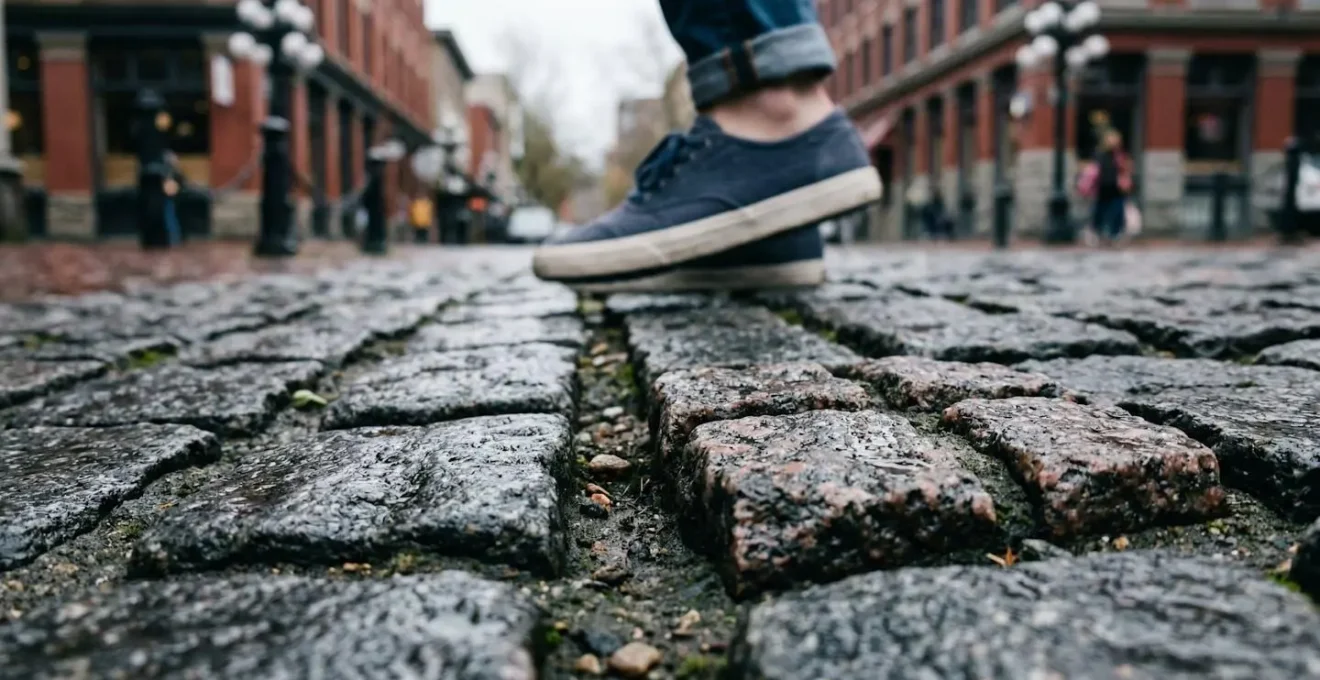
Choosing heels or unsupportive shoes for Gastown’s cobblestones is a direct path to acute foot and ankle injuries.
- The uneven 1970s-era granite setts create significant biomechanical stress, putting you at high risk for ankle sprains and chronic conditions like plantar fasciitis.
- Unlike the smooth pavement of Yaletown or the West End, Gastown’s terrain demands footwear with excellent torsional support and thick, cushioned soles.
Recommendation: Opt for stylish yet supportive flats or ankle boots with good grip, and save high heels for Vancouver’s more forgiving neighborhoods.
You have the perfect outfit planned for a memorable evening in Vancouver’s historic Gastown. The reservation is made, and you envision stunning photos against a backdrop of Victorian architecture and charming, lamplit streets. The final touch? A pair of fashionable heels or sleek, thin-soled dress shoes to complete the look. From a podiatric perspective, this is a critical misstep. While many guides advise “comfortable shoes” for travel, this generic counsel fails to address the specific and significant biomechanical hazards posed by Gastown’s signature cobblestone streets.
The issue isn’t merely about comfort; it’s about injury prevention. The irregular, unforgiving surface of Water Street presents a clinical risk for a range of musculoskeletal problems, from acute ankle sprains to the onset of chronic conditions. The allure of the “historic aesthetic” often masks a terrain that is fundamentally hostile to modern footwear. But what if the key to navigating Gastown wasn’t sacrificing style for bulky orthopedic shoes, but understanding the specific mechanics of the foot and choosing a shoe that is both chic and structurally sound?
This article moves beyond vague advice. We will dissect the podiatric risks of this unique urban environment, explain the specific footwear features that provide protection, and contextualize Gastown’s challenges within the broader landscape of Vancouver’s walkable neighborhoods. My goal is to equip you with the medical knowledge to make an informed choice, protecting your feet without compromising your style.
To help you plan your visit with both fashion and function in mind, this guide breaks down the critical factors to consider, from the physical realities of the terrain to the history that shaped it. Discover why your choice of footwear is a crucial health decision in this iconic part of Vancouver.
Summary: Why You Should Wear Flat Shoes When Visiting Water Street in Gastown?
- Is Gastown Wheelchair Friendly Despite the Cobblestones?
- Low Angle Shots: How to Use the Wet Cobblestones for Moody Photos?
- The “Bone Shaker”: Why Cyclists Should Avoid Water Street?
- Are the Cobblestones Real or Just Stamped Concrete from the 70s?
- The Noise Factor: Why Locals Hate It When You Drive Fast in Gastown?
- Skirts or Pants: Why Wardrobe Choices Matter on the Cliffwalk?
- The Great Fire of 1886: What Remains of the Original Gassy Jack Saloon?
- West End or Yaletown: Which Walkable Neighborhood Fits Your Vibe?
Is Gastown Wheelchair Friendly Despite the Cobblestones?
To understand the challenge for bipedal walkers, it’s clinically instructive to first consider the environment from the perspective of wheelchair users. Accessibility is a strong indicator of a terrain’s overall friendliness. While some tour operators state the area is accessible, the reality is nuanced. For example, Forbidden Vancouver Tours notes their walk is “electric wheelchair accessible and is led on mostly flat terrain (with some historic cobblestones).” This distinction is key; the tour navigates *around* the worst of the terrain, but the cobblestones remain a known obstacle.
The core issue is the surface’s inconsistency. For a manual or electric wheelchair, this translates into constant, jarring vibrations and the need for greater propulsive force. A traveler’s experience often provides the most honest assessment. As one visitor noted while navigating the area:
It’s a very cute area to stroll around; some parts of the sidewalk were a little rough or had slight inclines but overall pretty accessible.
– Wheelchair traveler, Wheelchair Traveling
This highlights that while passage is possible, it is not seamless. The sidewalks may be partially paved, but crossing streets or navigating wider squares means contending with the setts. For a person on foot, especially in unsupportive shoes, this same “rough” surface translates to gait instability and an increased load on the small stabilizing muscles of the ankle and foot, setting the stage for injury.
Low Angle Shots: How to Use the Wet Cobblestones for Moody Photos?
The very surface that poses a biomechanical risk is also what gives Gastown its celebrated aesthetic, particularly after a classic Vancouver rainfall. The uneven granite setts, polished by rain, become a reflective canvas that photographers cherish. As noted by Lucas Diack Photography, the beauty of “the rain-slick streets of Gastown in Vancouver, where old brick buildings glow under the city’s winter lights” is undeniable. This creates a powerful draw for visitors seeking that perfect, moody photograph.
Capturing these reflections often requires getting low to the ground, using the wet cobblestones as a mirror for the historic architecture and iconic gas lamps. This creative pursuit, however, can distract from the immediate physical environment. While focusing through a viewfinder, a person is less aware of their footing, increasing the risk of a misstep on the slick, uneven stones. An ankle can easily roll on the edge of a sett while composing a shot.
The image above perfectly illustrates the visual reward, but it also depicts a surface that offers poor traction and multiple angles of incidence for the foot. From a podiatric standpoint, the combination of a visually distracting task (photography), a low-friction surface (wet stone), and an unstable base (cobblestones) is a trifecta of risk factors. Proprioception—your body’s sense of its position in space—is already compromised on such a surface; dividing your attention significantly heightens the danger of a fall or torsional injury.
The “Bone Shaker”: Why Cyclists Should Avoid Water Street?
The biomechanical stress exerted by Gastown’s cobblestones is not limited to pedestrians. For cyclists, the surface is notoriously punishing, earning it the “bone shaker” moniker. The high-frequency vibrations transmitted through the bicycle frame are not just uncomfortable; they can be hazardous. This intense jarring can lead to hand and wrist fatigue, reducing a rider’s control and reaction time. Furthermore, the gaps between the granite setts create a significant risk for narrow road bike tires, potentially causing a sudden stop or loss of balance.
The inherent danger is widely recognized, and an analysis of Gastown’s surface materials confirms the uneven surface can be challenging for bicycles and other wheeled transport. If a bicycle’s pneumatic tires and suspension cannot adequately absorb the shock, one must consider the extreme impact on the human body’s own suspension system: the joints of the feet, ankles, and knees. Wearing heels on this surface is functionally equivalent to riding a bicycle with solid steel tires—every single irregularity is transmitted directly into your skeletal structure.
Fortunately for cyclists, Vancouver’s well-developed infrastructure offers safer, smoother alternatives to navigate around the area. It is medically and practically advisable for cyclists to bypass Water Street entirely. The same principle applies to pedestrians: when the primary thoroughfare is hazardous, seek a safer path or, if you must traverse it, use the appropriate protective equipment—in this case, supportive footwear.
Action Plan: Alternative Cycling Routes Around Gastown
- Route via Powell Street: Use the designated Powell Street bike lane running parallel to Water Street, offering smoother pavement and safer cycling infrastructure.
- Alexander Street Alternative: Navigate through Alexander Street, which provides a flatter, less touristed route with better road surface quality for cyclists.
- Waterfront Connection via Cordova Street: Access the protected waterfront bike paths by using Cordova Street, connecting to the seawall and downtown cycling network.
- Download Official Maps: Obtain the City of Vancouver cycling map to view all designated bike routes and protected lanes near the area.
Are the Cobblestones Real or Just Stamped Concrete from the 70s?
A common misconception about Gastown is that its streets are a preserved relic of the 19th century. This romantic notion contributes to a visitor’s willingness to endure the difficult walk, believing they are treading on authentic history. However, the truth is more recent and pragmatic. The cobblestones, or more accurately, the granite setts, are not original to the Victorian era. As Vancouver heritage documentation confirms, the stones we see today were laid in the 1970s as part of a major revitalization and beautification project.
This fact is clinically significant for two reasons. First, it reframes the surface not as a delicate historical artifact to be preserved at all costs, but as a design choice from a specific era. The 1970s project aimed to create a historic *atmosphere* rather than prioritize pedestrian mobility and comfort by modern standards. The result is a surface that is artificially and uniformly uneven, which can be more challenging than genuinely time-worn, varied stone.
Second, knowing the stones are a relatively modern installation demystifies the experience. You are not walking on a 150-year-old street; you are walking on a 50-year-old design feature. This removes the romanticism and allows for a more objective risk assessment. The priority should not be an imagined historical reverence, but a real-world evaluation of the terrain’s impact on your body. The choice of footwear should be based on the physical reality of 1970s granite setts, not the fantasy of a 1880s dirt-and-plank road.
The Noise Factor: Why Locals Hate It When You Drive Fast in Gastown?
The impact of Gastown’s cobblestones extends beyond the physical stress on bodies and vehicles; it creates a significant auditory disturbance. The tall, historic brick buildings that line the narrow streets create what is known as an “urban canyon.” This architectural feature causes sound to reflect and amplify, rather than dissipate. When vehicles, particularly those with worn suspension or heavy loads, drive over the uneven granite setts, the resulting noise is a loud, percussive clatter that echoes intensely between the buildings.
This noise pollution is a major point of contention for local residents and businesses. The constant rumbling disrupts the ambiance that the neighborhood’s aesthetic is supposed to foster. This has fueled community support for pedestrianization projects, aiming to reclaim the streets for a quieter, more pleasant experience. As one local perspective highlights:
The ambiance of a pedestrian district would make the area so much better, addressing long-standing community concerns about vehicle noise echoing through the historic brick canyon.
– Local Resident, Burrard Bulletin
While this seems unrelated to footwear, it reinforces a central point: the cobblestone surface is fundamentally problematic in a modern urban context. It generates negative externalities, from physical vibration and shock to noise pollution. The very element that defines Gastown’s visual identity is also the source of many of its functional drawbacks. For a visitor, recognizing this multi-faceted problem should serve as another warning that this is not a normal street environment and requires special consideration.
Skirts or Pants: Why Wardrobe Choices Matter on the Cliffwalk?
While Gastown’s urban cobblestones present a specific set of biomechanical challenges, it’s important to recognize that terrain dictates wardrobe choices all across the Vancouver area. A prime example is the Capilano Suspension Bridge’s Cliffwalk attraction. This narrow, cantilevered walkway clings to the side of a granite cliff face, offering stunning views but also unique practical considerations, including exposure to wind and the need for unrestricted movement.
Here, the primary concern shifts from underfoot stability to overall mobility and security. On a high, exposed walkway, a flowing skirt can become a significant liability, easily caught by a gust of wind. This can be both a matter of modesty and a genuine distraction that could compromise safety. Pants or close-fitting athletic wear offer a far more practical solution, allowing for confident movement and focus on the experience rather than on managing one’s clothing.
This serves as a valuable parallel to the Gastown dilemma. In both scenarios, a purely aesthetic wardrobe choice can conflict with the physical realities of the environment. On the Cliffwalk, the risk is related to wind and exposure. In Gastown, the risk is torsional forces on the ankle and impact stress on the foot. The underlying principle is the same: a successful and safe visit requires dressing for the specific activity and terrain, not just for a generic “day out.” This is the essence of practical, injury-preventative thinking.
The Great Fire of 1886: What Remains of the Original Gassy Jack Saloon?
To fully appreciate the manufactured nature of Gastown’s historic environment, one must look back to its dramatic origin. Shortly after the city’s incorporation, the Great Fire of 1886 destroyed almost every building in the fledgling settlement. This cataclysmic event means that virtually nothing of the original 1860s-1870s town, including the first saloon established by John “Gassy Jack” Deighton, survived. The Gastown we see today is the product of a rapid, speculative reconstruction in the late Victorian period, built atop the ashes of the original.
This historical fact dismantles the idea of a continuously preserved 19th-century streetscape. The buildings are of a period, but they are a “reboot,” not an original. This context makes the 1970s addition of cobblestones even more logical—it was one more layer of “historicizing” an area that had already been completely rebuilt once before. The famous Gassy Jack statue itself is another example of this layered history.
Case Study: The Gassy Jack Statue
The statue of “Gassy Jack” Deighton, which for decades marked the approximate location of his original saloon, was not a relic of the 19th century. It was installed during the same 1970s revitalization project that brought the cobblestones. The statue’s presence became a point of controversy, leading to its removal in 2022 following discussions with local First Nations regarding the area’s complex colonial history. This illustrates how Gastown’s identity is a modern construct, constantly being re-evaluated and re-interpreted.
Knowing this history is essential for any visitor. It allows you to see Gastown not as a perfectly preserved museum piece, but as a dynamic, layered neighborhood. The ground beneath your feet is not sacred, ancient earth; it is a modern paving project designed to evoke a past that was itself erased by fire. Your footwear choice should therefore be governed by modern podiatric science, not by a misplaced reverence for a non-existent historical continuity.
Key Takeaways
- Footwear choice in Gastown is a medical decision, not just a stylistic one, due to the high risk of ankle sprains and plantar fasciitis on its uneven surfaces.
- Gastown’s cobblestones are a 1970s design feature, not a preserved 19th-century street, demanding a practical, not romantic, approach to navigation.
- Unlike the flat, modern surfaces of Yaletown, Gastown’s terrain requires shoes with superior cushioning and torsional stability to prevent injury.
West End or Yaletown: Which Walkable Neighborhood Fits Your Vibe?
Vancouver is a city of distinct, highly walkable neighborhoods, but “walkable” does not mean “uniform.” The choice between an evening in Gastown, Yaletown, or the West End is also a choice between vastly different underfoot environments, each with its own appropriate footwear. From a podiatric health perspective, understanding these differences is the key to planning a safe and enjoyable urban exploration. While Gastown demands caution, other areas offer a much more forgiving experience for the fashion-conscious.
Yaletown, for instance, with its converted warehouses and trendy patios, features wide, smooth brick and modern paved sidewalks. It is a high-fashion environment where heels and dress shoes can be worn with a low risk of biomechanical injury. The West End offers a more relaxed, residential feel with conventional concrete sidewalks, perfect for comfortable sneakers or walking sandals, especially for those heading into Stanley Park. Gastown is the outlier, the one neighborhood where surface-specific footwear is non-negotiable.
This comparative understanding is your most powerful tool. You do not have to sacrifice your desired look for your entire trip—only for the specific, high-risk environment. The following table breaks down the key differences to help guide your daily footwear decisions.
This direct comparison, based on an analysis of Vancouver’s varied neighborhood surfaces, provides a clear, practical guide for any visitor.
| Neighborhood | Ground Surface | Walking Pace & Atmosphere | Recommended Footwear | Accessibility Level |
|---|---|---|---|---|
| Gastown | Uneven granite cobblestones (installed 1970s) | Contemplative, slow pace; historic browsing environment | Stylish flats, ankle boots with grip, avoid heels | Challenging; rough sidewalks, slight inclines, cobblestone gaps |
| Yaletown | Smooth wide brick sidewalks and modern paving | Chic, brisk pace; trendy patio dining culture | Fashionable heels, loafers, dress shoes acceptable | Excellent; modern, flat, wheelchair-friendly infrastructure |
| West End | Conventional concrete sidewalks | Relaxed, leisurely stroll; residential greenery | Comfortable sneakers, walking sandals for Stanley Park access | Good; mostly accessible but can be hilly in sections |
Therefore, the most critical step in preparing for your visit to Vancouver is to plan your outfits not just by day, but by neighborhood. By matching your footwear to the specific terrain you will be traversing, you can enjoy the best of the city’s diverse atmospheres—from the historic aesthetic of Gastown to the chic promenades of Yaletown—stylishly, comfortably, and, most importantly, without injury.