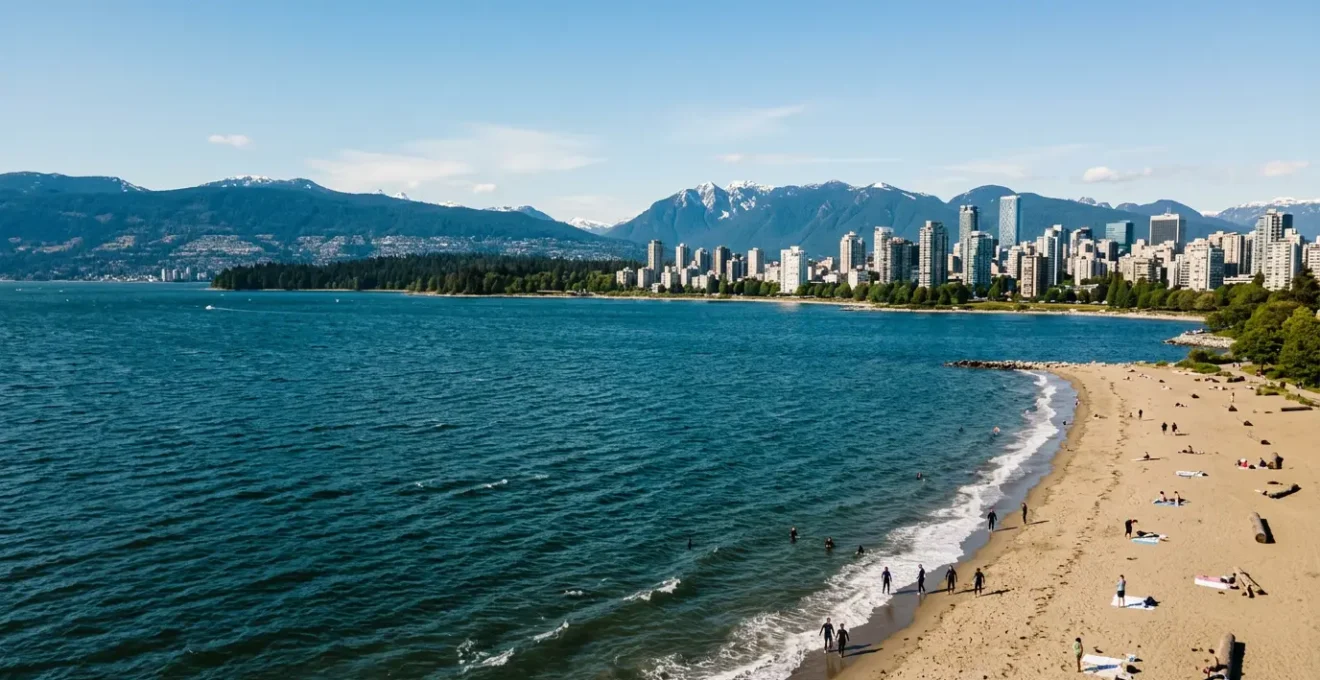
You’ve packed for a summer beach day in Vancouver, only to find the Pacific Ocean feels more like an ice bath. Contrary to the simple idea that the water just “comes from Alaska,” the truth is far more dynamic. Vancouver’s invigorating chill is the result of a powerful coastal engine—a mix of deep-ocean currents, seasonal upwelling, and freshwater from mountain rivers—that makes our water uniquely cold, but also uniquely alive. Understanding this system is the key to safely enjoying our beautiful, albeit brisk, coastline.
You see it every summer at Kitsilano Beach. A tourist, giddy with the sun on their shoulders and the stunning mountain backdrop, sprints toward the shimmering water. They hit the shoreline, take a gleeful leap, and emerge a second later with a look of pure, unadulterated shock. Welcome to Vancouver, where the air can say “tropical vacation” but the water says “Arctic expedition.” As a local lifeguard, I’ve seen that look a thousand times. It’s a mix of betrayal and disbelief, usually followed by the question that inspired this guide: “Why is it SO cold?”
Many people assume it’s a simple answer: the water flows down from Alaska. While not entirely wrong, it’s a bit like saying a car runs because it has wheels. It misses the fascinating mechanics under the hood. The truth is, our water temperature is the signature of a complex and powerful coastal engine. It’s a system driven by the massive North Pacific Current, a deep-ocean conveyor belt bringing nutrient-rich but cold water our way. This is intensified by a process called upwelling, where wind and tides pull cold, deep water up to the surface, especially during the sunniest months. Add in the constant feed of glacial melt from our iconic mountains via the Fraser River, and you have the perfect recipe for a brisk dip.
But here’s the perspective shift I want to offer you: this cold isn’t a flaw. It’s the lifeblood of our coast. It’s what makes the Salish Sea a vibrant ecosystem teeming with salmon, seals, and even orcas. Understanding this isn’t just a fun science lesson; it’s the foundation of your safety. This guide will walk you through the real risks of our “West Coast chill,” how to embrace it like a local (Polar Bear Swim, anyone?), and how to read the water’s other secrets, from E. coli counts to the tell-tale signs of passing whales. Let’s turn that look of shock into one of savvy respect.
In this guide, we’ll dive into the specifics of enjoying Vancouver’s coastline safely and fully. From understanding the immediate dangers of cold water to planning your activities around a park’s specific rules, you’ll get an insider’s perspective on how to make the most of our unique urban-marine environment.
Summary: A Lifeguard’s Guide to Vancouver’s Cold Pacific Waters
- Hypothermia Risks: The Mistake That Sends 20 Swimmers to the ER Every Summer
- How to Train for the Vancouver Polar Bear Swim in 4 Weeks?
- Wreck Beach or Jericho: Which Offers the Best Sunset Views in August?
- The 3 Signs That Indicate Orcas Are Passing by the Shoreline
- When to Avoid Swimming: Interpreting E. Coli Counts at Sunset Beach
- The E. Coli Count: Is It Safe to Swim in English Bay After a Rainstorm?
- Why Sunset at English Bay Happens Later Than You Think in June?
- Stanley Park Seawall: How to Ride the One-Way Path Without Getting Fined?
Hypothermia Risks: The Mistake That Sends 20 Swimmers to the ER Every Summer
That initial, breathtaking gasp you take when you hit Vancouver’s water isn’t just a dramatic reaction; it’s the start of a serious physiological event called the cold shock response. Your body, expecting warm summer water, is suddenly fighting to preserve its core temperature. Your blood vessels constrict, your heart rate and blood pressure spike, and you involuntarily gasp for air. This is the most dangerous moment of any cold-water swim. In fact, research into cold water safety shows that about 20% of cold water deaths occur in the first two minutes, often from drowning caused by that initial gasp and hyperventilation. Even in the peak of summer, our local ocean temperatures rarely exceed 12-16°C (54-61°F), which is well within the range for a potent cold shock.
If you survive the first two minutes, the next risk is incapacitation and, eventually, hypothermia. Your body will start sacrificing the extremities to protect your core, leading to numb, useless limbs. This is why you might find you can’t swim back to shore after just 10-15 minutes. The final danger, and one many people forget, is “afterdrop.” This is when your core temperature continues to drop even after you’ve exited the water, as cold blood from your limbs returns to your core. It’s why you might feel colder 10 minutes after your swim than you did in the water. This is where a simple towel fails and proper post-swim care becomes critical.
Your Cold Water Safety Checklist: How to Swim Safely in Vancouver
- Assess your gear: Do you have a thermos with a warm, non-alcoholic drink and a proper wool blanket or dry robe, not just a thin towel, for post-swim warming to combat afterdrop?
- Plan your exposure: Set a hard limit for your swim, ideally under 15 minutes for your first few times, to prevent significant heat loss. Will you wear a wetsuit for longer activities?
- Buddy up: Always swim with a partner who can spot the early signs of hypothermia (like slurred speech or poor coordination) and can call for help if needed.
- Practice breathing: Before you go in, take a few deep, slow breaths. When you enter, focus on controlling your breathing and resisting the gasp reflex. Never jump or dive in.
- Plan your re-warming: Know exactly how you will get warm afterwards. Have your warm, dry layers ready to put on immediately after drying off.
How to Train for the Vancouver Polar Bear Swim in 4 Weeks?
For most visitors, the idea of swimming here on a sunny July day is daunting enough. But for thousands of locals, the ultimate celebration of our chilly waters happens on January 1st: the Vancouver Polar Bear Swim. This iconic event, which began in 1920, has become a beloved, if slightly mad, tradition. What started with just 10 brave swimmers has grown massively; the City of Vancouver reported a record 8,683 official entries in 2024, making it one of the largest events of its kind in the world. Participants, often in hilarious costumes, take a collective plunge into English Bay, where water temperatures hover around a bracing 6-8°C (43-46°F). It’s a festival of goosebumps, community spirit, and collective insanity.
So, how do you go from a hesitant summer paddler to a triumphant Polar Bear? The key is gradual acclimatization. Don’t make the New Year’s Day plunge your first cold-water swim of the year. Starting in early December, commit to short, regular dips. Here’s a simple 4-week plan:
- Week 1: The 1-Minute Challenge. Go to a local beach (with a buddy!) and stay in the water up to your shoulders for a full 60 seconds. Focus entirely on controlling your breath. Get out, dry off quickly, and get into warm clothes immediately. Do this twice in the week.
- Week 2: The 3-Minute Soak. Repeat the process, but extend your time in the water to three minutes. Your body will start to adapt, and the initial shock will feel less intense.
- Week 3: The 5-Minute Immersion. By now, you should feel more in control. Aim for a five-minute swim. Try to move around a little to keep circulation going.
- Week 4: The Dress Rehearsal. A few days before January 1st, do a final swim of 5-10 minutes. Practice your post-swim routine: get your wet things off and warm layers on as efficiently as possible. This builds the muscle memory you’ll need on the big day.
The official race rules themselves are a lesson in safety: limit your time to 15 minutes, don’t drink alcohol (it speeds up heat loss), and have a post-swim plan. Training for the Polar Bear Swim isn’t about becoming immune to the cold; it’s about learning to manage your body’s response to it, turning panic into a manageable and even exhilarating experience.
Wreck Beach or Jericho: Which Offers the Best Sunset Views in August?
Once you’ve had your swim (or decided to stay warm and dry on the sand), Vancouver’s beaches offer a world-class reward: the sunset. But not all sunset spots are created equal. Two of the most famous, Jericho Beach and Wreck Beach, offer completely different experiences, especially during the golden light of late summer. Your choice depends on whether you prefer a backdrop of sparkling cityscapes or a raw, untamed natural view.
Jericho Beach is the accessible, postcard-perfect option. It offers a stunning panorama that includes the downtown Vancouver skyline, the North Shore mountains, and the sailboats moored at the Jericho Sailing Centre. As the sun dips, it backlights the city, and the whole scene glows. It’s the ideal place for a wide-angle photo that captures the essence of Vancouver as a city on the edge of nature. Wreck Beach, on the other hand, is a commitment. Reached via a steep, 500-step staircase (Trail 6), it’s a world away from the city. Here, the view is pure, unobstructed ocean. The sun sinks directly into the Strait of Georgia, often silhouetting the distant mountains of Vancouver Island. It’s a more primal, powerful sunset experience, famous for its bohemian vibe and drum circles that often accompany the day’s end.
This paragraph introduces the table below, which breaks down the key differences to help you choose your ideal sunset spot, based on a comparative analysis of local beach features.
| Feature | Jericho Beach | Wreck Beach |
|---|---|---|
| Sunset Type | Cityscape & mountains sunset with downtown skyline illuminated | Pure oceanic sunset behind Vancouver Island |
| Access | Easy ground-level access, family-friendly | 500-step staircase (Trail 6), physically demanding |
| Amenities | Washrooms, concessions, parking nearby | Minimal facilities, no nearby parking |
| Atmosphere | Family-oriented, lifeguarded, structured | Clothing-optional, bohemian, drum circles |
| Best Photography | Wide-angle lens to capture sailboats, skyline & sunset in one frame | Telephoto lens to compress sun against Gulf Islands |
| Afterglow Timing | Standard sunset timing | Best colors appear 15-25 minutes after official sunset |
The choice ultimately comes down to the kind of memory you want to create. Do you want the iconic shot of the city bathed in golden light, or the raw, immersive experience of watching the sun disappear into the Pacific?
As you can see, the feeling at a Vancouver beach during sunset is one of shared awe. Whether you’re surrounded by families at Jericho or the free spirits at Wreck, the moment the sun touches the horizon creates a sense of connection and quiet contemplation, a perfect end to a day on the coast.
The 3 Signs That Indicate Orcas Are Passing by the Shoreline
One of the most magical experiences you can have on a Vancouver beach is spotting orcas. While not a daily occurrence, pods of Bigg’s (Transient) killer whales regularly patrol the waters of the Salish Sea in search of seals and sea lions. Seeing their iconic black dorsal fins slice through the water against the backdrop of the city or mountains is an unforgettable moment. As a visitor, you might think it’s pure luck, but locals know to watch for a few key signs that increase your chances.
First, look for the whale-watching boats. If you see a cluster of zodiacs and larger tour boats all stopped in one area, they’re not just admiring the view. They have almost certainly found a pod, and are maintaining a respectful distance. Their presence is your number one clue that something is happening just offshore. Second, watch the birds and seals. If you notice a sudden commotion of gulls diving or seals and sea lions suddenly scrambling onto rocks or buoys, it can be a sign that a predator is near. The local wildlife often knows the orcas are coming before we do. Finally, and most obviously, scan the horizon for blows and fins. The misty spray from an orca’s blow can be seen from a great distance on a calm day. Following that, look for the tall, unmistakable black dorsal fin of a male or the smaller, curved fin of a female or juvenile.
It’s thrilling to know that these are wild, intelligent animals going about their lives right on our doorstep. As Jared Towers, a local cetologist, notes, the whales we see are part of a well-known community.
About 99.5 per cent of the time, orcas photographed in the Salish Sea are well-known whales, most commonly transient orcas, also known as Bigg’s killer whales.
– Jared Towers, Bay Cetology Executive Director
Lighthouse Park in West Vancouver, the shoreline along Stanley Park, and the ferry route to Bowen Island are all fantastic vantage points. Just remember to bring binoculars and a lot of patience. Spotting orcas is a game of chance, but by reading the water and the activity around it, you can definitely stack the odds in your favor.
When to Avoid Swimming: Interpreting E. Coli Counts at Sunset Beach
While the cold is the most obvious hazard in Vancouver’s waters, there’s another, invisible one you need to be aware of: water quality. Because our beaches are at the edge of a major city, they are susceptible to contamination, primarily from E. coli bacteria. This bacteria is an indicator of fecal contamination from sources like storm-water runoff, sewage overflows, and waste from boats and animals. Vancouver Coastal Health (VCH) regularly monitors the water at major swimming beaches like Sunset Beach, Kitsilano, and English Bay to ensure it’s safe for public use.
Understanding the numbers is key. VCH has a clear system for issuing advisories. The guideline is based on the number of E. coli bacteria per 100mL of water. You don’t need to be a microbiologist to understand the thresholds, but knowing them can help you make an informed decision. According to the official Vancouver Coastal Health guidelines, a swimming advisory is issued when the geometric mean of five samples is greater than 200 E. coli/100mL or when any single sample is greater than 400 E. coli/100mL. If a single sample comes back above 235, it triggers an immediate investigation and further testing.
These advisories are not to be taken lightly. Swimming in water with high E. coli counts can lead to gastrointestinal illness, as well as skin, ear, and eye infections. Before you head to the beach, especially popular and enclosed ones like Sunset Beach or Trout Lake, it’s a wise habit to check the latest water quality reports on the VCH website. They post a map with green (safe), red (advisory), and grey (no recent data) icons for all monitored beaches. It’s a simple, two-minute check that can save you from a very unpleasant post-swim experience.
The E. Coli Count: Is It Safe to Swim in English Bay After a Rainstorm?
So, what causes those E. coli counts to spike? While multiple factors are at play, the single biggest culprit in Vancouver is rain. A heavy downpour, especially after a dry spell, acts like a giant flush for the city. It washes everything from our streets, parks, and sewer systems directly into the ocean. This “urban-marine interface” is where the city’s grit meets the sea, and it’s why lifeguards and savvy locals are always wary of swimming in the 24 to 48 hours following significant rainfall.
This isn’t just anecdotal evidence. The connection is well-documented. For instance, a 2023 Bayesian analysis of water quality at Vancouver beaches found a clear positive correlation between precipitation in the preceding 48 hours and elevated E. coli concentrations. The study confirms that our combined sewer systems, which carry both sewage and stormwater in the same pipe, can overflow during heavy rain, releasing untreated waste into areas like False Creek and English Bay. Beaches located in enclosed bays with less water circulation, like False Creek or Trout Lake, are particularly vulnerable and often have advisories posted for longer periods after a storm.
This image of a storm drain in action is a powerful reminder of the direct connection between our city streets and the water we swim in. Every drop of rain carries pollutants from the urban landscape into the marine ecosystem. This is why a beautiful, sunny day after a night of storms can be the most deceptive and riskiest time for a swim. Your best bet? If there has been heavy rain within the last day or two, it’s wise to stick to the sand or choose a beach on the more open coastline, like those further west in Point Grey, which benefit from better tidal flushing.
Why Sunset at English Bay Happens Later Than You Think in June?
There’s a peculiar phenomenon that often catches visitors by surprise during Vancouver’s early summer: the lingering light. You check your weather app, it says the sun sets at 9:15 PM. Yet, at 9:45 PM, the sky is still painted in vibrant shades of orange, pink, and purple, and there’s enough light to read a book on the beach at English Bay. This isn’t a glitch in your app; it’s a beautiful gift of our northern latitude.
The “official” sunset time refers to the moment the top edge of the sun disappears below the horizon. However, what follows is a period called civil twilight, the time when the sun is just below the horizon and its rays are still scattering through the upper atmosphere to illuminate the sky. The duration of twilight varies dramatically with latitude. Near the equator, it’s a brief 20-minute affair, and darkness falls quickly. But here in Vancouver, situated at a latitude of 49° North, we get a much longer, more luxurious show.
During the weeks surrounding the summer solstice in late June, this effect is at its peak. The angle of the setting sun is so shallow that it takes a very long time to get far enough below the horizon for complete darkness to set in. This is the science behind our famously late and long sunsets.
In June, civil twilight at Vancouver’s northern latitude (49°N) can last for 30-40 minutes after the sun has vanished, creating the illusion of a much later sunset.
– Atmospheric optics observation
This extended “golden hour” is a photographer’s dream and a beachgoer’s delight. It means you have almost an extra hour of usable, beautiful light after the sun has technically set. So next time you’re planning a sunset picnic at English Bay, don’t pack up the moment the sun is gone. The best part of the show, the deep, colourful afterglow, is often just beginning. It’s a magical quirk of our place on the globe.
Key Takeaways
- Vancouver’s ocean is cold due to a “coastal engine” of deep-ocean currents and upwelling, not just because it’s “from Alaska.”
- The greatest danger of cold water is the “cold shock response” in the first two minutes; controlling your breathing upon entry is critical for safety.
- Always check Vancouver Coastal Health’s website for E. coli advisories before swimming, especially 24-48 hours after heavy rainfall.
Stanley Park Seawall: How to Ride the One-Way Path Without Getting Fined?
Beyond the beaches, Vancouver’s most famous coastal feature is the Stanley Park Seawall. This 9-km loop is arguably the most scenic urban path in the world, but for cyclists, it comes with a very important and strictly enforced rule: for most of its length, it is one-way in a counter-clockwise direction. Ignoring this rule won’t just earn you dirty looks from locals; it can also land you a fine from patrolling park rangers. The rule was first implemented during the pandemic to facilitate physical distancing on the narrowest parts of the path and was made permanent due to its success in reducing collisions between cyclists and pedestrians.
Understanding the flow is simple. Whether you start from Coal Harbour or English Bay, your journey around the park must follow a counter-clockwise route. For cyclists, the one-way section officially begins near the 9 O’Clock Gun and continues all the way around Brockton Point, under the Lions Gate Bridge, and past Third Beach before becoming two-way again as you approach Ceperley Park and Second Beach. Pedestrians, meanwhile, have their own separate, two-way lane on the inside of the path.
To avoid any issues and enjoy a stress-free ride, follow these essential guidelines:
- Always go counter-clockwise: From the Georgia Street entrance, this means turning right and heading towards the Rowing Club and Brockton Point.
- Respect the 15 km/h speed limit: The Seawall is a shared, recreational path, not a racetrack. Go at a leisurely pace, especially in congested areas.
- Yield to pedestrians: They always have the right of way. Use your bell to politely signal your approach when passing.
- No e-scooters: Motorized devices like e-scooters and hoverboards are explicitly prohibited on the Seawall path. Bicycles and e-bikes (with speed limiters) are permitted.
- Use bypass routes if needed: If you need to get from English Bay to the Lions Gate Bridge quickly, you can use the internal, two-way Stanley Park Drive, which runs parallel to the Seawall but allows for faster travel.
This rule isn’t meant to be inconvenient; it’s a crucial safety measure that makes the experience better for millions of users each year. By following it, you’re not just avoiding a fine—you’re being a good citizen of one of the world’s greatest urban parks.
Now that you understand the ‘why’ behind our chilly waters and the local rules of the road and sea, you’re ready to enjoy our coastline like a local: with respect, preparation, and a sense of adventure. Check the latest water quality reports, pack that warm blanket, and embrace the invigorating spirit of the Pacific.